Dementia and Walking About: Freedom and Safety
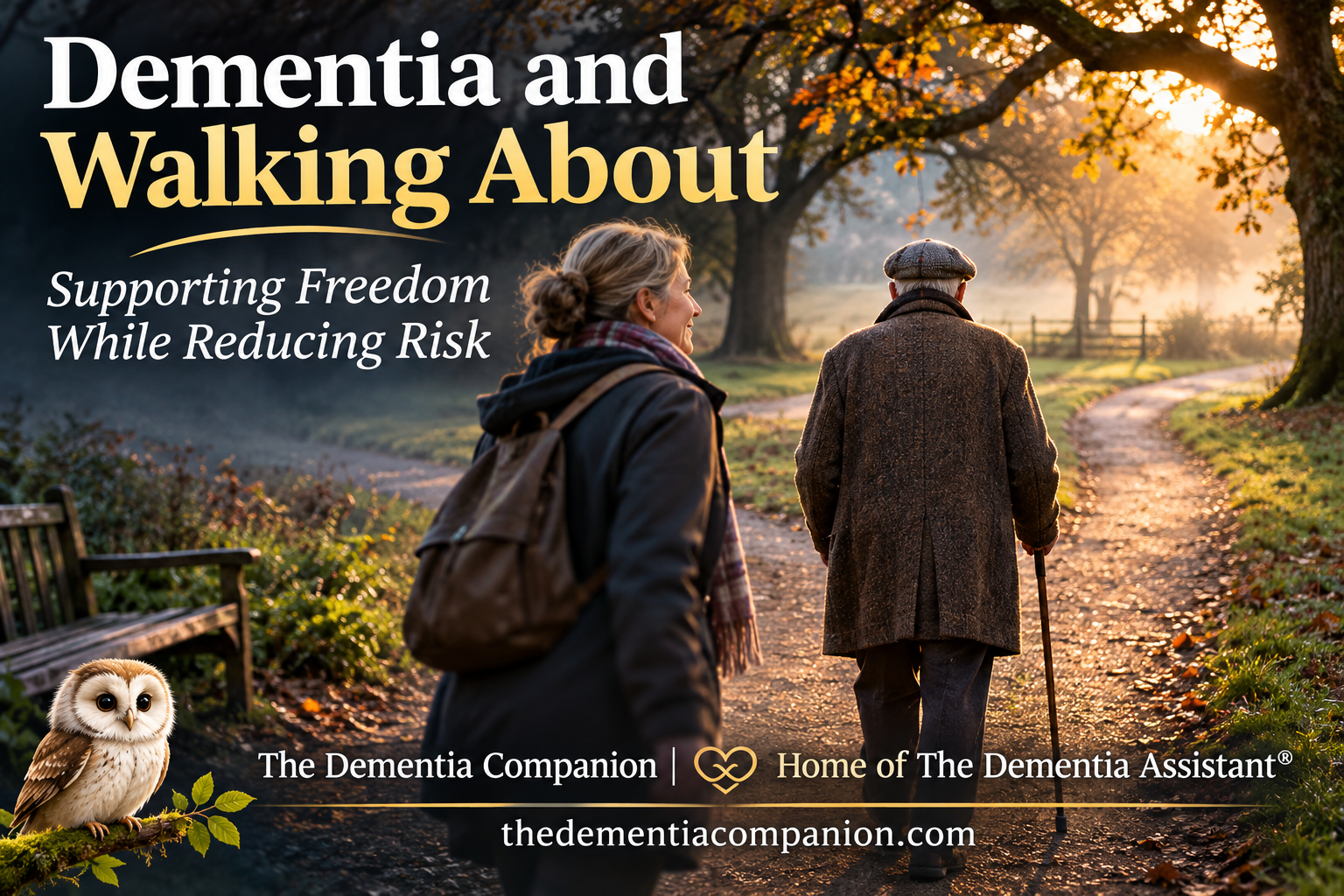
Dementia and Walking About: Supporting Freedom While Reducing Risk
Because sometimes a walk isn’t wandering. Sometimes it’s a journey towards something that still matters.
By Louise Donaghy, Founder of The Dementia Assistant® and The Dementia Companion, Creator of Hugo Intelligence™
There is a particular sort of panic that comes when you look towards the front door and realise it is open.
The coat is missing. The shoes have gone. And the person you love, who was sitting quite happily with a cup of tea only ten minutes ago, is nowhere to be seen.
Suddenly, you have developed the speed of an Olympic sprinter, the detective skills of Sherlock Holmes and a heartbeat that sounds like a washing machine full of bricks.
It isn’t funny when it happens. Not remotely.
But if you’ve experienced it, you’ll recognise that dreadful mixture of fear, frustration and relief when you finally find your loved one, perhaps walking quite happily towards the shops, wondering why on earth everybody is making such a fuss.
And here’s something I think we need to talk about more often.
Just because someone has dementia doesn’t mean every walk they take is wandering.
Walking may be about independence, familiarity, comfort, exercise, purpose or simply enjoying a little fresh air.
Our responsibility is not automatically to stop the walking. It’s to understand what matters to that person and find ways to protect their freedom while reducing the risks.
That distinction can make an enormous difference.
What might the person be trying to do?
Imagine spending forty years getting up at six o’clock, putting on your shoes and heading to work.
Then one morning, somebody tells you to sit down because you’re not going anywhere.
You might feel rather annoyed too.
Dementia can affect memory, orientation, judgement and the ability to recognise familiar surroundings. However, longstanding routines, emotional associations and the desire to do something meaningful may remain important.
Someone who keeps heading towards the front door may be trying to:
- Go to work, collect the children or visit someone important.
- Return to a former home or familiar neighbourhood.
- Find the toilet, kitchen or another room.
- Escape somewhere noisy, uncomfortable or overwhelming.
- Relieve restlessness, anxiety, boredom or physical discomfort.
- Enjoy movement, exercise, sunshine or fresh air.
And sometimes, they simply fancy a walk.
We don’t always need to turn an ordinary human desire into a symptom.
When the destination means more than the address
A woman might tell you she’s going home, despite having lived in the same house for twenty years.
Perhaps she’s thinking of the home where she raised her children. Perhaps she’s searching for familiarity or reassurance. Perhaps she simply feels uncomfortable where she is.
We cannot know without trying to understand her experience.
Rather than immediately replying, “You are home!”, we could try:
“Tell me about home. What do you miss about it?”
Or:
“Is there somewhere you’d like to go? Shall we have a little walk together?”
The conversation might give us clues, and the walk itself may offer comfort.
The important thing is to listen without assuming every answer must be corrected.
Notice the patterns, not just the footsteps
If walking becomes frequent or distressing, try observing what happens before it begins.
Does it happen after lunch? Towards evening? When the house becomes crowded? When a particular visitor leaves?
Could the person be in pain, thirsty, needing the toilet or struggling to explain something?
Changes in walking may also reflect medication effects, illness, fatigue or difficulties with hearing or vision.
Sudden new confusion or a marked change from the person’s usual behaviour deserves prompt medical assessment. It should not automatically be attributed to dementia.
Sometimes the most useful question isn’t “How do we stop this?”
It’s “What is this person trying to tell us?”
How can walking remain part of everyday life?
One of the saddest things about dementia care is how easily safety can begin to swallow independence.
First, someone is discouraged from going to the shops alone.
Then they’re discouraged from walking down the road.
Eventually, they may find themselves being told to sit still, even when they’re perfectly capable of enjoying a walk with suitable support.
And imagine how that must feel.
Walking can offer movement, stimulation, social connection and the simple pleasure of being part of the world.
The trick is to adapt the activity rather than automatically remove it.
Make room for the walks they enjoy
If someone loves walking, try building it into their routine.
A familiar route through the park, a short walk to the local café, a visit to the garden or a gentle stroll after breakfast may offer an enjoyable, predictable part of the day.
You might say:
“Fancy coming with me? I could do with stretching my legs.”
Or:
“Shall we go and see whether those roses have finally decided to behave themselves?”
A little humour can make an invitation feel natural rather than like another instruction.
But remember, not everybody likes company every minute of the day. Some people may still be able to walk independently, perhaps with a familiar route and an agreed safety arrangement.
The right level of support depends on the individual, not simply their diagnosis.
Think about the surroundings
Consider how easy and comfortable the environment is to navigate.
Look at uneven paths, busy roads, poor lighting, unsuitable footwear and places where someone could become disorientated.
At home, good lighting, clear pathways, recognisable doors, accessible toilets and a safe outdoor space may help.
A secure garden, where appropriate, can offer freedom to move without the same risks as an unfamiliar street.
It’s also worth remembering that a person may have good days and difficult days.
Someone who confidently navigated a familiar route last week might struggle on another day because they’re tired, unwell or distracted.
This is why a walking plan should be reviewed, not treated as a permanent verdict on someone’s abilities.
Don’t forget the person who accompanies them
There is a reality we sometimes overlook.
The person providing care may already have been awake half the night, made breakfast, sorted medication, changed bedding and answered the same question seventeen times before ten o’clock.
Then comes the suggestion of another walk.
You can love somebody enormously and still be exhausted.
If regular walking is important, consider sharing the responsibility with family, friends, trusted companions or suitable community services.
Supporting independence shouldn’t mean that one exhausted carer has to provide every minute of it.
And if today all you can manage is sitting together in the garden with a cup of tea, that can still be a lovely moment.
What should an individual safety plan include?
A good safety plan shouldn’t read like a list of everything the person is no longer allowed to do.
It should explain what they enjoy, where they like going, what support helps and how everyone can respond if something goes wrong.
Above all, involve the person living with dementia as much as possible.
A diagnosis does not automatically mean someone lacks the ability to make decisions about walking or using safety technology.
Start with the person, not the risks
Record the person’s preferred name, communication needs, familiar routines, places they enjoy and any destinations they might try to reach.
Include former addresses, workplaces, favourite shops, places of worship and locations connected to family or friends.
Someone’s history can be particularly valuable if they become disorientated.
A former bus driver may have particular routes that remain meaningful. A retired teacher might head towards a school. Someone who once walked to the same bakery every morning may still feel drawn towards it.
These possibilities are clues, not predictions.
Agree on practical precautions
An individual plan might include:
- A recent photograph and description of the person’s usual clothing.
- Contact details for family members or trusted supporters.
- An identification card or bracelet containing appropriate emergency contact information.
- Familiar walking routes and arrangements for accompaniment where needed.
- Information about mobility, communication, health needs and medication.
- Clear instructions about what to do and whom to contact if the person becomes missing.
- An agreed review date, especially after a change in health or circumstances.
In the UK, families can also prepare a Herbert Protocol form, recording information that may help police find a vulnerable person who becomes missing.
This can be particularly reassuring because essential information is already collected before an emergency happens.
What about GPS trackers and location technology?
Technology can be extremely useful.
A GPS watch, location-sharing service or suitable alert device may help someone continue walking with greater reassurance for everyone involved.
But technology isn’t a substitute for understanding the person.
Ask whether the device is comfortable, whether it works reliably in the places the person visits, who receives alerts and what happens if the battery runs out.
Most importantly, discuss it openly and seek the person’s agreement wherever they can give it.
If decision-making ability is in question, follow the relevant country’s legal framework and obtain appropriate advice about capacity, best interests or supported decision-making.
We should be careful not to allow safety technology to become unnecessary surveillance.
There is a difference between helping somebody find their way home and monitoring their every movement simply because they have dementia.
When safety becomes more complicated
If the person repeatedly becomes lost, enters dangerous areas, struggles with road awareness or goes out without appropriate clothing in severe weather, a more detailed risk assessment may be needed.
Speak with their GP or relevant healthcare professional, dementia specialist, occupational therapist or adult social care service.
Try to explore the least restrictive option that appropriately manages the actual risks.
Locking someone inside, physically restricting their movement or using medication simply to prevent walking can raise serious safety, consent and legal concerns. These are not routine solutions to walking about.
The goal should remain the same: helping someone live as independently and safely as possible, with dignity and meaningful choice.
What if someone becomes lost?
This is the part nobody wants to think about.
But having a plan before an emergency can make an enormous difference.
If a person living with dementia is missing and may be at risk, act promptly. Do not wait 24 hours.
What to do immediately
If someone is missing:
- Check quickly whether they are in the home, garden or another immediately accessible safe area, without delaying an emergency call.
- Contact emergency services promptly when their whereabouts are unknown and they may be at risk.
- Give the person’s name, description, most recent photograph, last known location, clothing and relevant health information.
- Explain clearly that the person has dementia and may be confused, unable to find their way back or unable to communicate their address.
- Share their Herbert Protocol form or equivalent prepared information, if available.
- Tell police about former homes, workplaces and meaningful destinations.
Follow the emergency services’ instructions. Do not put yourself at risk or leave another vulnerable person unattended while searching.
If the person is found, approach calmly, check for injury, exposure or distress, and seek medical help where needed.
They may not understand why everyone has been worried.
A gentle “I’m so glad to see you. Shall we go somewhere warm?” may be far more helpful than an angry explanation of how frightened everybody has been.
Emergency advice by country
If someone living with dementia goes missing and may be at risk, contact emergency services immediately.
United Kingdom: Call 999 if the person is vulnerable and at risk of harm. You do not need to wait 24 hours.
Republic of Ireland: Call 999 or 112 for emergency police assistance.
United States: Call 911 promptly if a person living with dementia is missing and may be at risk.
Canada: Call 911 when a person with dementia goes missing and may be in danger.
Australia: Call 000 for emergency police assistance.
New Zealand: Call 111 to report a missing person with dementia who may be at risk.
For other countries, contact the appropriate local emergency services and follow their missing-person procedures.
Freedom and safety should not be enemies
I think this is one of the most important things to remember.
A person living with dementia is still a person with preferences, memories, habits, opinions and a lifetime of experiences.
They haven’t suddenly stopped wanting fresh air, companionship or the pleasure of deciding where to go.
A walk might be their favourite part of the day.
It might give them a sense of purpose.
It might remind them of who they are.
And yes, sometimes it may carry risks that we need to manage carefully.
But we should never become so focused on preventing something going wrong that we forget to make room for things going right.
Because dementia care isn’t simply about keeping somebody safe.
It’s about helping them continue to live.
And sometimes, living looks like putting on a coat, opening the front door and going for a walk.
Preferably with somebody who knows where the nearest café is.
And who doesn’t mind paying for the cake. ❤️
Ask Hugo: Support that begins with the person
If someone you care for is walking about more frequently, becoming unsettled or struggling to find their way, Hugo can help you explore possible reasons and think through an individual, person-centred approach.
You can ask Hugo:
“Hugo, someone I care for has dementia and keeps wanting to go out walking. Help me understand what they might be looking for, how we can support their independence and what a practical safety plan might include.”
Hugo Intelligence™ is part of The Dementia Assistant®, created and powered by Person-Centred Intelligence®.
Explore more dementia guidance at:
https://thedementiacompanion.com/
Or visit https://thedementiaassistant.com/ to meet Hugo and explore the 30-day complimentary trial available with every subscription.
Hugo offers information and support, not a medical diagnosis or emergency response service.
With warmth and understanding,
Louise and Hugo ❤️🦉
The Dementia Companion, home of The Dementia Assistant® and Hugo 🦉
https://thedementiacompanion.com/
⸻
References and further reading
Alzheimer’s Society
Why a person with dementia might walk about:
https://www.alzheimers.org.uk/about-dementia/stages-and-symptoms/dementia-symptoms/dementia-walking-about
Supporting a person with dementia who walks about:
https://www.alzheimers.org.uk/about-dementia/stages-and-symptoms/dementia-symptoms/supporting-person-dementia-who-walks-about
How technology can help:
https://www.alzheimers.org.uk/get-support/living-with-dementia/how-technology-can-help
Alzheimer’s Association (US)
Wandering and dementia safety:
https://www.alz.org/help-support/caregiving/safety/wandering
UK Police
What to do when someone goes missing:
https://www.police.uk/advice/advice-and-information/missing-person/missing-persons/what-to-do-when-someone-goes-missing/
Alzheimer Society of Canada
Disorientation and losing one’s way:
https://www.alzheimer.ca/en/help-information/im-caring-person-living-dementia/understanding-symptoms/disorientation-losing-ones
New Zealand Police
Dementia and cognitive impairment:
https://www.police.govt.nz/missing-persons/advice-and-support/dementia-wandering
You May Also Find Helpful
Need help with your own situation? Ask Hugo.
One Person. One Continuing Care Story. The Dementia Companion is where you discover guidance. Inside The Dementia Assistant®, talk with Hugo, save and categorise conversations, record daily notes and involve authorised supporters in a continuing care plan centred around the person.
Ask Hugo About This · Start Your Continuing Care Plan — Families · Continuing Care Planning — Professionals
Personal guidance requires the appropriate account and subscription access. Care-plan information is used only with authorised access and the required consent and selection steps. All subscription plans include a 30-day complimentary trial.