Dementia and Hearing Loss: Is Mum Not Hearing Us or Not Understanding?
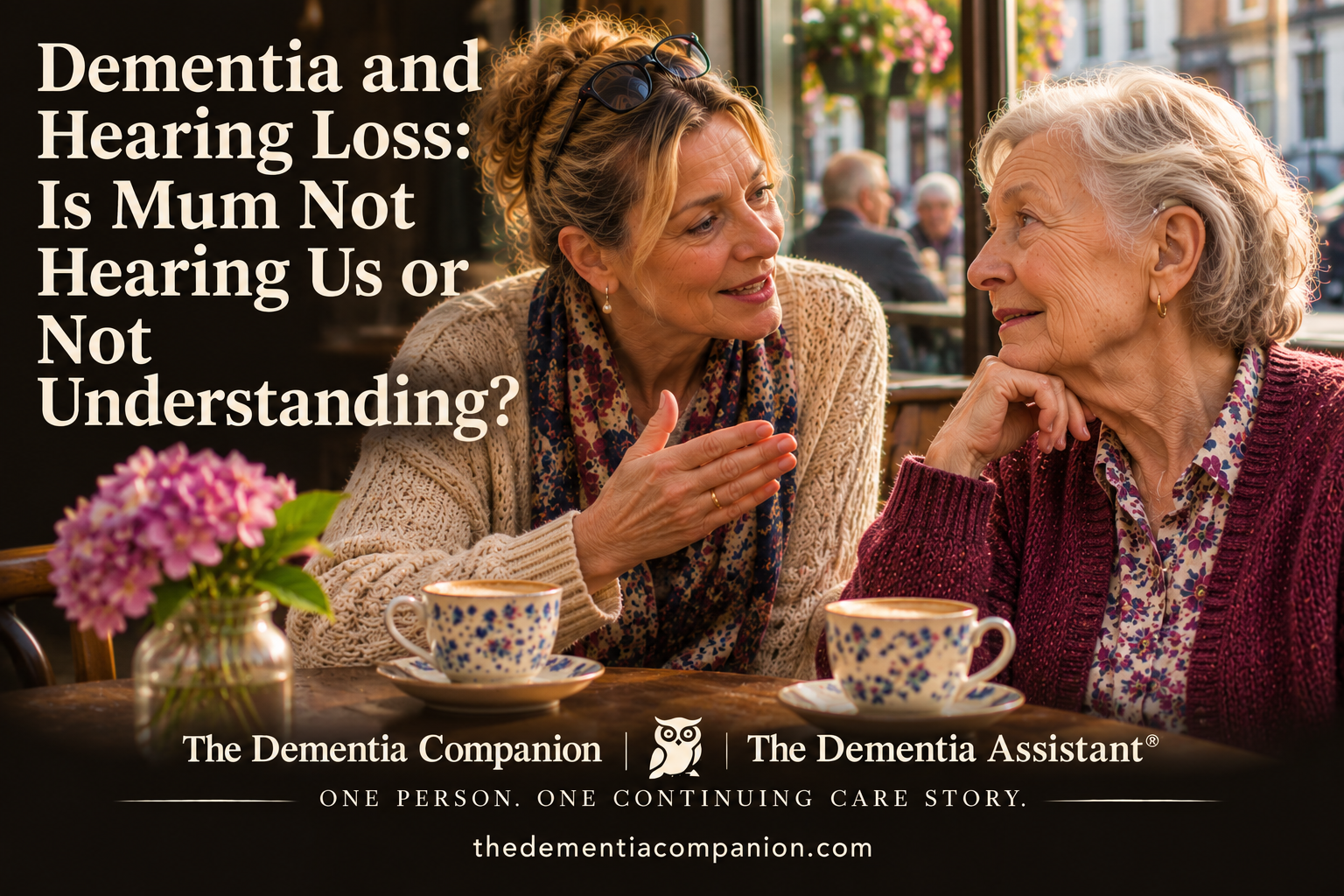
Dementia and Hearing Loss: Is Mum Not Hearing Us or Not Understanding?
One Person. One Continuing Care Story. | Article 44 of 80
By Louise Donaghy, Dementia Practitioner, Founder of The Dementia Companion and The Dementia Assistant®, and Creator of Hugo Intelligence™.
“Mum, would you like a cup of tea?”
No answer.
“Mum?”
Still nothing.
You try again, a little louder.
“MUM! WOULD YOU LIKE A CUP OF TEA?”
She turns around.
“There’s no need to shout, love. I’m not deaf!”
And there you are, standing in the kitchen, wondering whether she genuinely couldn’t hear you, didn’t understand the question or was simply concentrating on her television programme.
Which, incidentally, is loud enough for the neighbours to enjoy without even switching theirs on.
It’s a situation many families recognise.
Mum seems to ignore certain questions.
She misunderstands what people say.
She becomes confused when several relatives are talking.
Perhaps she answers a completely different question from the one you’ve asked.
Or she smiles politely and nods, even though you’re not convinced she’s heard a word.
And because Mum has dementia, it’s tempting to assume that every communication difficulty is caused by the condition.
But what if part of the problem is hearing loss?
How can you tell whether someone living with dementia isn’t hearing you properly or is struggling to understand what you’re saying?
The answer is that it can be difficult to distinguish between the two.
Hearing loss affects how sound is detected, while dementia can affect attention, language, memory and how the brain interprets information. A person may experience either problem or both together.
This means that somebody may hear your voice but struggle to understand the words.
Another person may understand perfectly well when they can hear clearly.
And someone experiencing both dementia and hearing loss may need support with each.
The most important first step is to avoid assuming that difficulty responding means the person doesn’t understand.
Check whether Mum needs a hearing assessment, explore practical communication adjustments and pay attention to what helps her participate.
Because sometimes a person appears more confused than they actually are simply because nobody has recognised that they cannot hear properly.
And nobody should be excluded from a conversation because the people around them have mistaken a hearing difficulty for an inability to understand.
Why can hearing loss and dementia look so similar?
Think about everything involved in an ordinary conversation.
First, you need to hear the sounds.
Then recognise them as words.
Understand what the words mean.
Remember enough information to follow the conversation.
And decide how to respond.
If any part of that process becomes difficult, communication can break down.
Hearing loss can make words difficult to recognise
Imagine Mum can hear that someone is speaking but cannot make out every word.
She may catch part of a sentence.
Guess the rest.
And answer based on what she thinks she heard.
For example, you ask:
“Did you enjoy the visit from Sarah?”
Mum hears:
“Did you enjoy … Sarah?”
She replies:
“Yes, she’s very well, thank you.”
It might look as though she hasn’t understood the question.
But perhaps she simply didn’t hear the whole sentence.
Dementia can affect how information is processed
Another person may hear the sentence clearly but have difficulty understanding it.
Perhaps the question contains too much information.
Perhaps they need more processing time.
Perhaps they have difficulty recognising particular words.
Or perhaps they cannot hold the information in mind long enough to respond.
In this situation, simply speaking louder may not help.
Both problems can happen together
This is particularly important.
Mum may have age-related hearing loss alongside Alzheimer’s disease, vascular dementia, Lewy body dementia or another dementia condition.
The hearing loss may make existing communication difficulties more noticeable.
She may become frustrated, tired or socially withdrawn because conversations require so much effort.
And the family may mistakenly believe that every change represents dementia progression.
Alzheimer’s Society and Dementia UK emphasise that sensory difficulties should be considered rather than automatically attributed to dementia.
Before deciding that Mum cannot understand us, make sure we’re giving her the best possible opportunity to hear us.
What are the signs of hearing loss in someone living with dementia?
Hearing loss doesn’t always mean someone hears nothing.
Many people can hear certain sounds quite well while struggling with others.
Possible signs include:
- Asking people to repeat themselves.
- Turning the television or radio up unusually high.
- Struggling to follow conversations in busy rooms.
- Misunderstanding words.
- Responding more easily when someone faces them.
- Appearing to ignore someone speaking from another room.
- Finding telephone conversations difficult.
- Becoming tired during long conversations.
- Withdrawing from social occasions.
- Seeming frustrated when several people speak at once.
These signs aren’t proof of hearing loss.
Dementia, fatigue, vision changes and other factors may also contribute.
But they provide good reasons to consider a hearing assessment.
Mum may hear some people better than others
Perhaps she understands her granddaughter’s voice but struggles with her son’s.
Perhaps she finds deep voices easier to hear.
Perhaps she struggles with certain consonants or higher-pitched speech sounds.
Different patterns of hearing loss affect sounds differently.
An audiologist can assess the nature of any hearing difficulty.
Background noise can be particularly challenging
Imagine trying to understand someone in a busy café.
People are talking.
Cups are clattering.
The coffee machine is hissing.
Music is playing.
Now imagine that you also have difficulty hearing certain sounds and processing several pieces of information at once.
Even an ordinary conversation may become exhausting.
Mum may seem more confused in a restaurant than when sitting quietly with you at home.
That doesn’t automatically mean her dementia is fluctuating.
The listening environment may simply be much more demanding.
What if Mum hears me but doesn’t understand what I’m saying?
Sometimes the difficulty involves understanding or processing speech rather than detecting sound.
Dementia can affect language comprehension and the interpretation of auditory information.
Someone may hear a voice clearly but struggle to understand a long explanation.
For example:
“Mum, when you’ve finished your breakfast, could you put your cardigan on, take your tablets and come into the kitchen because we’re leaving for the appointment at ten?”
That’s a lot of information.
Even with perfect hearing.
For someone experiencing dementia-related communication difficulties, it may be overwhelming.
Try one idea at a time
You might say:
“Mum, would you like to finish your breakfast?”
Then, when appropriate:
“Shall we get your cardigan?”
Give her time to respond.
Keep your voice natural.
You don’t need to speak as though you’re addressing a small child.
Watch what happens when the environment changes
Does Mum understand better when the television is switched off?
When you’re facing her?
When sentences are shorter?
When she’s less tired?
When she has her hearing aids in?
These observations can help professionals understand the difficulty.
They don’t replace formal assessment, but they can help identify useful adjustments.
Can dementia affect how the brain understands sounds?
Yes.
Hearing involves both the ears and the brain.
Dementia can sometimes affect the processing and interpretation of sounds.
This may mean a person struggles to recognise, identify or make sense of a sound even when it can be detected.
Dementia UK describes difficulties with sounds that are not necessarily caused by ordinary hearing loss.
What might this look like?
Perhaps Mum hears the telephone ringing but doesn’t recognise what the sound means.
Perhaps she hears people speaking but struggles to follow the conversation.
Perhaps an everyday noise seems unfamiliar or frightening.
These difficulties may involve auditory processing, cognition, attention or other factors.
They need professional assessment rather than a family diagnosis.
Will hearing aids fix this?
Not necessarily.
Hearing aids can improve access to sound when someone has a type of hearing loss that benefits from amplification.
But they cannot automatically correct the brain’s difficulty interpreting that sound.
Someone may need both audiology support and person-centred communication adjustments.
Making a sound louder is not always the same as making it easier to understand.
Should Mum have a hearing test if she already has dementia?
Yes, a hearing assessment may be very important.
A dementia diagnosis is not a reason to stop checking hearing.
In fact, it makes considering hearing difficulties particularly relevant.
NICE guideline NG98 recommends considering an audiology referral for adults with diagnosed or suspected dementia or mild cognitive impairment.
For people with diagnosed dementia or mild cognitive impairment who have not previously been diagnosed with hearing loss, NICE also recommends considering referral for a hearing assessment every two years.
This is a recommendation for clinicians to consider, rather than a guarantee of a fixed testing schedule for every individual.
Where should families begin?
In the UK, you can speak to the GP or appropriate audiology service about the local referral pathway.
Explain that Mum has dementia and describe the communication difficulties you’ve noticed.
For example:
“Mum has become increasingly unable to follow conversations, particularly when there is background noise. We’d like to check whether hearing loss is contributing.”
Can someone with dementia manage a hearing test?
Often, yes.
Hearing assessments can be adapted to someone’s abilities and communication needs.
An audiologist may use different approaches or allow more time.
Explain Mum’s needs in advance.
Consider whether she would like somebody familiar to accompany her.
And make sure she is involved in the process as much as possible.
Don’t assume a person cannot have a hearing test because they have dementia.
Could something simple, such as earwax, be making things worse?
Yes.
Earwax build-up can sometimes reduce hearing.
An ear infection or another ear condition may also cause problems.
These possibilities matter because some causes of hearing loss can be treated.
If Mum has become noticeably harder of hearing, ask a healthcare professional to assess the situation.
Don’t try to remove earwax with cotton buds
Putting cotton buds or other objects into the ear can cause injury or push wax further inside.
Follow professional advice about appropriate treatment.
And never assume that earwax explains sudden hearing loss without assessment.
When is hearing loss urgent?
The NHS advises seeking urgent help through a GP or NHS 111 for sudden hearing loss in one or both ears, hearing that worsens rapidly over days or weeks, or hearing loss associated with certain concerning symptoms.
Sudden unexplained hearing loss can require urgent specialist treatment.
If Mum suddenly develops hearing or communication difficulties alongside facial drooping, limb weakness, new speech problems or other stroke symptoms, call emergency services immediately.
Don’t wait for a routine audiology appointment when the change is sudden or alarming.
Can hearing aids help someone who has dementia?
Yes, hearing aids can help some people living with dementia who also have hearing loss.
They may improve access to conversations, familiar voices, music and everyday sounds.
But the benefit depends on the individual and the type of hearing difficulty.
Hearing aids aren’t suitable for every cause of communication difficulty.
And they don’t make hearing perfect.
Hearing aids are not a cure for dementia
This is worth stating clearly.
A hearing aid cannot reverse dementia.
It cannot restore lost memories.
And it cannot guarantee that someone will understand every conversation.
However, appropriately fitted hearing aids can improve communication for people with suitable hearing loss.
That can make an enormous difference to everyday life.
Mum may need time to get used to them
Hearing aids can initially make the world sound unfamiliar.
Ordinary background noises may suddenly become noticeable again.
The person may feel overwhelmed.
Someone living with dementia may need additional time, support and follow-up to become comfortable with the equipment.
Ask the audiologist about a personalised approach.
What if Mum refuses to wear her hearing aids?
Don’t immediately assume she’s being stubborn.
Perhaps they’re uncomfortable.
Perhaps the sound is too loud.
Perhaps they whistle.
Perhaps she struggles to insert them.
Perhaps she dislikes how they feel.
Or perhaps she doesn’t understand why she needs them.
Ask what bothers her.
An audiologist can review the fit, settings and suitability.
Hearing aids should improve someone’s everyday experience, not become another battle that leaves them distressed.
What if Mum keeps taking her hearing aids out?
This can become a familiar family frustration.
You carefully help Mum put the hearing aids in.
Five minutes later, they’re on the table.
An hour later, one has disappeared.
And now you’re searching the living room for something smaller than a fingernail.
Which is a challenge nobody particularly needs before breakfast.
But before repeatedly putting the aids back in, consider why she’s removing them.
Check comfort
Are they painful?
Do they feel blocked?
Is the fit correct?
Is she experiencing irritation?
Arrange professional advice if discomfort is suspected.
Check whether they’re working properly
Are the batteries charged or replaced appropriately?
Are the devices clean?
Is wax affecting the sound?
Do the settings need reviewing?
Follow the manufacturer’s and audiologist’s instructions.
Ask Mum what she prefers
Perhaps she is comfortable using the hearing aids during conversations but finds wearing them throughout a busy day overwhelming.
Discuss any concerns with the audiologist rather than assuming she should be forced to keep them in.
The goal is to find a suitable hearing and communication arrangement.
Keep them somewhere familiar
A clearly identified case and a consistent routine may help.
But avoid creating a system that depends entirely on Mum remembering several complicated steps.
If she needs assistance managing the devices, that support can be included in her care plan.
How should I speak to Mum when she has dementia and hearing loss?
Let’s make this practical.
Sometimes the most helpful changes don’t involve buying anything.
They involve changing how we communicate.
Get her attention before speaking
Approach from where Mum can see you.
Say her name.
Wait until she’s ready.
Avoid beginning a conversation from another room.
Face her
Make sure Mum can see your face clearly.
For some people, facial expression, gestures and lip-reading provide useful information.
Don’t cover your mouth unnecessarily.
Reduce background noise
Switch off the television or radio if Mum agrees and it helps.
Move away from a noisy area.
Try to avoid several conversations happening at once.
Speak clearly, not dramatically
Use a natural tone.
Speak slightly more slowly if that helps.
But don’t exaggerate every word.
And avoid shouting.
Shouting can distort speech and may sound angry.
Keep the message manageable
One question at a time.
Allow space for a response.
Avoid giving several instructions in one sentence.
Use gestures and familiar objects
If you’re asking whether Mum would like her cardigan, showing it to her may help.
If you’re discussing lunch, the food or menu may provide useful context.
Only use visual prompts if Mum can see and interpret them comfortably.
Give her time
Don’t fill every pause.
Mum may need a few moments to hear, process and respond.
Patience matters.
Change the approach when necessary
If she doesn’t understand the question, try expressing it differently.
Repeating exactly the same sentence at increasing volume isn’t always helpful.
Ask what she finds easiest
Perhaps Mum prefers people to sit beside her.
Perhaps she wants a quieter room.
Perhaps she lip-reads.
Perhaps she prefers written information.
The person herself is often the best starting point for understanding what communication approach feels comfortable.
What should I say when Mum keeps asking me to repeat myself?
Try not to make the repetition feel like a problem.
Instead of:
“Mum, I’ve told you three times!”
Try:
“Of course, Mum. I’ll say it again.”
Or:
“Let me explain that a different way.”
Or:
“Shall we move somewhere a little quieter?”
You may be tired.
You may have answered the same question repeatedly.
And yes, sometimes it can test your patience.
But imagine how frustrating it feels to be surrounded by people speaking and not quite be able to understand them.
A little adjustment may help protect everyone’s dignity.
What if Mum seems to ignore us during family gatherings?
Imagine Sunday lunch.
Several conversations happening at once.
Children laughing.
The television on in the background.
Plates being passed around.
Someone asks Mum a question.
She doesn’t respond.
Another person asks again.
She looks confused.
Eventually, she becomes quiet.
The family might think she’s withdrawing because her dementia has progressed.
But perhaps she simply can’t follow the conversation.
Reduce competing demands
Try sitting somewhere quieter.
Speak to her one at a time.
Introduce changes of topic.
Make sure she’s included rather than talked over.
And consider whether shorter visits or quieter gatherings would be more enjoyable.
Don’t make everything a test
Instead of:
“Mum, can you remember who Sophie is?”
Try:
“Here’s Sophie. She was telling us about her new job.”
Then give Mum the chance to join in.
Respect her choice to rest
Sometimes people become tired during busy occasions.
They may need a quiet room.
Or may simply prefer a smaller gathering.
That’s fine.
Being included doesn’t mean having to participate in every conversation.
Can hearing loss make dementia appear worse than it is?
Yes, hearing loss may make some cognitive and communication difficulties more noticeable.
If somebody cannot hear questions clearly, they may provide incomplete or incorrect answers.
If they miss information, they may appear confused.
If they struggle to follow group conversations, they may withdraw.
This can affect how other people perceive their abilities.
What about memory assessments?
Hearing difficulties may complicate cognitive assessments.
If the person cannot hear the instructions, their performance may not reflect their cognitive abilities accurately.
This is one reason hearing and other sensory difficulties should be considered during assessment.
Tell the clinician if Mum has hearing difficulties.
Ask whether suitable communication adjustments are needed.
But don’t assume every difficulty is hearing loss
Sometimes cognitive changes are genuinely contributing.
The person may have hearing loss and dementia-related language difficulties together.
Professional assessment can help identify what support is appropriate.
Does treating hearing loss prevent dementia getting worse?
This is an important research question, but we need to be careful about the answer.
Hearing loss is associated with a higher risk of dementia in population studies.
Researchers are investigating whether addressing hearing loss may help reduce cognitive decline.
The ACHIEVE randomised trial, reported in 2023, found no significant overall difference in cognitive decline across its entire study population over three years.
However, a prespecified subgroup of older adults at higher risk of cognitive decline showed a benefit from the hearing intervention.
These findings are promising, but they do not prove that hearing aids prevent dementia or stop existing dementia from progressing.
Why address hearing loss anyway?
Because being able to hear and communicate matters in its own right.
Hearing support may improve participation in conversations, confidence, social connection and quality of life.
Mum doesn’t need a promise about preventing dementia to deserve proper hearing care today.
What about people who are Deaf or use sign language?
Not everyone with hearing differences experiences the world in the same way.
Some people develop age-related hearing loss.
Others have been Deaf since childhood.
Some use British Sign Language or another sign language as their primary language.
Some identify strongly with Deaf culture.
This is not simply an issue of making speech louder.
Respect established communication methods
If the person uses sign language, appropriate sign-language interpreting may be necessary.
Family members and professionals should not automatically replace established communication with written notes or spoken instructions.
Dementia can sometimes affect the ability to use or understand sign language, just as it can affect spoken language.
Specialist assessment and support may be helpful.
Keep the person involved
Use their preferred communication method wherever possible.
Avoid discussing them as though they cannot participate.
And don’t automatically assume that their hearing or communication identity is a problem to be corrected.
Person-centred care includes respecting how somebody has communicated throughout their life.
What if Mum is in hospital or a care home?
This is where hearing difficulties can become especially important.
Imagine Mum is admitted to hospital.
Staff approach her wearing masks.
The environment is noisy.
She doesn’t have her hearing aids.
Somebody asks a question while standing behind her.
Mum doesn’t respond.
She’s described as confused.
But perhaps nobody has checked whether she can hear the person speaking.
Share practical communication information
Tell staff:
“Mum struggles to hear when there’s background noise.”
“She understands better when somebody faces her.”
“She uses hearing aids.”
“She needs a little more time to answer.”
“Please explain one thing at a time.”
These details may help staff communicate more effectively.
Ask about hearing-aid support
Who will help Mum put them in if she needs assistance?
How will batteries or charging be managed?
Where will the devices be stored safely?
How are faults reported?
A care plan should include relevant arrangements.
Don’t forget consent
Mum should receive information in a form she can understand.
Hearing loss should not automatically be treated as an inability to consent.
Professional assessments of decision-making ability must consider appropriate support and communication adjustments.
The person must have a fair opportunity to hear and understand what is being asked before conclusions are drawn about their abilities.
How can the family help Mum at medical appointments?
A medical appointment may involve unfamiliar words, several questions and limited time.
That can be challenging for someone living with dementia and hearing loss.
Prepare in advance
Ask Mum what she wants to discuss.
Make a short list of relevant concerns.
Bring her hearing aids or other communication equipment if she uses them.
Explain any communication needs when booking.
During the appointment
Make sure Mum can see the professional.
Ask for clear explanations.
Allow time for her responses.
Check whether she can hear the information.
Ask for written information when useful and appropriate.
Afterwards
Help Mum review what was discussed, if she wants support.
Confirm important recommendations.
If medication or treatment instructions are unclear, ask the relevant professional rather than guessing.
The aim is to keep Mum involved.
Not have the family speak over her.
Where can families get hearing support internationally?
United Kingdom
In the UK, families can speak with the GP or appropriate local hearing service.
NHS hearing assessments and hearing aids may be available through the relevant service pathway.
NICE guidance provides recommendations for people with dementia and suspected hearing loss.
RNID offers information about hearing tests, hearing aids and communication support.
Arrangements differ across the UK nations and local services.
United States
An audiologist can assess hearing and discuss suitable hearing support.
The National Institute on Deafness and Other Communication Disorders and the National Institute on Aging provide information about age-related hearing loss.
The American Speech-Language-Hearing Association offers guidance about hearing and cognitive-communication needs.
Insurance coverage and access arrangements vary.
Canada
The Alzheimer Society of Canada recommends accounting for hearing and vision needs when communicating with someone living with dementia.
Audiology access and funding arrangements differ between provinces and territories.
Australia
Dementia Australia provides guidance and educational resources about hearing loss and dementia.
Hearing Australia and other appropriate hearing services can help people explore assessments and suitable devices.
Eligibility for government-supported services varies.
Republic of Ireland
The HSE provides audiology services and information about hearing assessments.
Eligible adults may receive support through HSE audiology arrangements.
The person can also seek advice from their GP or appropriate hearing specialist.
Wherever you live
The essential question is the same:
Has the person’s hearing been properly considered alongside their dementia-related communication needs?
What should we record in Mum’s continuing care plan?
Now imagine several people supporting Mum.
Her daughter knows she struggles to hear conversations from another room.
Her son knows she understands better in quiet surroundings.
A visiting carer discovers that she dislikes the hearing aids because they’re uncomfortable.
The audiologist makes recommendations.
A nurse notices that Mum appears confused when spoken to from behind.
Each person holds useful information.
But if that information remains scattered, the next professional may have to discover everything all over again.
A fictional care-plan example
Person: Margaret, aged 82.
Relevant diagnoses: Alzheimer’s disease and hearing loss, confirmed through appropriate professional assessment.
Preferred name: Maggie.
Communication strengths: Enjoys familiar conversations and can express preferences clearly when communication is accessible.
Hearing needs: Uses hearing aids. Finds speech difficult to follow in noisy environments.
What helps: Quiet surroundings, face-to-face conversation, natural clear speech, one question at a time and additional processing time.
What doesn’t help: Shouting, speaking from another room, several people talking simultaneously or giving multiple instructions at once.
Hearing-aid routine: Relevant fitting, storage, charging and maintenance arrangements as agreed with Maggie and the audiology team.
Preferences: Enjoys listening to music and speaking with her grandchildren.
Professional guidance: Current audiology recommendations and follow-up arrangements.
Review needs: Reassess if hearing, communication or comfort changes.
This is a fictional example.
But notice the difference.
Instead of writing:
“Maggie is confused and doesn’t listen.”
We have described the individual’s communication needs.
That helps the next person understand how to approach her.
Meet Hugo Intelligence™: helping families look beyond the words
This is exactly the sort of everyday situation that inspired Hugo Intelligence™.
Because families don’t always know whether a problem is caused by hearing loss, dementia or something else.
They simply know that conversations have become difficult.
Mum is frustrated.
Everybody is repeating themselves.
And the relationship begins to feel more strained.
Hugo Intelligence™ is the conversational, person-centred guidance system within The Dementia Assistant®, powered by Person-Centred Intelligence®.
Hugo stands for:
H — Human
U — Understanding
G — Guidance
O — One person at a time
Hugo is represented by our owl mascot.
But he’s designed to do much more than provide the same generic advice to every family.
He supports natural, continuing educational conversations, helping families explore their concerns and prepare for appropriate professional support.
Begin with the question you actually have
You might say:
“Hugo, Mum has dementia and I don’t know whether she can’t hear me or doesn’t understand me. She gets upset when I repeat things and she won’t wear her hearing aids. What can I do?”
Hugo can explain general information about hearing loss and dementia-related communication difficulties.
He can help you explore possible reasons for the problem.
Suggest practical communication adjustments.
And help you prepare questions for the GP or audiologist.
Hugo can ask follow-up questions
For example:
“Does Mum hear better in quiet surroundings?”
“Does she use hearing aids?”
“Has her hearing been tested recently?”
“Does she understand more easily when people face her?”
“Has the difficulty developed gradually or suddenly?”
“Are there signs of pain or discomfort?”
“Which communication approaches have worked before?”
“Are the difficulties affecting medical appointments or safety?”
These questions help families think through the situation.
They do not establish a medical diagnosis.
Hugo’s continuing conversations
A family might begin with questions about hearing.
Later, they might ask:
“How can we help Mum feel more comfortable wearing her hearing aids?”
“What should a care worker know about her communication needs?”
“How should we prepare for an audiology appointment?”
“Can you help organise the observations we’ve made?”
“What information belongs in her care plan?”
Hugo can continue the educational conversation as the family’s questions change.
He cannot perform a hearing test, diagnose auditory processing difficulties, fit hearing aids or replace professional clinical assessment.
General Hugo: guidance without a care plan
Anyone can ask Hugo general dementia questions.
They don’t need to create a care plan first.
For example:
“What are the signs that a person with dementia may also have hearing loss?”
Hugo can provide general educational guidance and explain when appropriate assessment may be needed.
Personalised Hugo: using the explicitly selected individual care plan
Now imagine Margaret’s family has created her care plan.
It includes her routines, communication preferences, hearing needs, relevant health information and previous observations.
When the user explicitly selects Margaret’s individual care plan, Hugo can use relevant recorded information to offer more personalised educational guidance.
For example:
“Hugo, using Margaret’s care plan, help us prepare a communication guide for her new carers that reflects her hearing loss, preferred routines and the approaches that work best.”
Hugo can consider the relevant information contained in that selected plan.
Hugo does not automatically access every care plan in an account.
The user must explicitly select the individual person’s plan.
Families supporting multiple people can maintain separate care plans.
This helps keep guidance relevant to the correct individual.
The Care Planning Centre™ and guided Talk to Hugo
The Care Planning Centre™ helps people living with dementia and their families build, review and maintain individual person-centred care plans.
Through guided Talk to Hugo conversations, users can explore relevant care-planning questions.
For example:
“Does Mum prefer spoken or written communication?”
“What helps her understand a conversation?”
“Does she use hearing aids?”
“How does she indicate that she hasn’t heard?”
“What should staff do when she appears confused?”
“What professional advice has been provided?”
“What communication preferences matter most to her?”
Relevant information can be organised into appropriate parts of the person’s care plan, with the user reviewing what is recorded.
The platform also supports care-plan reviews, gap suggestions and assistance with clearer professional wording.
The aim is to help families turn their everyday knowledge into useful information.
Not to replace audiology, speech and language therapy or other professional assessments.
Daily notes: seeing what happens over time
The Dementia Assistant® includes daily notes.
These can help families record relevant observations.
For example:
Monday: Margaret appeared unable to follow a conversation while the television was on. She understood more comfortably after the room became quieter.
Wednesday: Margaret said her hearing aids felt uncomfortable. Family contacted the audiology service for advice.
Friday: Margaret enjoyed speaking with her granddaughter in a quiet room. She appeared comfortable when given time to respond.
Sunday: Family noticed a new difficulty hearing on the telephone. Further assessment requested.
These examples are fictional.
They do not prove the medical cause.
But they help preserve a useful picture.
And they avoid describing the person simply as confused or uncooperative.
Saved conversations, documents and exports
Hugo conversations can be saved, categorised and revisited.
Families may also organise relevant care information and professional documents.
Applicable exports include PDF, Word, CSV and JSON.
The family can share suitable information with authorised professionals when appropriate, respecting the person’s wishes, consent, privacy and permissions.
The family-held record complements professional care records.
It does not replace them.
Family Circle: making sure everybody communicates in a way Mum can understand
Different relatives may communicate differently.
One person speaks quickly.
Another speaks from across the room.
Another raises their voice.
Someone else has discovered that Mum responds beautifully when they sit beside her.
Family Circle can help authorised relatives share relevant care information.
This may help them agree on communication approaches that reflect Mum’s preferences.
For example:
“Mum understands better when the television is off.”
“Please face her before speaking.”
“Allow her a little time to respond.”
“Her hearing aids are kept in the labelled case beside her chair.”
The goal is not to make every family member speak identically.
It’s to help everybody understand what supports meaningful communication.
Access must remain appropriate to the person’s wishes, privacy and permissions.
Life Story and Memory & Moments: the familiar voice behind the words
Sometimes the emotional importance of hearing goes far beyond ordinary conversation.
Perhaps Mum loves listening to the songs she danced to when she was young.
Perhaps she has always enjoyed hearing her grandchildren laugh.
Perhaps Sunday telephone calls with her sister are a treasured tradition.
Perhaps she finds comfort in a familiar voice.
Life Story and Memory & Moments help families preserve meaningful relationships, experiences, routines and personal history.
This information can help carers understand what connections matter.
But never assume that familiar music or sounds will automatically be comforting.
Some people may find certain sounds unpleasant or overwhelming.
The individual’s preferences and responses should guide support.
The goal is connection, not testing whether someone can remember a song or recognise a voice.
Multilingual support: when hearing and language create additional barriers
Now imagine Mum has dementia and hearing loss.
But English isn’t the language she’s most comfortable using.
Perhaps she prefers Welsh.
Irish.
Hindi.
Spanish.
Or another language.
Perhaps her family lives across different countries.
Perhaps she uses British Sign Language or another sign language.
Language and hearing needs should be considered together.
The Dementia Assistant® offers 12 interface languages, with dictation and translation capabilities spanning 201 languages.
These tools can help families communicate and organise relevant care information across languages.
Not every feature is available in all 201 languages.
And dictation or translation should not be mistaken for a substitute for professional interpreting, particularly where sign-language interpreting, consent, clinical assessments or safety-critical information is involved.
Important medical and legal information must be independently verified where necessary.
Some people living with dementia experience changes in language use, but this varies.
Never assume everybody returns to a childhood language.
Ask what the person understands and prefers.
Being heard is important. Being understood in the way that works for you is just as important.
Dementia Academy™, crisis guidance and the Carer Wellbeing Hub
The Dementia Assistant® includes educational resources through the Dementia Academy™.
These help families and professionals explore dementia, communication and person-centred approaches.
The platform also includes educational crisis guidance to help users recognise when urgent or additional professional support may be needed.
Hugo cannot provide emergency intervention, a formal hearing assessment or live clinical monitoring.
What about the family carer?
Communication difficulties can be exhausting.
You may feel as though you’ve spent the entire day repeating yourself.
You may worry that Mum is becoming more confused.
Perhaps you feel guilty for getting frustrated.
Or upset because ordinary conversations have become difficult.
The Carer Wellbeing Hub recognises these emotional pressures.
But practical support matters too.
Ask for hearing and communication assessments where indicated.
Share appropriate strategies with the care team.
Seek dementia support when communication difficulties are affecting everyday life.
And remember that you shouldn’t have to solve everything alone.
Ask Hugo: 17 questions families ask about dementia and hearing loss
- How can I tell whether Mum isn’t hearing me or doesn’t understand me?
Look at the circumstances. Does she respond better in quiet surroundings, when you face her or when she uses hearing aids? Does she still struggle with simple language when hearing is optimised? These clues can be useful, but a professional hearing and communication assessment may be needed.
- Can hearing loss make dementia appear worse?
Yes. Hearing difficulties may make someone appear more confused or less responsive because they cannot access spoken information. This does not mean all communication problems are caused by hearing loss.
- Should Mum have a hearing test if she has dementia?
Hearing assessment is important when hearing loss is suspected. NICE recommends considering audiology referral for people with diagnosed or suspected dementia and considering assessment every two years for those without a previous hearing-loss diagnosis.
- Can someone with advanced dementia have a hearing test?
Often, adapted approaches can help, although the assessment method depends on the person. Discuss communication and cognitive needs with the audiology service in advance.
- Can earwax make Mum seem confused?
Earwax may reduce hearing and make communication more difficult. A clinician should assess possible earwax or other ear conditions. Don’t attempt to remove wax with cotton buds or assume that sudden hearing loss is caused by wax.
- Do hearing aids help people living with dementia?
They can help people who also have suitable hearing loss by improving access to sound and conversation. Their usefulness depends on the individual and the type of hearing problem.
- Can hearing aids reverse dementia?
No. Hearing aids do not reverse dementia or restore memory. They may support communication and quality of life when hearing loss is present.
- Why does Mum keep taking her hearing aids out?
Possible reasons include discomfort, noise sensitivity, poor fit, technical problems or difficulty understanding their purpose. Seek audiology advice rather than repeatedly forcing the issue.
- Why does Mum understand me at home but not in restaurants?
Background noise can make speech harder to hear and process. Try a quieter environment and consider a hearing assessment if difficulties persist.
- Should I speak louder to someone with dementia and hearing loss?
Speak clearly and at a comfortable level, but don’t automatically shout. Face the person, reduce background noise and allow time to respond. Shouting can make speech harder to understand.
- Can dementia affect the way the brain processes sounds?
Yes. Some forms of dementia can affect the interpretation of sounds and spoken language. A person may hear a sound but have difficulty understanding it. Specialist assessment may be helpful.
- Does hearing loss increase the risk of dementia?
Population research has found an association between hearing loss and dementia risk. The relationship is complex. Treating hearing loss is important for communication and wellbeing, but hearing aids cannot be promised to prevent dementia.
- What if Mum suddenly stops hearing properly?
Sudden or rapidly worsening hearing loss needs urgent medical advice, even if there is no pain. If it occurs alongside stroke-like symptoms, seek emergency help immediately.
- What should I tell hospital staff about Mum’s hearing?
Explain whether she uses hearing aids, how she prefers people to communicate, whether she lip-reads or signs, and which approaches help her understand. Ask that these needs are considered during care and consent discussions.
- What if Mum is Deaf and uses sign language?
Respect her established language and communication preferences. Appropriate professional sign-language interpreting and specialist support may be necessary. Do not assume written English or spoken language is an adequate substitute.
- Can Hugo help us create a communication approach for Mum?
Yes. Hugo can provide general educational guidance and help organise communication preferences. When a user explicitly selects Mum’s care plan, he can consider relevant recorded information for more personalised suggestions. Hugo cannot test hearing or diagnose communication disorders.
- How can we keep Mum’s hearing and communication needs connected between care providers?
The Dementia Assistant® supports individual care plans, daily notes, document organisation, saved Hugo conversations and appropriate Family Circle updates. Relevant information can be shared with authorised professionals, respecting privacy, consent and permissions.
One Person. One Continuing Care Story.
Different professionals. Different services. One person. One continuing story.
Imagine Margaret’s journey.
She begins experiencing memory difficulties.
Her daughter notices that she sometimes struggles to follow conversations.
A GP assessment is arranged.
Later, she attends a memory clinic.
A dementia diagnosis is made.
Then somebody recognises that hearing loss may also be contributing.
An audiologist assesses her.
Hearing aids are recommended.
The family learns which communication approaches help Margaret.
Over time, home carers become involved.
Perhaps Margaret has a hospital admission.
Later, she may need rehabilitation or residential care.
Different people meet her.
Different professionals carry out assessments.
Different services maintain their own records.
But Margaret remains the same person.
The woman who loves listening to music.
Who enjoys talking about her grandchildren.
Who prefers people to face her when speaking.
Who dislikes being shouted at.
Who needs a little time to process complicated information.
And who deserves the same opportunity to participate in conversations as anybody else.
The family’s own continuing care plan
This is the principle behind The Dementia Assistant®.
A person living with dementia, and their family where appropriate, can maintain their own continuing person-centred care information.
It can begin with the earliest memory concerns.
It can develop through GP appointments, memory assessments and diagnosis.
And it can continue through home care, hospital admissions, rehabilitation, residential care and palliative or end-of-life support where appropriate.
Communication needs should travel with the person
Imagine a new care worker meeting Margaret.
Instead of receiving only a diagnosis, the worker can be given appropriate information about her communication preferences.
Perhaps Margaret uses hearing aids.
Perhaps she needs a quiet room.
Perhaps she understands better when the speaker faces her.
Perhaps she needs extra time.
Perhaps her family knows which approach has worked previously.
That information may help the new worker communicate more respectfully from the beginning.
One person. One individual care plan.
Margaret’s needs may change.
Her hearing may change.
Her communication abilities may change.
Professional recommendations may be updated.
The family-held plan can be reviewed to reflect those changes.
But Margaret’s identity, preferences and strengths remain central.
The family-held record complements professional care
The Dementia Assistant® does not replace GP records, audiology reports, speech and language assessments, clinical documentation or statutory care plans.
It complements them.
Relevant information can be shared with appropriate professionals, subject to the person’s wishes, consent, privacy, permissions and applicable law.
The family continues maintaining its own understanding independently of any single provider.
Different professionals. Different services. One person. One continuing story.
Because Mum’s ability to communicate should not have to be rediscovered every time someone new becomes involved.
A gentle invitation to meet Hugo
If Mum doesn’t seem to hear or understand you as she once did, it can be upsetting.
You may feel frustrated.
Concerned.
Or frightened that her dementia is progressing.
You can begin by asking Hugo.
Explain what’s happening.
Explore general information about hearing loss and dementia.
Ask about practical communication approaches.
Prepare questions for a hearing assessment.
Record relevant observations.
And, when you explicitly select Mum’s individual care plan, Hugo can use the relevant recorded information to help explore approaches that reflect her needs and preferences.
The Dementia Companion is our public educational home for practical dementia articles, family guidance and Ask Hugo resources.
https://thedementiacompanion.com/
The Dementia Assistant® is our interactive platform where families can continue conversations with Hugo Intelligence™, create and maintain individual care plans, save and categorise conversations, record daily notes, organise documents, preserve Life Story and Memory & Moments information, and communicate appropriately through Family Circle.
The platform also includes multilingual capabilities, the Dementia Academy™, educational crisis guidance and the Carer Wellbeing Hub.
Every subscription includes a 30-day complimentary trial.
The UK Family subscription is £4.99 per month after the trial.
International subscription prices are available through the platform.
Meet Hugo and explore The Dementia Assistant®:
https://thedementiaassistant.com/
Hugo provides educational guidance, not medical diagnosis, hearing assessments, hearing-aid fitting, emergency intervention, formal capacity assessments or legally binding decisions.
One final thought
I want you to imagine Mum sitting at the kitchen table.
You’re talking about something ordinary.
Perhaps the weather.
A family visit.
Or what’s for lunch.
She looks at you.
Smiles.
But doesn’t respond.
It’s easy to think she’s forgotten what you’ve said.
Perhaps she has.
But perhaps she never heard it properly in the first place.
And perhaps, when we slow down, move a little closer and make sure she can see our face, something changes.
She responds.
She joins in.
She laughs.
And for a moment, the conversation feels easier again.
Not because dementia has disappeared.
But because we’ve changed how we’re communicating.
Of course, not every difficulty can be resolved that simply.
Some people need hearing treatment.
Others need specialist communication support.
And some experience complex changes that require several approaches together.
But every person deserves that effort.
Before assuming Mum no longer understands us, let’s make sure we’re doing everything reasonable to help her hear and understand.
Because being listened to matters.
Being included matters.
And being understood is part of being treated with dignity.
One person.
One continuing care story.
With love,
Louise, Hugo and Charlie ❤️🦉✨
Louise Donaghy
Founder & CEO of The Dementia Assistant®
Created and powered by Person-Centred Intelligence®
Creator of Hugo Intelligence™
⸻
Continue exploring with The Dementia Companion
The Dementia Companion
https://thedementiacompanion.com/
Ask Hugo: Practical Dementia Questions
https://thedementiacompanion.com/ask-hugo/
The Dementia Assistant®
https://thedementiaassistant.com/
Related articles in our One Person. One Continuing Care Story series include Mum Can’t Use Her Mobile Phone Anymore, Mum Has Dementia but Insists Nothing Is Wrong, When Someone with Dementia Does Not Recognise You and Mum Seems Fine at the GP but Struggles at Home.
References and authoritative guidance
1. Alzheimer’s Society, UK. Sight and hearing loss with dementia. Explains overlapping symptoms, hearing assessments and ways to support people living with both conditions.
https://www.alzheimers.org.uk/about-dementia/stages-and-symptoms/sight-hearing-loss
2. Alzheimer’s Society, UK. Dementia, sensory impairment and communicating. Practical advice about hearing aids, clear speech, lip-reading, facial expressions and communication.
https://www.alzheimers.org.uk/about-dementia/stages-and-symptoms/dementia-symptoms/communicating-dementia-sensory-impairment
3. Dementia UK. Understanding dementia and hearing loss. Covers hearing difficulties and challenges interpreting sounds.
https://www.dementiauk.org/information-and-support/health-advice/dementia-and-difficulty-with-sounds/
4. Dementia UK. Tips for communicating with a person with dementia.
https://www.dementiauk.org/information-and-support/living-with-dementia/tips-for-communication/
5. NICE, UK. Hearing loss in adults: assessment and management, NG98. Includes recommendations for audiology assessment in people with suspected or diagnosed dementia or mild cognitive impairment.
https://www.nice.org.uk/guidance/ng98/chapter/recommendations
6. NICE, UK. Dementia: assessment, management and support, NG97.
https://www.nice.org.uk/guidance/ng97/chapter/recommendations
7. NHS, UK. Hearing loss. Symptoms, possible causes, assessment and urgent warning signs.
https://www.nhs.uk/conditions/hearing-loss/
8. RNID, UK. Hearing loss and dementia. Current information on the relationship between the conditions and the value of hearing support.
https://rnid.org.uk/information-and-support/hearing-loss/dementia/
9. RNID, UK. Get your hearing tested.
https://rnid.org.uk/information-and-support/hearing-loss/getting-hearing-tested/
10. National Institute on Aging, USA. Hearing loss: A common problem for older adults.
https://www.nia.nih.gov/health/hearing-and-hearing-loss/hearing-loss-common-problem-older-adults
11. National Institute on Aging, USA. Hearing aids slow cognitive decline in people at high risk. Summary of the ACHIEVE study and its findings.
https://www.nia.nih.gov/news/hearing-aids-slow-cognitive-decline-people-high-risk
12. The Lancet / PubMed. ACHIEVE randomised controlled trial, 2023. Hearing intervention versus health education control to reduce cognitive decline in older adults with hearing loss.
https://pubmed.ncbi.nlm.nih.gov/37478886/
13. American Speech-Language-Hearing Association, USA. Dementia. Information about cognitive-communication assessment and hearing support.
https://www.asha.org/practice-portal/clinical-topics/dementia/
14. Alzheimer Society of Canada. Communicating with people living with dementia.
https://www.alzheimer.ca/en/help-information/i-have-friend-or-family-member-who-lives-dementia/communicating-people-living
15. Dementia Australia. Talking to someone with dementia. Includes hearing difficulties and communication adjustments.
https://www.dementia.org.au/living-dementia/staying-connected/talking-someone-dementia
16. Dementia Australia. Hearing and vision. Audiology education and communication resources.
https://www.dementia.org.au/hearing-and-vision
17. Health Service Executive, Ireland. Hearing tests for adults.
https://www2.hse.ie/services/audiology/adults/tests-for-hearing-loss/
18. Health Service Executive, Ireland. Using the HSE audiology service.
https://www2.hse.ie/services/audiology/services-supports/using-the-hse-audiology-service/
Editorial and safety note: This article provides general educational guidance, not an individual hearing diagnosis or assessment of cognitive or communication abilities. Hearing loss and dementia-related communication difficulties may coexist. Sudden or rapidly worsening hearing loss requires urgent medical advice, and stroke-like symptoms or other medical emergencies require emergency assistance. Hearing aids can support some people with hearing loss but do not cure dementia or guarantee understanding. All illustrative family scenarios are fictional.
You May Also Find Helpful
Need help with your own situation? Ask Hugo.
One Person. One Continuing Care Story. The Dementia Companion is where you discover guidance. Inside The Dementia Assistant®, talk with Hugo, save and categorise conversations, record daily notes and involve authorised supporters in a continuing care plan centred around the person.
Ask Hugo About This · Start Your Continuing Care Plan — Families · Continuing Care Planning — Professionals
Personal guidance requires the appropriate account and subscription access. Care-plan information is used only with authorised access and the required consent and selection steps. All subscription plans include a 30-day complimentary trial.