Caring for a Parent With Dementia From Another Town or Country
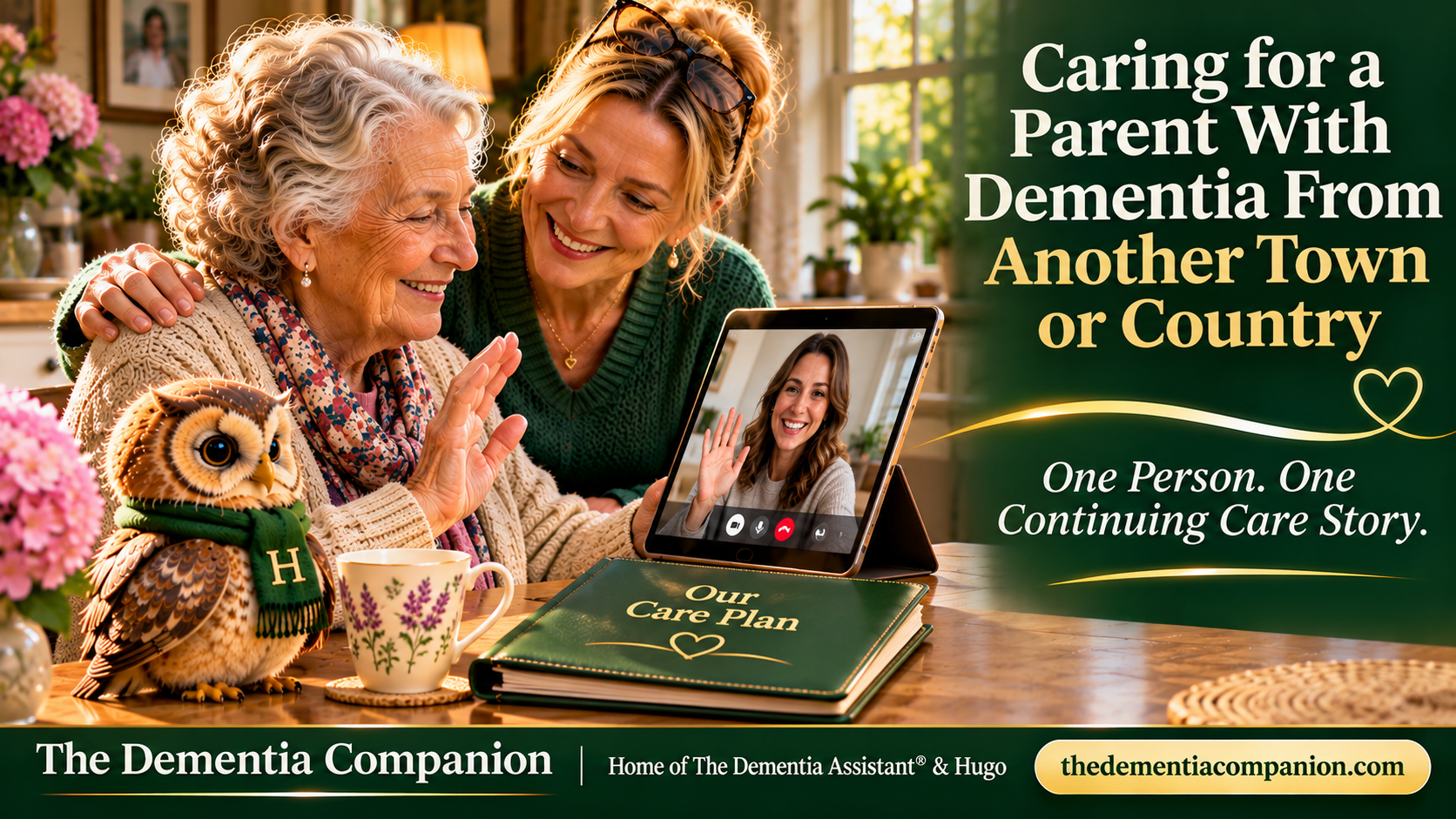
Caring for a Parent With Dementia From Another Town or Country
You may be hundreds or thousands of miles away. But you still want Mum to feel supported, heard and connected.
By Louise Donaghy, Dementia Practitioner, Founder of The Dementia Companion and The Dementia Assistant®, and Creator of Hugo Intelligence™
It’s a Tuesday afternoon.
You’re in the middle of work when your telephone rings.
It’s Mum.
She’s absolutely fine, she tells you.
Except she isn’t quite sure when her next appointment is.
And apparently somebody came to see her yesterday, although she’s not sure who.
You ask whether she’s had lunch.
“Oh yes, darling. Ages ago.”
Then, just as you’re beginning to relax, she says:
“Actually, what day is it?”
And there you are.
Two hours away. Perhaps two countries away.
Trying to work out whether Mum needs help, whether somebody has checked on her, and whether you should be getting into the car.
You ring your sister.
She hasn’t heard anything.
You message your brother.
He replies three hours later with a thumbs-up emoji.
Very reassuring.
If you’ve ever supported a parent living with dementia from another town or country, you’ll recognise that mixture of love, worry, helplessness and frustration.
Long-distance dementia care involves staying connected, arranging reliable local support, keeping important information organised and respecting the person’s independence.
It doesn’t mean you have to move home tomorrow.
It doesn’t mean you’re failing because you can’t physically be there every day.
And it certainly doesn’t mean you should have to coordinate every service using a collection of forgotten messages and scraps of paper.
You need a practical way to understand what’s happening, who is involved and what matters to your parent.
That’s where a continuing, family-held care plan can make a real difference.
Can you care for someone with dementia when you live far away?
Yes. Many families support relatives living with dementia from another town, another part of the UK or another country.
But distance can create additional challenges.
You may not see small everyday changes.
You may rely on telephone calls, video conversations or updates from other people.
And you may be unsure whether what you’ve been told reflects how your parent is actually managing.
Dementia UK provides specific guidance for people caring from a distance, recognising that they may be balancing work, their own families and responsibilities in different locations.
Long-distance caring can involve practical coordination, emotional reassurance, arranging professional support and visiting when possible.
It doesn’t always involve providing physical care yourself.
And it shouldn’t require one relative to manage everything alone.
The question isn’t simply how far away you live. It’s whether the person has the right support around them and whether everybody understands their role.
Start with what Mum wants, not what everybody thinks she needs
Before organising a rota of telephone calls, installing technology or contacting every care provider in town, begin with Mum.
What does she want?
Does she enjoy living independently?
Would she welcome help with shopping?
Does she want family members involved in appointments?
How does she prefer to keep in touch?
Perhaps she loves her daily telephone call.
Perhaps she enjoys seeing the grandchildren on video.
Perhaps she’s perfectly happy managing her own morning routine and would rather not have three people checking whether she’s eaten breakfast.
A dementia diagnosis does not automatically remove someone’s independence or decision-making ability.
Capacity is specific to the decision and circumstances.
The person should be supported to make choices and participate in their care arrangements wherever possible.
A family care plan should record Mum’s voice, not simply everybody else’s worries.
How do we know whether Mum is managing at home?
This can be one of the hardest parts of long-distance dementia support.
You may speak to Mum every evening and find her cheerful and conversational.
But a telephone call doesn’t necessarily tell you everything about her daily life.
Equally, one forgotten appointment doesn’t automatically mean she is unsafe at home.
Try to look at the whole picture.
Ask Mum how she feels about everyday activities.
Where appropriate, discuss whether she wants help reviewing:
- Meals, shopping and household routines.
- Appointments and correspondence.
- Medication arrangements.
- Mobility and getting around.
- Social contact and activities.
- Managing money and bills.
- Personal care and health appointments.
- Any difficulties that she herself has noticed.
If there are concerns about unmet needs, ask about a professional care needs assessment.
Depending on where Mum lives, this may be arranged through local social care services.
Families should not try to assess clinical or safeguarding risks entirely from a distance.
And remember that the person may still manage many things very well.
Good dementia care should support independence, not remove it because somebody lives too far away to feel reassured.
Who should be our local contact?
Having a reliable local point of contact can be helpful.
That might be a relative, friend, neighbour, paid carer or relevant professional.
But don’t assume somebody is willing or able to take on responsibilities without asking them.
And don’t assume a neighbour who occasionally brings the bins in is now responsible for Mum’s wellbeing.
Agree what each person is comfortable doing.
For example:
A neighbour might agree to contact you if Mum asks for help.
A relative might accompany her to agreed appointments.
A paid care provider might assist with assessed daily needs.
A GP or specialist service may provide healthcare follow-up.
Where a professional care coordinator is involved, ask how to contact them.
In England, NICE recommends that people living with dementia have a named health or social care professional responsible for coordinating their care.
Local arrangements differ across the UK and internationally.
Your family can help organise communication, but professional care coordination remains a professional responsibility.
How do we keep track of appointments from another country?
This is where families can quickly become overwhelmed.
One relative has the appointment letter.
Another has the GP telephone number.
Somebody else knows when the care worker visits.
And Mum quite reasonably wants to know why everybody keeps asking about her diary.
Start with one agreed place for important information.
Record:
- Upcoming appointments.
- Relevant professional contacts.
- Who is attending each appointment.
- Questions Mum wants to ask.
- Any agreed actions following a review.
- Important documents and follow-up arrangements.
Ask whether Mum wants someone involved in the consultation.
Healthcare services have responsibilities around confidentiality and consent. Being someone’s child doesn’t automatically mean you can access all their medical information.
But you can discuss appropriate arrangements while Mum is able and willing to express her preferences.
And if you live abroad, check whether appointments can accommodate an appropriately authorised family member joining remotely.
This will depend on the service and circumstances.
What if one sibling lives nearby and does most of the caring?
Ah, now this can become delicate.
You’re living in another country.
Your sister is five minutes from Mum.
You want to help.
She feels she’s doing everything.
You ring with suggestions.
She has just finished sorting medication queries, shopping, the washing machine and a missed appointment.
Your helpful suggestion about getting Mum out more may not receive quite the enthusiastic response you imagined.
Before suggesting another task, ask:
“What would genuinely help you?”
Perhaps you can organise appointments from a distance.
Perhaps you can handle agreed administrative work.
Perhaps you can arrange a regular delivery.
Perhaps you can visit for several days and give your sister proper time off.
Or perhaps the family needs additional professional support rather than trying to squeeze more work out of one exhausted person.
Dementia UK emphasises the challenges faced by long-distance carers and the importance of supporting family members who are providing regular care nearby.
Fairness doesn’t necessarily mean equal tasks.
It means realistic responsibilities, clear agreements and respect for one another’s circumstances.
How can families share updates without endless telephone calls?
Telephone and video calls can be wonderful ways to stay connected.
But they’re not always reliable systems for organising care information.
One person remembers the appointment differently.
Another forgets to forward the letter.
A third shares sensitive information in a group message without checking whether Mum wanted everybody to know.
The problem isn’t necessarily a lack of communication.
Sometimes it’s that there’s no agreed place for important information.
This is one of the reasons I created The Dementia Assistant®.
I wanted people living with dementia and their families to have their own continuing place to maintain information, even when relatives live miles apart.
Through personalised care planning, daily notes, document organisation and Family Circle, families can keep relevant information together and support appropriate communication.
Family Circle is designed to help involved relatives stay connected through updates.
But the person’s privacy, wishes and access permissions remain important.
Being part of the family doesn’t mean everybody automatically needs access to everything.
One Person. One Continuing Care Story, even across borders
Imagine Mum lives in England.
Her daughter lives in Scotland.
Her son lives in Australia.
Another relative lives in Spain.
Mum attends her GP, memory clinic and perhaps receives some home care.
Each professional service maintains its own records.
But Mum’s life doesn’t change into a different story depending on who is reading it.
Her preferences remain hers.
Her life history remains hers.
Her familiar routines still matter.
Her health information, everyday observations and care needs may change, but the person remains at the centre.
A family-held care plan provides an opportunity to keep that continuing story together.
Within The Dementia Assistant®, the person and their family can maintain their own care information independently of a particular care provider.
They can organise documents, record daily notes and preserve personal preferences.
And they can prepare relevant information for professionals when appropriate.
This doesn’t connect every international health system or replace professional records.
Nor does it guarantee that every service will accept family-supplied information in a particular format.
But it gives the person and family a continuing resource of their own.
Different professionals. Different countries. One person. One continuing story.
Meet Hugo Intelligence™: Support when you’re miles away
One of the most difficult aspects of caring from a distance is having a question when nobody is immediately available to talk it through.
Perhaps Mum sounded worried during a telephone call.
Perhaps your sister has mentioned a change in routine.
Perhaps you’re trying to prepare questions before travelling home.
Or perhaps you feel guilty because you cannot visit as often as you’d like.
You might ask:
“Hugo, Mum lives three hours away and I’m worried about how she’s managing. Where should I start?”
Or:
“Hugo, my sister does most of Dad’s daily care. How can I support her from another country?”
Or:
“Hugo, we’ve had conflicting updates about Mum’s appointments. How do we organise everything?”
Hugo Intelligence™ is designed for natural, supportive conversations about dementia care.
You can explain the situation, ask follow-up questions and explore practical options without judgement.
Hugo can help you think about communication, care planning and questions to raise with relevant professionals.
He cannot remotely assess someone’s safety, diagnose symptoms or replace local healthcare and social care services.
But he can provide a space to explore concerns and prepare for the next conversation.
And when families are separated by distance, that can be a valuable form of support.
Personalised guidance from a selected care plan
You can ask Hugo general dementia questions without selecting a care plan.
When you select Mum’s care plan, Hugo can use relevant recorded information about her routines, preferences, communication needs and circumstances to provide more individualised suggestions.
Perhaps Mum dislikes unexpected visitors.
Perhaps she prefers afternoon appointments.
Perhaps she finds video calls tiring but enjoys short telephone conversations.
These details can help you explore support that reflects her preferences.
Rather than assuming every person with dementia needs the same arrangements.
That’s the purpose of Person-Centred Intelligence®.
Save and organise your conversations
Long-distance dementia care often involves questions that return over time.
You may discuss appointments this week.
Communication next month.
And changes in care arrangements later.
The Dementia Assistant® allows you to save, categorise and organise your Hugo conversations.
You can revisit earlier guidance and keep related questions together.
This provides continuity in the information you explore.
Saved conversations are not a substitute for professional records, verified clinical instructions or agreed care arrangements.
But they can help families avoid starting from scratch every time something changes.
Hugo’s multilingual support: One family, several countries and languages
This is particularly relevant when families live internationally.
Perhaps Mum lives in Wales and prefers speaking Welsh.
Perhaps her son lives in India and another relative lives in Canada.
Perhaps some relatives communicate most comfortably in Hindi, French, Spanish or Portuguese.
Or perhaps Mum grew up speaking Irish and finds it easier to express certain feelings in that language.
Language is part of our identity.
And some people living with dementia may experience changes in how they use different languages.
That varies between individuals, but it’s important to respect the person’s preferred language.
The Dementia Assistant® supports 12 interface languages and provides dictation and translation capabilities spanning 201 languages.
These tools can help families organise care information, record observations and communicate across language barriers.
They can also make it easier for someone to dictate a note rather than type it.
Hugo’s conversational guidance offers another way for families to express concerns naturally.
Not every feature is available in every one of the 201 languages.
And important clinical, legal or medication information must be checked for accuracy. Qualified interpreters remain important for formal discussions where needed.
But multilingual support helps make dementia guidance and family care information more accessible.
Because one person’s continuing care story shouldn’t be divided simply because their family speaks different languages.
How can we stay emotionally close when we live far away?
Sometimes caring from a distance becomes so focused on administration that families forget something important.
Connection.
Every telephone call turns into:
“Have you eaten?”
“Did you take your medication?”
“Have you got your appointment letter?”
“Has the carer been?”
All sensible questions.
But sometimes Mum just wants to tell you about the neighbour’s new dog.
Or complain about the weather.
Or ask what the grandchildren are doing.
Try to leave room for ordinary conversations.
Share photographs.
Talk about familiar interests.
Arrange calls at times Mum enjoys.
If video calling is confusing or tiring, a simple telephone call may be better.
Perhaps write letters or send cards if she likes receiving them.
And don’t assume that every conversation needs to become a memory test.
You are still her daughter or son, not simply her remote care administrator.
The relationship matters.
The laughter matters.
The everyday connection matters.
What if Mum refuses help and we cannot get there?
This can be particularly worrying.
Perhaps Mum says everything is fine.
But relatives or professionals have identified concerns.
Start by understanding what help she is refusing and why.
Does she feel she doesn’t need it?
Is she uncomfortable with strangers?
Would she prefer a different arrangement?
Does she want more independence than others think is safe?
Don’t assume that refusal automatically means she lacks decision-making capacity.
A dementia diagnosis does not remove someone’s rights.
But if there are significant concerns about unmet needs or safety, seek a professional assessment through the appropriate local services.
If there are safeguarding concerns, contact the relevant adult safeguarding service.
If there’s immediate danger or a medical emergency, contact the appropriate emergency service where the person is located.
A family-held care record may help you provide factual information to professionals.
But it must never delay urgent action.
Who can help families caring from abroad?
The answer depends on where the person with dementia lives.
If your parent lives in the UK, start with their GP, memory service, relevant local health or social care services, and established dementia charities.
Dementia UK specifically offers advice for families living abroad when the person with dementia lives in the UK.
For someone living in England, NICE recommends a named professional responsible for coordinating dementia care.
Carers may also be able to request an assessment of their own support needs. Eligibility and arrangements differ across the UK nations.
If your parent lives outside the UK, healthcare, social care, privacy and legal arrangements may be different.
Avoid assuming that UK rules apply internationally.
Ask the appropriate services in the country where your parent lives.
A long-distance dementia care checklist
If you’re supporting someone from another town or country, begin with these questions:
- [ ] What does Mum want, and who does she want involved?
- [ ] Who is the main local professional contact?
- [ ] Are any regular care or support arrangements in place?
- [ ] Who can respond locally when Mum needs practical help?
- [ ] How are appointments and important documents organised?
- [ ] Does everyone have accurate, current information where appropriate?
- [ ] Have family responsibilities been agreed realistically?
- [ ] Is the person providing most local care receiving enough support?
- [ ] Are Mum’s communication and language preferences understood?
- [ ] Does she want regular calls, visits or another way of keeping in touch?
- [ ] Is there a plan for urgent concerns?
- [ ] Are her privacy and access permissions respected?
- [ ] Can the family’s own care information be kept together as services change?
You do not have to answer every question today.
Begin with the most important concerns.
Then build a plan that works for the person, not simply for the family’s anxiety.
Distance doesn’t change who Mum is
A dementia diagnosis can create uncertainty.
Distance can add another layer of worry.
But Mum is still Mum.
She still has her favourite chair.
Her preferred routines.
Her sense of humour.
Her opinions about what constitutes a proper cup of tea.
And a lifetime of experiences that matter far more than the number of miles between you.
You cannot always be physically present.
But you can help preserve her voice, support appropriate care arrangements and stay meaningfully connected.
And you shouldn’t have to carry every responsibility alone.
One Person. One Continuing Care Story.
Because love can travel across borders.
And important care information should be able to travel with the person too.
⸻
Ask Hugo: Caring for Someone With Dementia From a Distance
Hugo, Mum has dementia and lives three hours away. Where do I start?
Hugo 🦉: Begin with Mum’s wishes and what support she already has.
Find out who her main local contacts are, how appointments are managed and whether there are concerns that need professional assessment.
Then consider how you can stay involved without unnecessarily taking away her independence.
Can I help Mum manage dementia care if I live abroad?
Hugo 🦉: Yes. You may be able to help organise information, prepare questions, coordinate agreed family responsibilities and maintain contact with appropriate services.
The arrangements depend on Mum’s wishes, her circumstances and the laws and services where she lives.
Can The Dementia Assistant® help keep information together?
Hugo 🦉: Yes. It provides personalised care plans, daily notes, document organisation and family communication features.
Your family can maintain its own continuing care information independently of one care provider, subject to the appropriate access arrangements.
Can Family Circle help relatives in different countries?
Hugo 🦉: Family Circle can support sharing relevant updates with appropriately involved relatives.
The information shared should respect the person’s privacy, wishes and permissions.
Can I talk to Hugo about worries when I live far away?
Hugo 🦉: Absolutely. You can ask questions, explain your concerns and explore practical, person-centred approaches.
I can’t assess Mum’s safety remotely or replace professional services, but I can help you prepare questions and think about possible next steps.
Can Hugo use Mum’s individual care plan?
Hugo 🦉: Yes, when you select her care plan.
I can use relevant recorded information to provide more personalised suggestions based on her routines, preferences and circumstances.
Without a selected plan, I can still offer general dementia guidance.
Can we save our Hugo conversations?
Hugo 🦉: Yes. You can save, categorise and revisit conversations within The Dementia Assistant®.
That helps you return to useful information as circumstances change.
Does Hugo support different languages?
Hugo 🦉: The Dementia Assistant® supports 12 interface languages and dictation and translation capabilities spanning 201 languages.
These tools can help multilingual families organise and communicate care information, with important translations checked for accuracy.
What if my sister is doing most of Mum’s caring?
Hugo 🦉: Ask what would genuinely help her.
You may be able to take responsibility for agreed administrative tasks, help organise appointments, arrange visits or support access to professional services.
Recognise that the person providing daily care may need practical help and time for themselves.
How much does The Dementia Assistant® cost?
Hugo 🦉: The Family subscription is £4.99 per month.
All subscriptions include a 30-day complimentary trial.
You can explore Hugo Intelligence™, Family Circle, personalised care planning, saved conversations, daily notes and multilingual support.
⸻
One Person. One Continuing Care Story.
Dementia care may involve relatives living in different towns, countries and time zones.
It may also involve GPs, memory clinics, hospitals, dementia nurses, home care providers and other professionals.
Each service may maintain its own records.
But the person living with dementia and their family should have the opportunity to maintain their own continuing care information too.
A place to preserve the person’s wishes.
A place to organise appointments, documents and daily observations.
A place to support appropriate family communication.
A place to revisit important conversations.
And with Hugo Intelligence™, a place to explore person-centred guidance in a conversational, multilingual environment.
The Dementia Assistant® was created to put the person living with dementia and their family at the centre of their own continuing care information.
It doesn’t replace professional medical records, clinical advice or local care coordination.
It gives the person and family their own organised information alongside those services.
Different professionals. Different countries. One person. One continuing story.
Meet Hugo and The Dementia Assistant®
Created by dementia practitioner Louise Donaghy and powered by Person-Centred Intelligence®, The Dementia Assistant® brings together:
- Hugo Intelligence™ for conversational, person-centred dementia guidance.
- Family-held continuing care plans.
- Guided care plan creation.
- Family Circle for appropriate family communication.
- Daily notes and observations.
- Document organisation.
- Saved and categorised Hugo conversations.
- Life Story and Memory & Moments.
- Multilingual support, dictation and translation.
- Dementia learning and practical resources.
Every subscription includes a 30-day complimentary trial.
Explore The Dementia Assistant®:
https://thedementiaassistant.com/
The Dementia Companion, home of The Dementia Assistant® and Hugo 🦉
https://thedementiacompanion.com/
Louise and Hugo ❤️🦉
Louise Donaghy
Founder & CEO of The Dementia Assistant®
Created and powered by Person-Centred Intelligence®
Creator of Hugo Intelligence™
⸻
References and Further Reading
- Dementia UK: Caring for Someone With Dementia From a Distance
Practical advice for families supporting someone living with dementia when they cannot be physically present every day.
- Dementia UK: Admiral Nurse Dementia Helpline
Specialist support, including for relatives living overseas when the person with dementia lives in the UK.
- NICE: Dementia, Assessment, Management and Support (NG97)
Recommendations on named care coordinators, person-centred care planning and family carer support.
https://www.nice.org.uk/guidance/ng97/chapter/recommendations
- NICE: Dementia Quality Standard, Coordinating Care (QS184)
Guidance about appropriate care coordination and ensuring people living with dementia have access to support.
https://www.nice.org.uk/guidance/qs184/chapter/quality-statement-4-coordinating-care
- NHS: Looking After Someone With Dementia
Practical information on supporting a person with dementia and recognising the needs of family carers.
https://www.nhs.uk/conditions/dementia/living-with-dementia/looking-after-someone/
- NHS: Carer’s Assessments
Information about requesting an assessment of an unpaid carer’s support needs in England.
https://www.nhs.uk/social-care-and-support/support-and-benefits-for-carers/carer-assessments/
- Alzheimer’s Society: Supporting a Person With Dementia Who Lives Far Away and Refuses Help
Advice and family experiences concerning distance, independence and support needs.
⸻
Important information: This article provides general educational guidance and does not replace medical, safeguarding, legal or professional care advice. Healthcare, social care, information-sharing and legal arrangements vary across UK nations and countries.
Reviewed: 20 November 2026
You May Also Find Helpful
Need help with your own situation? Ask Hugo.
One Person. One Continuing Care Story. The Dementia Companion is where you discover guidance. Inside The Dementia Assistant®, talk with Hugo, save and categorise conversations, record daily notes and involve authorised supporters in a continuing care plan centred around the person.
Ask Hugo About This · Start Your Continuing Care Plan — Families · Continuing Care Planning — Professionals
Personal guidance requires the appropriate account and subscription access. Care-plan information is used only with authorised access and the required consent and selection steps. All subscription plans include a 30-day complimentary trial.