AI Dementia Assistant: Meet Hugo | Family Dementia Support
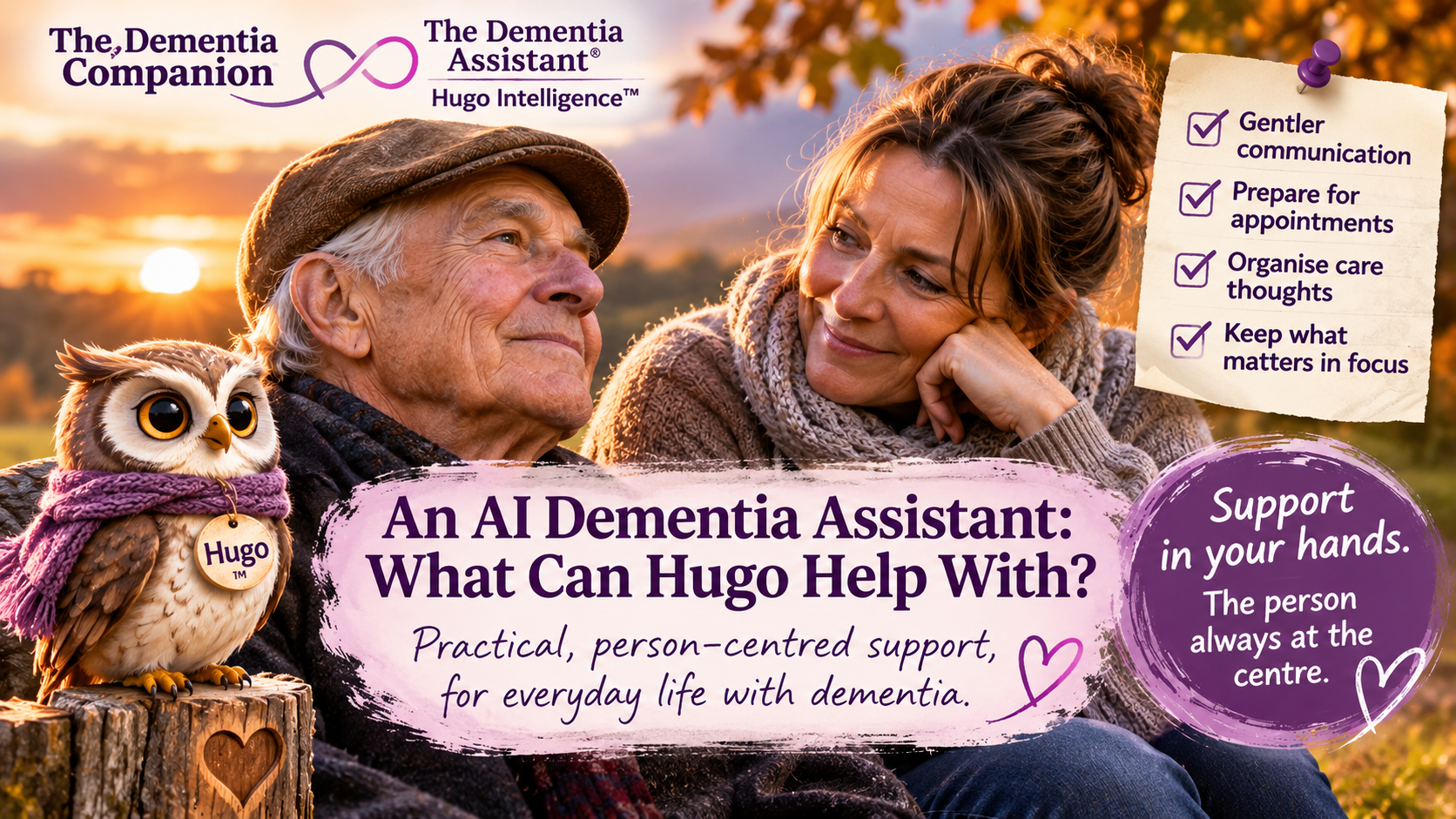
An AI Dementia Assistant: What Can Hugo Help With?
Dementia support that starts with the person, stays in the family’s hands, and brings professional care into the conversation when it is needed.
By Louise Donaghy, Founder & CEO of The Dementia Assistant®, created and powered by Person-Centred Intelligence®, and Creator of Hugo Intelligence™.
There is a moment in dementia care that rarely makes it into a medical appointment.
It’s 7.30 in the evening. Mum has asked to go home for the sixth time, despite sitting in the house she has lived in for forty years.
Dad has started refusing his morning wash. Your partner is becoming unsettled whenever visitors arrive. Or you’ve noticed something different about someone you love, but you’re struggling to find the words to explain it.
And somewhere amongst the washing, the medication reminders, the appointments and a cup of tea you’ve reheated three times, you have a question.
“Am I handling this the right way?”
You don’t necessarily need another appointment to ask how to make a conversation gentler. You don’t need a medical degree to wonder why a familiar routine has suddenly become difficult.
Sometimes, you simply need help thinking things through.
This is where an AI dementia assistant can be useful.
But not just any AI assistant.
Meet Hugo, the little owl with a rather important job.
Hugo Intelligence™ is part of The Dementia Assistant®, a dementia support platform designed to help people living with dementia, their families and those supporting them navigate everyday questions, communication difficulties and care planning.
And here’s something I feel particularly strongly about.
Hugo is designed to be in the hands of the person living with dementia and their family. Not held exclusively by the medical profession.
Because a diagnosis might happen in a clinic, but life with dementia happens at home, in the garden, around the dinner table, at the shops, and occasionally in the hallway where somebody has spent twenty minutes looking for their glasses while wearing them.
That is everyday life. And that is where practical, compassionate support matters.
What Is an AI Dementia Assistant?
An AI dementia assistant is a digital tool that uses artificial intelligence to help people explore questions, understand information and consider practical approaches to dementia-related situations.
You type or speak a question, and the assistant responds with information, suggestions or possible next steps.
But there is an important difference between asking a general AI chatbot about dementia and using an assistant specifically designed around person-centred dementia support.
Dementia does not affect everyone in the same way.
Two people may have the same diagnosis but very different personalities, histories, abilities, routines and ways of communicating.
One person might find reassurance in familiar music. Another might find music overwhelming.
One may enjoy a lively family gathering. Another might prefer one visitor, a quiet room and a decent biscuit.
That is why person-centred dementia care matters.
Hugo is built around an approach called Person-Centred Intelligence®. The principle is straightforward: we must look beyond the diagnosis and consider the individual.
What matters to them? What are they accustomed to? What makes them feel comfortable, respected and involved?
Hugo can help you think about these questions. But Hugo doesn’t know your loved one better than you do, and it shouldn’t pretend to.
Why Dementia Support Should Be in the Hands of Families
When someone develops memory problems, a great deal of attention understandably turns towards medical services.
There may be GP appointments, memory assessments, scans, referrals and discussions about diagnosis.
Those are important.
But what happens between appointments?
Who helps when Dad suddenly becomes frightened of the shower?
Who helps the daughter who has just been accused of stealing her mother’s purse?
Who supports a husband who is desperately trying to understand why the woman he’s loved for fifty years no longer recognises him on certain mornings?
Often, it is the family who must work through these moments.
Not because they have been trained for them, but because they love the person involved.
And that can feel like an enormous responsibility.
My belief is that families should not have to wait until their next appointment to access practical dementia information and support.
They should be able to ask a question, reflect on what they are noticing and prepare for conversations with professionals.
The Dementia Assistant® was created with that principle in mind.
The person living with dementia should remain at the centre of their care, with their wishes, preferences and abilities respected. Families and trusted supporters should be able to participate appropriately, rather than being left watching important decisions happen around them.
For someone living with dementia, Hugo may offer information and help them express questions or preferences, depending on their individual needs.
For a family carer, Hugo may provide another way to explore a difficult situation.
For a healthcare professional, Hugo and the information a family chooses to share may help support a more informed conversation.
The distinction matters.
We are not trying to replace GPs, nurses, memory clinics or dementia specialists.
We are trying to make sure the person and family have practical support in everyday life, including the long stretches when no professional is sitting beside them.
What Can Hugo Help Family Carers With?
- Finding the right words when dementia changes communication
Some of the most upsetting dementia moments begin with an ordinary conversation.
“Mum, you are home.”
“I’ve already told you that.”
“Dad, you had your breakfast twenty minutes ago!”
Most of us have said something similar at some point. Usually because we are tired, worried or trying desperately to help.
And sometimes our perfectly reasonable explanation makes the situation more difficult.
You might ask Hugo:
“My mum keeps saying she wants to go home, but she’s already home. What should I say?”
Hugo can help you consider that the word “home” may be expressing something more than a physical address.
Perhaps Mum is looking for familiarity, security, a person she misses, or a sense of belonging. We cannot assume which explanation applies to her.
Instead of correcting the address, you might try:
“Tell me about home, Mum. What do you miss most?”
Or:
“You seem a little unsettled. Shall we sit together for a while?”
Neither phrase is guaranteed to help. But both create an opportunity to understand what Mum might be communicating.
And that is the difference between simply answering a question and thinking about the person behind it.
- Exploring behaviour without immediately labelling it a problem
Imagine Dad has always enjoyed a morning shower.
Recently, he has begun refusing.
He’s becoming upset, turning away and insisting that he doesn’t need one.
You might think he’s being difficult.
But what if the bathroom is cold?
What if the water feels unpleasant, the shower is frightening, or he doesn’t understand what is being asked?
What if he is in pain?
Hugo can help families consider possible explanations without assuming they have found the answer.
You could ask:
“My dad has dementia and is refusing personal care. How can I understand what’s upsetting him without making things worse?”
Useful suggestions might include checking comfort, explaining one step at a time, offering choices, respecting privacy and trying another time when appropriate.
There may also be physical or medical reasons that require assessment.
The aim isn’t to force someone through a task.
It is to understand what is happening and protect their dignity.
- Preparing for appointments instead of forgetting everything when you arrive
There is something rather extraordinary about medical appointments.
You’ve spent three weeks worrying about fourteen different things.
You finally sit down opposite the doctor.
“Any concerns?”
And suddenly your mind is as empty as the fridge five minutes before the weekly shop.
This is another area where AI support for dementia carers can be useful.
You could ask Hugo:
“My husband has become more confused in the afternoons, and his sleep has changed. Can you help me organise what I’ve noticed and prepare questions for our GP?”
Hugo can help you structure the observations you provide into a clearer account.
For example:
- When did the changes begin?
- Did they happen suddenly or gradually?
- Are they occurring at particular times?
- Have there been changes in sleep, appetite, medication, mobility or comfort?
- What seems to help, and what makes things harder?
- What would you like the healthcare professional to assess?
This doesn’t diagnose the problem.
It helps you prepare to explain what you have noticed.
A sudden or marked change in confusion, awareness or behaviour needs prompt medical assessment rather than simply being attributed to dementia.
- Building care plans around the person, not just their condition
A care plan should be more than a list of diagnoses, medication and tasks.
It should describe a human being.
Someone who likes their tea strong, prefers to get dressed after breakfast, dislikes being hurried and still takes enormous pride in choosing their own clothes.
The Dementia Assistant® includes a Care Planning Centre™ designed to help users develop person-centred care information.
Families can document routines, preferences, important relationships, communication approaches and support needs.
They can also record what has changed and what may need reviewing.
With appropriate consent and involvement, a care plan can help keep the person’s wishes visible during conversations with others involved in their support.
And as circumstances change, the information can be updated.
The goal is not to create a document that sits untouched in a folder.
It’s to help maintain a useful picture of the person, their life and their needs.
- Organising daily observations and communicating with others
Sometimes a family knows something has changed but finds it difficult to explain.
“Mum’s just not herself.”
That may be an important observation, but a professional will often need more detail.
The Dementia Assistant® includes daily notes and family communication features that can help authorised users organise information.
For example, a family might record that someone has become more restless after lunch, has been sleeping poorly, or has seemed uncomfortable when walking.
Over time, carefully recorded observations may make it easier to describe a pattern or identify questions worth raising.
They are not clinical assessments, and an AI summary should always be checked against the original observations.
Nor should sharing intimate information ever become automatic. The person’s privacy, wishes and appropriate permissions remain important.
- Remembering the life beyond the diagnosis
Dementia care should never become entirely about what someone can no longer do.
There is still a lifetime of experience, humour, relationships, music, preferences and identity.
The Dementia Assistant® includes Life Story and Memory & Moments features to help families preserve and organise some of those important details.
Perhaps Mum was a wonderful baker.
Perhaps Dad spent every Sunday fixing something that wasn’t particularly broken.
Perhaps your partner still smiles when they hear a particular song.
These are not irrelevant details.
They can help family members and those providing care find more meaningful ways to connect.
They also remind us of something important.
A diagnosis is part of someone’s life. It is not the whole of their identity.
What Does a Conversation With Hugo Actually Look Like?
Let’s use a fictional example.
Sarah is supporting her mother, Margaret, who lives with dementia.
Margaret has recently become upset whenever Sarah mentions getting ready for bed.
Sarah opens Hugo and types:
Sarah: “My mum gets upset when I tell her it’s bedtime. She says I’m treating her like a child. What can I do?”
Hugo might suggest considering whether Margaret feels rushed, whether the language being used sounds like an instruction, and whether the routine still feels familiar.
It may encourage Sarah to offer choice and look for possible discomfort or tiredness.
Sarah follows up:
Sarah: “Mum worked night shifts for years. She’s never liked going to bed early.”
That changes the picture.
The difficulty may not simply be about bedtime.
It may involve Margaret’s longstanding routine, preferences and sense of independence.
Sarah could then explore whether a different evening routine might be suitable and safe.
The important part isn’t that AI has discovered a hidden answer.
It’s that a little more information about Margaret has helped Sarah consider a different approach.
And Margaret’s own views still matter.
That’s what person-centred support should encourage.
Can Hugo Help Before a Dementia Diagnosis?
Yes, Hugo can help someone organise questions and understand general information even when no diagnosis has been made.
Families sometimes notice changes in memory, language, confidence or everyday routines long before they know the cause.
Waiting for an assessment can be worrying.
During that time, an AI dementia companion can help explain commonly used terms, prepare a list of observations and suggest useful questions for a healthcare appointment.
But it is essential not to confuse education with assessment.
Memory difficulties do not automatically mean dementia.
There are other possible explanations, some of which may be treatable.
Hugo cannot determine whether someone has Alzheimer’s disease, vascular dementia, Lewy body dementia or another condition.
It cannot replace a GP assessment or specialist investigation.
And it should never be used as a reason to delay seeking medical advice.
What it can do is help you arrive at the appointment with your thoughts a little better organised.
How Is Hugo Different From a General AI Chatbot?
General AI tools can answer many questions about dementia.
Some are extremely capable at explaining information, summarising text and generating suggestions.
So it would be misleading to claim that Hugo is the only AI able to discuss dementia, or that being designed for dementia automatically makes every answer more accurate.
The difference we are working towards is in the experience and purpose.
Hugo sits within a connected dementia support platform that brings together questions, guidance, person-centred care planning, daily notes, family information and educational resources.
Where a care plan is available and has been deliberately selected for use with Hugo, the conversation can be informed by relevant information about that person.
Without that selected context, Hugo should not be assumed to know their history, preferences or care needs.
This distinction matters because an answer that is appropriate for one person may be unsuitable for another.
A useful AI dementia assistant should encourage the user to consider the actual person, check the information and recognise when professional help is needed.
Hugo is not intended to replace the relationship between a person living with dementia, their family and the professionals supporting them. It is intended to help those relationships work with better-informed questions and clearer information.
Is It Safe to Use AI for Dementia Advice?
This is one of the most important questions anyone can ask.
Artificial intelligence can make mistakes.
It can misunderstand a question, overlook important context, or produce information that sounds confident even when it is wrong.
That remains possible with dementia-focused AI tools.
Families should not assume that a reassuring answer means a situation is safe, or that an explanation is correct simply because it sounds convincing.
Hugo cannot:
- Diagnose dementia or determine its type or stage.
- Assess whether a person is medically safe in an emergency.
- Prescribe, stop or change medication.
- Replace a clinical assessment or professional judgement.
- Guarantee that a particular communication technique will work.
- Know what someone is thinking or feeling without their input.
- Make legal decisions or override a person’s rights, wishes or appropriate decision-making processes.
For urgent medical symptoms, significant sudden changes, suspected delirium, serious injury or immediate danger, seek appropriate urgent or emergency help.
In the UK, call 999 for a life-threatening emergency. NHS 111 can advise when urgent help is needed but it is not an emergency. Elsewhere, use the relevant local services.
AI can help you formulate a question.
It cannot examine the person sitting in front of you.
And sometimes, that examination is exactly what is needed.
What About Privacy and Personal Information?
Dementia conversations can involve sensitive personal details.
Health information, family circumstances, behaviours, medication and care arrangements all deserve careful handling.
Before using any AI system, it is sensible to understand its privacy information, how data is used, who may access it and what controls are available.
Avoid entering unnecessary identifying information into an ordinary AI conversation.
For example, you can ask:
“My mother has dementia and has become anxious during the evenings.”
You generally don’t need to supply her full name, address, date of birth or NHS number to explore that question.
Where personal information is intentionally added to a care plan or another dedicated feature, it should be limited to what is necessary and handled according to the platform’s current privacy information and the person’s wishes and applicable permissions.
Being family does not automatically mean someone is entitled to every private detail.
Respecting dignity and autonomy applies online just as it does in person.
Can AI Replace Human Contact in Dementia Care?
No. And it shouldn’t try.
No AI can hold someone’s hand when they’re frightened.
It cannot notice the tiny change in someone’s expression that a familiar companion may recognise.
It cannot take Mum into the garden, sit with Dad while he tells the same wonderful story, or replace the comfort of someone who knows how they like their tea.
Technology may provide information, prompts and ways of organising support.
But human connection remains central.
A good dementia support tool should help people find better ways to communicate, understand and spend time together, not encourage them to withdraw from real relationships.
The goal is not to make people dependent on AI.
It’s to help people feel more informed and more able to seek the right support.
What About Professional Dementia Carers?
Hugo can also be useful to care professionals, support workers and organisations.
A professional might use it to explore communication approaches, prepare educational materials or structure non-emergency care observations.
But professional use brings additional responsibilities.
Care records need appropriate permissions, factual accuracy, professional review and compliance with the relevant organisation’s policies.
AI-generated suggestions should never silently become clinical conclusions or verified observations.
And whilst professionals can play an important part in introducing families to helpful resources, the purpose of The Dementia Assistant® is broader than professional use.
Families should be able to access support directly. They should not need permission from a GP or memory clinic simply to ask a practical dementia question.
A referral or recommendation may help someone discover Hugo.
But Hugo’s everyday support is designed for the person and their circle of care, not exclusively for the organisation that introduced them.
Can an AI Dementia Companion Support Families Over Time?
Dementia support is rarely about one question.
A family may begin by wondering whether a change in memory needs investigating.
Later, they may need help thinking about communication, routines, personal care, appointments or changes in support needs.
The Dementia Assistant® brings several of these practical activities together, including Hugo Intelligence™, care planning, daily notes, family communication and learning resources.
The intention is to help families maintain a useful record and revisit information as circumstances change.
That does not mean AI can predict someone’s dementia journey.
It means people can organise what they know, update it when necessary and use it to support better conversations.
And importantly, the person living with dementia should remain involved as far as possible, with their own wishes and rights respected throughout.
A Final Thought: Dementia Care Is About People, Not Technology
I created The Dementia Assistant® because dementia support needs to recognise what life actually looks like for the people living it.
Not just the diagnosis.
Not just the appointment.
Not just the care plan.
The ordinary Tuesday afternoons. The difficult evenings. The family disagreements about what might help. The funny moments that arrive unexpectedly. The exhaustion, the uncertainty and the love behind so much of what families do.
Artificial intelligence will not solve all of that.
I wouldn’t trust a piece of technology that promised it could.
But if Hugo can help someone find a gentler way to begin a conversation, organise an important question or remember to look beyond a behaviour to the person experiencing it, then that is a meaningful purpose.
And if Hugo can help a person living with dementia have their preferences heard, rather than their diagnosis speaking for them, that matters too.
Because the future of dementia support should not be about handing people’s lives over to technology.
It should be about putting useful information, guidance and practical tools into the hands of the people who need them.
One person. One family. One question at a time.
Meet Hugo and Explore The Dementia Assistant®
If you are living with dementia, supporting someone you love, or simply trying to understand a difficult situation, you are welcome to explore Hugo.
Start with a question. It doesn’t need to be perfectly worded.
You can also discover practical articles, communication guidance and family resources through The Dementia Companion.
The Dementia Companion, home of The Dementia Assistant® and Hugo 🦉
https://thedementiacompanion.com/
Explore The Dementia Assistant® and Hugo Intelligence™:
https://thedementiaassistant.com/
All subscriptions include a 30-day complimentary trial.
You do not need to have all the answers before you ask your first question.
Sometimes, knowing what to ask is a very good place to begin.
Louise and Hugo ❤️🦉
Louise Donaghy
Founder & CEO of The Dementia Assistant®
Created and powered by Person-Centred Intelligence®
Creator of Hugo Intelligence™
What is an AI dementia assistant?
An AI dementia assistant is a digital tool that helps people living with dementia, their families and carers explore everyday questions, understand information and consider practical ways to approach care. Hugo Intelligence™ is designed around person-centred dementia support, helping families think through communication challenges, care planning and preparing for appointments.
Can Hugo help someone who is living with dementia directly?
Yes. Hugo is designed for the person living with dementia as well as their family and supporters. Depending on their individual abilities and preferences, someone may use Hugo to ask questions, explore information or express what matters to them. Support should be accessible and respectful, with the person’s choices and independence at the centre.
Is Hugo only for healthcare professionals?
No. Hugo is designed to be in the hands of people living with dementia and their families. GPs, dementia nurses, memory clinics and care professionals remain important partners, but families do not need a professional referral simply to access Hugo and ask everyday questions.
How is Hugo different from ChatGPT or other AI assistants?
General AI assistants can provide useful dementia information. Hugo’s distinction is its focus on person-centred dementia support and its connection to The Dementia Assistant®, which includes care planning, daily notes, family communication and learning resources. Hugo encourages people to consider the individual’s needs rather than assuming one approach will suit everyone.
Can Hugo help before someone receives a dementia diagnosis?
Yes. Hugo can explain general information about memory concerns, help families organise observations and prepare questions for a GP or memory clinic. However, memory problems can have many causes. Hugo cannot diagnose dementia, determine its type or replace medical assessment.
Can Hugo help when someone with dementia keeps asking the same question?
Hugo can help you explore why a question may be repeated and suggest communication approaches to consider. Sometimes the person may be seeking reassurance rather than factual information. The most helpful response depends on their individual circumstances, preferences and what they may be experiencing.
Can Hugo help create a person-centred dementia care plan?
The Dementia Assistant® includes a Care Planning Centre™ where authorised users can organise information about the person’s routines, preferences, communication needs and support requirements. Hugo can help guide the process when the appropriate care-planning context is selected. Plans should be reviewed with the person and relevant supporters and professionals.
Can families use Hugo to prepare for GP or memory clinic appointments?
Yes. Hugo can help organise observations, develop questions and prepare summaries for discussion with healthcare professionals. Families can explain what they have noticed more clearly, while the professional remains responsible for clinical assessment and advice.
Does Hugo remember everything about the person living with dementia?
No. Hugo should not be assumed to know someone’s personal history or access all their records automatically. Person-specific guidance depends on relevant information being deliberately provided or the appropriate care plan being selected through supported platform features.
Can Hugo help when someone with dementia becomes distressed or refuses care?
Hugo can help explore possible reasons, such as pain, fear, discomfort, communication difficulties or changes in surroundings. It may suggest respectful approaches that protect the person’s dignity and choices. New, sudden, severe or persistent changes may require medical or other professional assessment.
Is Hugo safe and medically approved?
Hugo is an AI support and information tool, not a replacement for clinical care. AI can make mistakes, misunderstand information or offer suggestions that are unsuitable for an individual. Hugo cannot diagnose, prescribe treatment or assess emergencies. Users should check important information and seek qualified professional advice when needed. No claim of clinical approval or independently validated outcomes should be assumed.
Is my family’s information private when using Hugo?
Privacy is especially important when discussing dementia. Users should avoid entering unnecessary identifying information into general AI questions and should review the platform’s current privacy information before sharing personal data. Anyone accessing or sharing care records should have appropriate permission and respect the person’s wishes and rights.
Can Hugo replace a dementia nurse, doctor or human carer?
No. Hugo is designed to complement human support, not replace it. AI can help with information, communication ideas and organising thoughts, but it cannot provide the clinical judgement, personal relationships, physical assistance or emotional presence that people may need.
How much does The Dementia Assistant® cost?
The Dementia Assistant® offers family and professional subscription options. The Family subscription is currently £4.99 per month, with a 30-day complimentary trial. All subscription plans include a 30-day complimentary trial. Check the website for current pricing, terms and plan details.
How do I start using Hugo Intelligence™?
Visit https://thedementiaassistant.com/ to explore Hugo and The Dementia Assistant®. You can begin by asking an everyday dementia-related question and explore the care-planning and support features available to your account.
For practical dementia articles, communication guidance and family resources, visit https://thedementiacompanion.com/.
The Dementia Companion, home of The Dementia Assistant® and Hugo 🦉
Resources and Further Reading
The following trusted resources provide additional information about person-centred dementia care, communication, supporting families and using technology responsibly.
- NICE: Dementia Assessment, Management and Support (NG97)
Official UK clinical guidance covering person-centred dementia care, involving people in decisions, supporting family carers and investigating causes of distress.
https://www.nice.org.uk/guidance/ng97/chapter/recommendations
- Alzheimer’s Society: Communicating and Dementia
Practical guidance for families and carers on adapting communication, understanding changes and maintaining meaningful connections.
- Alzheimer’s Society: Understanding Changes in Behaviour
Information about possible reasons for distress and changes in behaviour, including discomfort, communication difficulties and environmental factors.
- Alzheimer’s Society: Using Technology
Guidance about technology for people living with dementia, including choosing appropriate tools, independence, consent and privacy.
https://www.alzheimers.org.uk/get-support/living-with-dementia/advice-on-using-technology
- NHS: Sudden Confusion (Delirium)
Important medical information explaining why sudden confusion requires immediate medical assessment and should not automatically be attributed to dementia.
https://www.nhs.uk/symptoms/confusion/
- Alzheimer’s Society: Looking After Yourself as a Carer
Practical information about carer wellbeing, finding support and recognising the needs of family carers.
https://www.alzheimers.org.uk/get-support/help-dementia-care/looking-after-yourself
- The Dementia Companion
Person-centred dementia information, practical articles, communication guidance and educational resources for people living with dementia, families and carers.
https://thedementiacompanion.com/
- The Dementia Assistant® and Hugo Intelligence™
Explore person-centred AI dementia support, everyday guidance, care planning, family communication tools and educational resources.
https://thedementiaassistant.com/
Important Information
Hugo Intelligence™ provides educational information and practical guidance. It does not diagnose medical conditions, replace professional clinical judgement or provide emergency assessment.
Artificial intelligence can make mistakes. Always seek appropriate professional advice for medical concerns, sudden changes or decisions affecting someone’s safety.
The Dementia Assistant® is designed to put practical dementia support in the hands of people living with dementia and their families, while recognising the important role of healthcare professionals.
Louise and Hugo ❤️🦉
You May Also Find Helpful
Need help with your own situation? Ask Hugo.
One Person. One Continuing Care Story. The Dementia Companion is where you discover guidance. Inside The Dementia Assistant®, talk with Hugo, save and categorise conversations, record daily notes and involve authorised supporters in a continuing care plan centred around the person.
Ask Hugo About This · Start Your Continuing Care Plan — Families · Continuing Care Planning — Professionals
Personal guidance requires the appropriate account and subscription access. Care-plan information is used only with authorised access and the required consent and selection steps. All subscription plans include a 30-day complimentary trial.