A New Carer Is Starting. What Do They Need to Know About Mum?
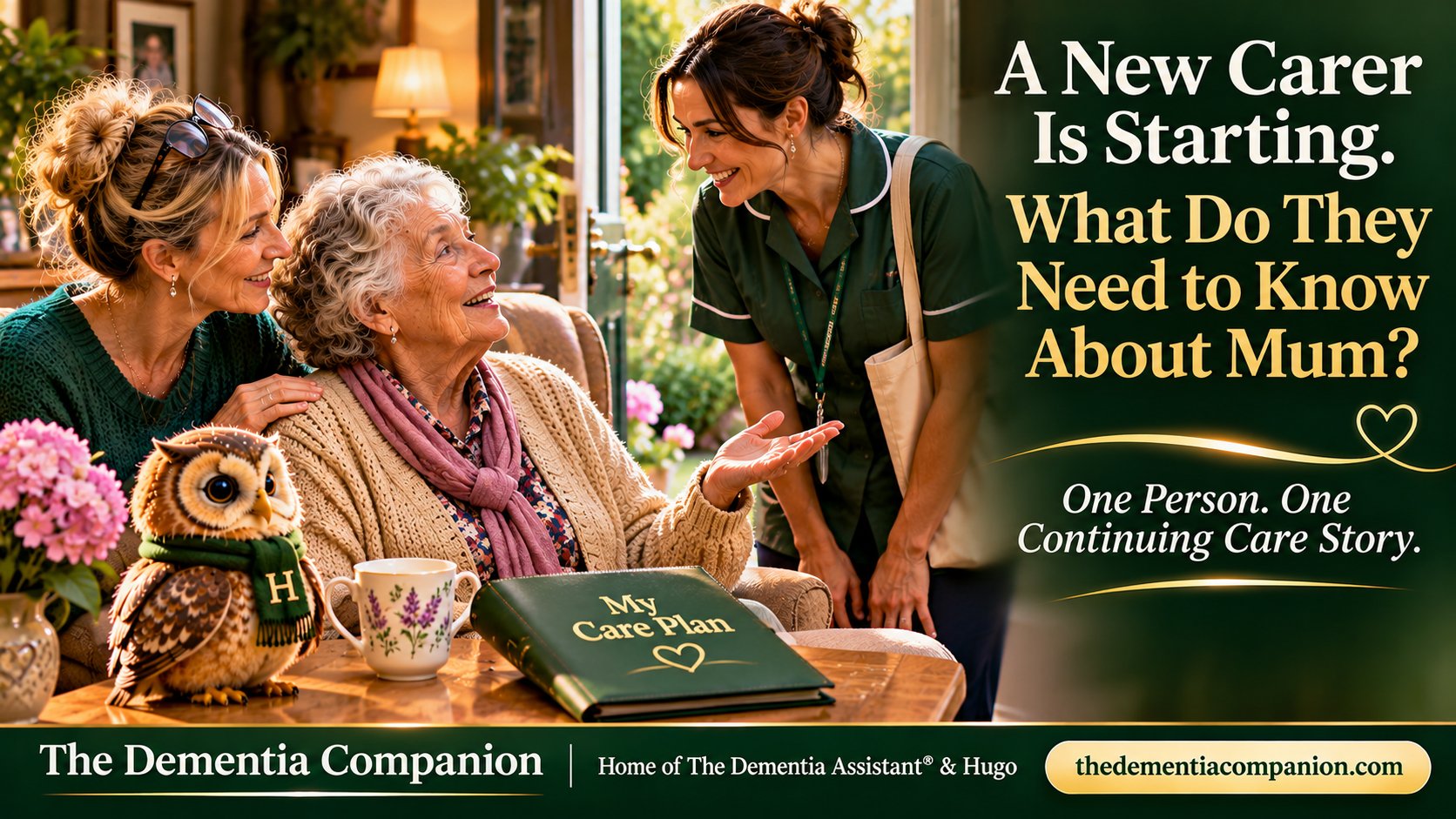
A New Carer Is Starting. What Do They Need to Know About Mum?
The new carer may know about dementia. But do they know Mum? Helping someone new understand the person behind the diagnosis.
By Louise Donaghy, Dementia Practitioner, Founder of The Dementia Companion and The Dementia Assistant®, Creator of Hugo Intelligence™
There’s a particular kind of nervousness that comes with introducing a new carer into someone’s home.
Especially when that someone is your mum.
You want the extra support. You know it could make life easier. Perhaps you’ve spent weeks arranging it.
But now the first visit is approaching and you’re wondering how it will go.
Will Mum like them?
Will they speak to her properly?
Will they know she hates being rushed?
What if Mum tells them she doesn’t need any help and sends them straight back out of the door?
And perhaps, underneath all those questions, there’s another worry.
Will this person see Mum, or will they only see her dementia?
The best way to prepare for a new dementia carer is to involve the person living with dementia, introduce the carer gently, explain important routines and communication preferences, and make sure any necessary care arrangements are understood.
A personalised care plan can help.
But the most important introduction isn’t a list of tasks.
It’s an introduction to the person.
Why can a new carer feel unsettling for someone with dementia?
Imagine sitting in your favourite chair when somebody you’ve never met arrives at your door.
They know your name.
They know things about your health.
And apparently, they’re here to help you get washed, dressed or ready for the day.
You might reasonably wonder who invited them.
You might feel uncomfortable.
You might even think everybody has lost their minds.
For a person living with dementia, an unfamiliar visitor can sometimes create additional uncertainty, particularly if they have difficulty remembering arrangements or understanding why support has been introduced.
But that does not mean every person with dementia will react badly.
Some people welcome companionship and practical help.
Others prefer to build trust gradually.
The starting point should always be the person’s feelings, wishes and understanding.
Not simply whether the visit has been scheduled.
NICE guidance emphasises supporting people living with dementia to participate in decisions about their care, respecting their individual preferences and adapting communication to their needs.
How should we introduce a new carer to Mum?
Where possible, begin before the first formal care visit.
Talk with Mum about what support she wants or might find helpful.
Rather than announcing:
“Someone is coming to look after you because you can’t manage anymore.”
Try something more collaborative:
“I thought it might be helpful to have someone visit and give you a hand with a few things. What do you think?”
If she is comfortable with the idea, involve her in choosing how the introduction happens.
Perhaps she would prefer a short introductory visit.
Perhaps she wants you to be present.
Perhaps she’d rather meet the new person over a cup of tea before discussing practical support.
There’s no universal approach.
And please don’t assume Mum has lost the right to decide simply because she has dementia.
Decision-making capacity depends on the individual decision and circumstances. Appropriate support should be offered to help the person participate.
Start with familiarity, not a checklist
A new carer doesn’t need to know every detail of Mum’s life within the first five minutes.
But finding something familiar to talk about can help build rapport.
Perhaps Mum loves gardening.
Perhaps she has a dog who considers himself the official household receptionist.
Perhaps she enjoys discussing old films.
Perhaps she has strong opinions about the correct way to make a cup of tea.
Those details provide a starting point for human connection.
The first visit may be more successful if the carer takes time to listen and learn, rather than immediately focusing on completing tasks.
What should a new dementia carer know about the person?
A good introduction should include the person’s strengths, preferences and any information necessary for safe, respectful care.
I would begin with these seven areas.
- Mum’s identity and life story
Who is she?
What has mattered to her throughout life?
What does she enjoy talking about?
What relationships are important?
What makes her laugh?
These aren’t irrelevant details.
They help someone understand the person they’re supporting.
For example:
“Mum worked as a teacher for many years. She loves gardening, enjoys classical music and is very proud of her grandchildren.”
That tells a new carer much more than:
“Female, 82, Alzheimer’s disease.”
The diagnosis is relevant.
But it isn’t the introduction.
- Her preferred name and communication style
How does Mum like to be addressed?
Does she prefer her full name or a familiar nickname?
Does she need extra time to answer?
Does she find several questions at once confusing?
Does she have hearing or sight difficulties?
Does she prefer a particular language?
You might explain:
“Please speak directly to Mum, rather than asking me questions about her while she’s sitting there. She may need a little extra time to reply.”
A small adjustment in communication can make an enormous difference to how respected and comfortable somebody feels.
- Her daily routines
We all have routines.
And many of us become rather particular about them as we get older.
I certainly wouldn’t appreciate somebody appearing at my door and announcing that breakfast now happens at six-thirty because that’s what their schedule says.
Mum may feel exactly the same.
Does she prefer to wash before breakfast?
Does she like choosing her own clothes?
Does she enjoy sitting quietly with the newspaper?
Are there regular activities she wants to continue?
A good care arrangement should accommodate the person’s familiar routines wherever reasonably possible.
Professional care schedules matter, but they should not automatically override every personal preference.
- What Mum can still do independently
This is particularly important.
A new carer might hear the word dementia and assume Mum needs help with everything.
But perhaps she still chooses her own clothes.
Perhaps she enjoys preparing simple meals.
Perhaps she can wash independently with a little verbal prompting.
Perhaps she manages beautifully once she has enough time.
Good care should support independence, not unnecessarily replace it.
Explain what Mum wants to do for herself and where she welcomes assistance.
The goal is to work with her, not take over.
- What helps when she feels worried or uncomfortable
Perhaps Mum becomes anxious when unfamiliar people enter her home.
Perhaps she dislikes being touched without warning.
Perhaps she needs procedures explained before they begin.
Perhaps she finds music reassuring.
You might record:
“Mum prefers people to introduce themselves before beginning care. Please explain what you’re doing and give her time to respond.”
This is practical, person-centred information.
It helps the carer support her respectfully.
But no single technique should be treated as guaranteed to work. The carer must respond to Mum’s needs and wishes in the moment.
- Her current care needs and relevant health information
The new carer also needs information relevant to the support they’re responsible for providing.
This may include:
- Mobility and assistance needs.
- Personal care preferences.
- Relevant allergies.
- Communication and sensory needs.
- Eating, drinking or swallowing requirements.
- Current risks identified through professional assessment.
- Medication support arrangements.
- Emergency contact details.
- The agreed care tasks and any clinical instructions.
Professional care providers must establish and follow their own appropriate assessments, care plans and procedures.
A family-held care plan can provide helpful background, but it doesn’t replace the provider’s responsibilities.
- Her wishes about privacy, dignity and sharing information
This matters enormously.
Mum may be comfortable discussing some things with family members but not others.
She may prefer a female carer for intimate personal care.
She may want privacy when dressing.
She may not want every relative informed about her health.
Her wishes should be respected as far as possible, alongside relevant legal and safeguarding requirements.
A diagnosis of dementia is not permission to disregard someone’s privacy.
Should the first visit just be a cup of tea?
Sometimes, yes.
If the person’s needs and the care arrangements allow it, a gentle introductory visit can help everyone get to know one another.
There is something lovely about a new carer sitting down and asking:
“How do you like your tea?”
Rather than arriving with a clipboard and immediately announcing:
“Right, let’s get you washed.”
Of course, some visits involve urgent or essential care that cannot be postponed.
But even then, introductions, explanations and asking permission should remain part of the interaction.
A short conversation can establish something important.
The carer is there to support Mum, not simply to complete a list of tasks in Mum’s house.
What if Mum says she doesn’t want a carer?
Take her concern seriously.
Try to understand what she is objecting to.
Does she feel she doesn’t need help?
Is she embarrassed?
Is she uncomfortable with a stranger?
Does she dislike the proposed timing?
Has she had a previous experience that made her wary?
Or does she simply want to make her own decisions?
Avoid automatically treating refusal as a symptom of dementia.
You might say:
“I understand you don’t want somebody coming in. What is it about the arrangement that worries you?”
Perhaps there is a different approach she would prefer.
A shorter visit.
A different time.
A different carer.
Or support with a task she genuinely wants help with.
If essential care is being refused and there are concerns about safety, capacity or serious unmet needs, seek appropriate professional advice.
Do not use deception or pressure as a routine way to overcome someone’s objections.
What if the new carer doesn’t understand Mum’s dementia?
This is a reasonable concern.
Dementia care requires more than kindness alone.
Care workers should have appropriate training, supervision and an understanding of person-centred support.
In England, CQC’s expectations for regulated home care include involving people in decisions, respecting their preferences and providing appropriate care.
NICE recommends dementia training that helps staff adapt communication and understand individual needs.
You can ask the provider:
- What dementia training has the carer received?
- How will the carer learn Mum’s preferences?
- How will her care plan be developed and reviewed?
- What happens if Mum is uncomfortable with the arrangement?
- How are concerns and changes communicated?
- Who should we contact if something isn’t working?
If the service is regulated, check the relevant care regulator and registration arrangements for your UK nation.
And remember that care quality isn’t measured only by whether someone arrives on time.
It is also about dignity, choice, communication, safety and how the person experiences the support.
Why should Mum’s care plan remain in the family’s hands?
Imagine Mum has had three different care workers over several months.
Each may be caring and capable.
But each is new to Mum.
Each needs to understand her routines.
Each may ask the same questions.
And every time someone changes, the family worries that important details will be forgotten.
This is where one continuing, family-held dementia care plan can make a real difference.
The Dementia Assistant® was designed to give people living with dementia and their families their own place to organise important care information.
A place to preserve:
- Life Story and personal preferences.
- Communication needs.
- Familiar routines.
- Strengths and independence.
- Relevant health information.
- Everyday observations.
- Important documents.
- Changes in support needs.
The family’s information can continue when a care worker changes, a different agency becomes involved or Mum attends another healthcare service.
Professional providers still need their own appropriate records and assessments.
But the person’s story need not depend entirely on one organisation.
Different carers. Different services. One Mum. One continuing care story.
Meet Hugo Intelligence™: Helping families prepare for a new carer
Sometimes you know exactly what you want to tell a new carer.
Other times, you have so much information in your head that you don’t know where to begin.
Perhaps you are worried about how Mum will respond.
Perhaps you want to explain her communication needs without making her sound difficult.
Perhaps you want to preserve her independence while making sure the support is safe.
You might ask:
“Hugo, Mum has a new carer starting next week. How can we introduce them gently?”
Or:
“Hugo, Mum hates being rushed in the morning. How can I explain this to the care agency?”
Or:
“Hugo, can you help me organise the important details from Mum’s care plan for her new carer?”
Hugo Intelligence™ provides conversational, person-centred dementia guidance within The Dementia Assistant®.
You can explain situations naturally, explore possible approaches and ask follow-up questions.
Hugo isn’t a replacement for a qualified care professional or safeguarding advice.
But he can help families think through what matters, organise their questions and prepare for constructive conversations.
Guidance based on Mum’s selected care plan
You can ask Hugo general dementia questions without selecting a care plan.
But when you choose Mum’s care plan, Hugo can use relevant information recorded about her routines, communication needs, preferences and circumstances to help provide more personalised guidance.
Rather than simply asking how to introduce a new carer to someone with dementia, you can explore approaches informed by Mum’s individual needs.
That is the difference between giving general advice and keeping the person at the centre.
Save and organise your conversations with Hugo
Perhaps you speak with Hugo before the first visit.
You return afterwards with questions about what happened.
A few weeks later, you want to revisit guidance about communication or daily routines.
Within The Dementia Assistant®, you can save, categorise and organise Hugo conversations.
This allows families to return to useful discussions without starting from the beginning each time.
The saved conversations aren’t substitutes for the provider’s professional records or instructions.
They are a continuing source of guidance and reflection for the family.
Why Hugo’s multilingual support matters when a new carer starts
Imagine Mum grew up speaking Welsh.
Or perhaps her first language was Irish, Spanish, French or Hindi.
She may have used English comfortably for many years but still feel most at ease communicating in another language.
Some people living with dementia experience changes in how easily they use different languages, although this varies considerably.
A new carer should know the person’s preferred language and communication needs.
And families should be able to explain those preferences clearly.
The Dementia Assistant® provides 12 interface languages, alongside dictation and translation capabilities covering 201 languages.
These tools can help families organise information and communicate across language barriers.
They may be particularly valuable when relatives live in different countries or when care information needs to be discussed in more than one language.
For example, a family might record a person’s language preferences within their care plan, use dictation to capture everyday observations and translate relevant information to support understanding.
Not every feature is available in all 201 languages, and important clinical instructions must be checked for translation accuracy.
Qualified interpreting support may also be necessary for significant care and consent discussions.
Language is part of identity. Good dementia care should respect it.
How can we help the new carer and Mum build trust?
Trust rarely appears because a care plan says it should.
It develops through experience.
A carer arriving when expected.
Introducing themselves.
Asking before helping.
Listening to Mum.
Respecting her preferences.
Not making her feel hurried.
And recognising the things she can still do.
Families can support that relationship by sharing helpful information, encouraging clear communication and raising concerns respectfully.
But the relationship should be between the carer and Mum too.
She is not simply somebody the family is handing over.
She is the person receiving support.
Her experience matters.
What should we do after the first few visits?
Ask Mum what she thinks.
Not simply whether the carer completed everything on the task list.
Ask:
“How did you feel with them?”
“Was there anything you particularly liked?”
“Was there anything you weren’t comfortable with?”
You might also review:
- Whether agreed care tasks are being completed.
- Whether Mum’s independence is respected.
- Whether communication is working well.
- Whether her routines are being understood.
- Whether any concerns need discussing.
- Whether the care plan needs updating.
If Mum reports feeling unsafe, experiences disrespectful treatment or you notice possible abuse or neglect, raise safeguarding concerns promptly through the appropriate provider, local authority or relevant service.
A family-held care record may help you organise factual observations, but serious concerns must be reported rather than simply documented.
A new-carer introduction checklist for families
Before the first visit, or during the first few days, consider:
- [ ] Mum has been involved in the arrangements as far as possible.
- [ ] The carer knows how Mum prefers to be addressed.
- [ ] Her communication and language preferences are understood.
- [ ] Her usual routines and personal choices are explained.
- [ ] Her strengths and independent abilities are recognised.
- [ ] Important health and safety information is available.
- [ ] Agreed care tasks and professional instructions are clear.
- [ ] Mum’s privacy, dignity and consent are respected.
- [ ] Relevant personal information is shared appropriately.
- [ ] The family knows who to contact with questions.
- [ ] Mum has an opportunity to express how she feels about the arrangement.
- [ ] The care plan can be reviewed if her needs or wishes change.
This doesn’t need to be an enormous document.
A short, thoughtful introduction can be much more helpful than twenty pages nobody has time to read.
The carer may be new. Mum isn’t.
That’s the point I want families to remember.
Mum has a lifetime of experiences.
Relationships.
Memories.
Preferences.
Habits.
A sense of humour.
Perhaps a slightly suspicious attitude towards anyone who makes tea with the milk first.
And all of that remains important.
A new carer might be meeting her for the first time.
But Mum shouldn’t have to become a new person every time a different professional arrives.
Her story deserves continuity.
One Person. One Continuing Care Story.
And the more we help others understand the person, the more opportunities we create for respectful, meaningful care.
⸻
Ask Hugo: Introducing a New Carer to Someone With Dementia
Hugo, Mum has a new carer starting. How should we introduce them?
Hugo 🦉: Begin with Mum’s wishes and how she feels about the arrangement.
If possible, introduce the new carer gently, allow time to get acquainted and explain the support in a way Mum understands.
Familiar routines and a relaxed conversation may help, but every person is different.
What should I tell the new carer about Mum?
Hugo 🦉: Share information relevant to understanding Mum as a person, including her preferred name, communication needs, routines, strengths and what matters to her.
Also make sure necessary health and safety information is available through the appropriate care arrangements.
What if Mum doesn’t want the new carer?
Hugo 🦉: Take her concerns seriously.
Try to understand whether she feels uncomfortable, wants more independence or prefers a different arrangement.
Explore choices with her rather than automatically assuming refusal is caused by dementia.
Seek appropriate professional support if essential care needs or safety concerns cannot be resolved.
Can Hugo help us prepare a person-centred introduction?
Hugo 🦉: Yes. I can help you think through what a new carer might need to understand about Mum’s routines, preferences, communication and strengths.
When you select Mum’s care plan, I can use relevant recorded details to make the guidance more individualised.
Can I save our conversations with Hugo?
Hugo 🦉: Yes. You can save, categorise and organise our conversations in The Dementia Assistant®.
You can return to earlier guidance as Mum’s care arrangements develop.
Can The Dementia Assistant® help us keep Mum’s care information together?
Hugo 🦉: Yes.
You can maintain a personalised care plan, daily notes, documents, Life Story information and other relevant records.
The family-held plan can continue as carers and services change, subject to your account arrangements and the person’s permissions.
What if Mum’s preferred language isn’t English?
Hugo 🦉: The Dementia Assistant® includes 12 interface languages and dictation and translation capabilities spanning 201 languages.
These can help families record information and communicate across language barriers.
Important care instructions and consent discussions should be checked with appropriate professionals or interpreters.
Can family members share updates about the new care arrangements?
Hugo 🦉: Family Circle features can support appropriate sharing of information with relatives who have the necessary permissions.
Mum’s privacy and wishes should remain central.
Does Hugo replace the professional care plan?
Hugo 🦉: No.
Professional providers remain responsible for their own assessments, care plans, staff training and safe care delivery.
The family’s own plan complements those records by preserving the person’s continuing story.
How much does The Dementia Assistant® cost?
Hugo 🦉: The Family subscription is £4.99 per month.
All subscriptions include a 30-day complimentary trial so you can explore personalised care planning, Hugo Intelligence™, saved conversations, daily notes and multilingual support.
⸻
One Person. One Continuing Care Story.
When someone living with dementia begins receiving support at home, different carers may become involved.
Some may stay for years.
Others may change because of shifts, holidays, illness or a change in care provider.
Every professional has responsibilities to understand the person’s needs and provide safe, respectful care.
But the person and their family should also have their own continuing place for the information that matters.
A place to preserve routines, wishes and personal history.
A place to record communication and language preferences.
A place to organise care information, observations and relevant documents.
And with Hugo Intelligence™, a place to ask questions, save conversations, explore personalised approaches and access multilingual tools.
The Dementia Assistant® was created to help people living with dementia and their families maintain their own continuing care information, even when the professionals around them change.
It complements professional care plans and clinical records. It does not replace them.
Different professionals. Different services. One person. One continuing story.
Meet Hugo and The Dementia Assistant®
Created by dementia practitioner Louise Donaghy and powered by Person-Centred Intelligence®, The Dementia Assistant® brings together:
- Hugo Intelligence™ for conversational, person-centred dementia guidance.
- Personalised family-held care plans.
- Guided care plan creation.
- Daily notes and observations.
- Documents and appointment information.
- Saved and categorised Hugo conversations.
- Life Story, Memory & Moments and Family Circle.
- Multilingual dictation and translation.
- Dementia learning and practical resources.
Every subscription includes a 30-day complimentary trial.
Explore The Dementia Assistant®:
https://thedementiaassistant.com/
The Dementia Companion, home of The Dementia Assistant® and Hugo 🦉
https://thedementiacompanion.com/
Louise and Hugo ❤️🦉
Louise Donaghy
Founder & CEO of The Dementia Assistant®
Created and powered by Person-Centred Intelligence®
Creator of Hugo Intelligence™
⸻
References and Further Reading
- NICE: Dementia, Assessment, Management and Support (NG97)
Guidance on person-centred dementia care, communication, training and involving people in their care decisions.
https://www.nice.org.uk/guidance/ng97/chapter/recommendations
- NICE: Home Care, Delivering Personal Care and Practical Support to Older People (NG21)
Recommendations on individualised home care, developing care plans, maintaining choice and involving the person in decisions.
https://www.nice.org.uk/guidance/ng21/chapter/recommendations
- Care Quality Commission: Regulation 9, Person-Centred Care
Explains the responsibilities of regulated providers in England to deliver care reflecting individual needs, preferences and choices.
- Care Quality Commission: What Can You Expect From a Good Home-Care Agency?
Guidance for people using care services on dignity, choice, communication and safe care.
- NHS: Help at Home From a Paid Carer
Information about home care, arranging support and accessing care needs assessments.
https://www.nhs.uk/social-care-and-support/care-services-equipment-and-care-homes/homecare/
- NICE: People’s Experience in Adult Social Care Services (NG86)
Recommendations about communication preferences, involvement in decisions and respectful, individualised support.
https://www.nice.org.uk/guidance/ng86/chapter/recommendations
- Care Quality Commission: Regulation 11, Need for Consent
Guidance about respecting consent and involving people in decisions about their care.
⸻
Important information: This article provides general educational guidance and does not replace professional care assessments, safeguarding procedures or legal advice. Care regulation and legal arrangements vary across England, Scotland, Wales and Northern Ireland.
Reviewed: 20 November 2026
You May Also Find Helpful
Need help with your own situation? Ask Hugo.
One Person. One Continuing Care Story. The Dementia Companion is where you discover guidance. Inside The Dementia Assistant®, talk with Hugo, save and categorise conversations, record daily notes and involve authorised supporters in a continuing care plan centred around the person.
Ask Hugo About This · Start Your Continuing Care Plan — Families · Continuing Care Planning — Professionals
Personal guidance requires the appropriate account and subscription access. Care-plan information is used only with authorised access and the required consent and selection steps. All subscription plans include a 30-day complimentary trial.