A dementia care plan should follow the person, not stay with one service. Discover how families can organise care information and support continuity with Hugo.
Dementia Care Plans: Why Families Need Their Own
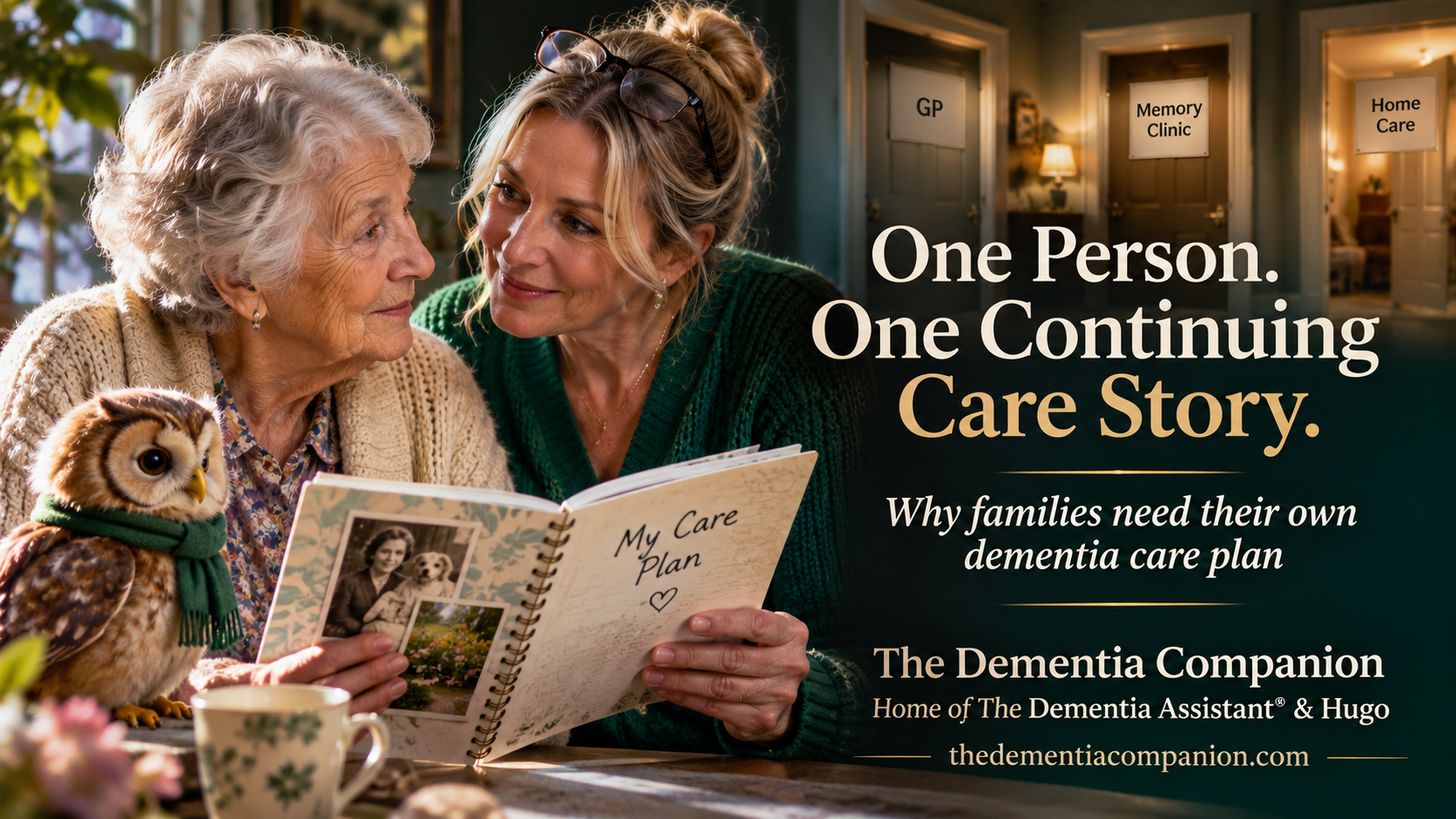
One person. One continuing care story. Because dementia care should not start from scratch every time a new professional becomes involved.
By Louise Donaghy, Dementia Practitioner, Founder of The Dementia Assistant® and The Dementia Companion, Creator of Hugo Intelligence™
There is something I find particularly frustrating about the way families often experience dementia care.
Not because the professionals involved don’t care. Many work incredibly hard, often under enormous pressure.
But because a person living with dementia can find themselves surrounded by different services, each keeping its own records, asking its own questions and seeing only one part of that person’s life.
The GP has a record.
The memory clinic has another.
The hospital has its own system.
The home care provider has a care plan.
The dementia nurse may have notes.
And somewhere in the middle is a family trying to keep track of everything.
Then somebody asks:
“Can you tell me a little bit about your mum?”
And the family begins explaining it all again.
Her diagnosis. Her medication. What upsets her. What makes her laugh. The fact that she hates being rushed, prefers tea in her favourite mug and needs a little time to find her words.
All those details that matter enormously when you’re supporting a real person, rather than reading a list of medical conditions.
Why should families have to keep starting from the beginning?
That question is one of the reasons I created The Dementia Assistant®.
Because I believe the person living with dementia and their family should have their own continuing record, one they can build, maintain and take with them throughout their care journey.
What is a dementia care plan?
A dementia care plan is a record of a person’s care needs, preferences, strengths, wishes and agreed support.
It should go beyond their medical diagnosis.
A good person-centred care plan helps people understand:
- Who the person is and what matters to them.
- What they can do independently.
- What support they welcome or need.
- How they prefer to communicate.
- Their familiar routines, interests and relationships.
- Relevant health conditions and medication.
- Changes that may need professional attention.
- How their support should be reviewed as circumstances change.
NICE guidance emphasises coordinated dementia care and support planning involving the person living with dementia, their family or carers as appropriate, and relevant professionals.
But there is another question worth considering.
What happens to all that knowledge when the person moves between services?
The problem with having ten different care records
Imagine someone has been living with dementia for several years.
They have attended memory clinic appointments, received support from their GP, spent time in hospital and begun receiving some assistance at home.
Each service has a legitimate reason to maintain its own records.
And those professional records are important.
But families can still find themselves repeating information or discovering that something significant hasn’t been communicated between services.
A hospital may know about medication and recent blood tests but not fully understand what helps the person feel safe.
A new care worker may have the correct list of daily tasks but not know that the person becomes distressed if someone enters their bedroom without knocking.
A family member may notice changes in sleep or eating that are difficult to explain accurately several weeks later.
And the person living with dementia may find themselves having to adapt to new faces, different routines and unfamiliar questions.
Of course, no single system can eliminate every communication gap.
But families having their own organised record can make it easier to preserve important information and prepare to share it when appropriate.
Who should be at the centre of the dementia care plan?
The person living with dementia.
Not the computer system.
Not the paperwork.
Not whichever organisation happens to be providing care that month.
The person.
As far as possible, they should be involved in deciding what information is recorded, who can access it and how it may be used.
Dementia does not automatically remove someone’s ability to make decisions.
Capacity is decision-specific, and any involvement by others must respect the person’s wishes, rights, appropriate consent and relevant legal arrangements.
For families, this means a care plan should never simply become a list of things everyone else has decided.
It should record the person’s voice.
Perhaps they want to continue visiting a familiar café.
Perhaps their morning walk is important.
Perhaps they want their daughter involved in appointments but would prefer to manage other matters themselves.
Those preferences deserve to be understood and respected.
Why does a family-managed dementia care plan matter?
There is a difference between having access to a care provider’s records and having a record of your own.
Professional care plans generally serve the responsibilities of the organisation providing care.
A family-maintained plan can offer a continuing place to organise information that matters across different appointments, services and stages of life.
- The person doesn’t have to be introduced from scratch
Imagine being able to explain someone’s preferred routines, important relationships, communication needs and personal history without relying entirely on memory.
Their story stays together.
- Important everyday changes can be recorded
Perhaps Dad has been sleeping poorly for several nights.
Perhaps Mum has been more withdrawn than usual.
Perhaps someone’s appetite has changed.
Recording what you notice can help you describe patterns more clearly to a healthcare professional.
It doesn’t mean making your own diagnosis.
It means having useful information available when you need to discuss concerns.
Sudden confusion or acute changes still require prompt medical assessment rather than simply being recorded and watched.
- Family members can be better informed
One relative might manage appointments.
Another might help with shopping.
A third might live abroad but want to remain involved.
With appropriate consent and permissions, shared information can help family members understand agreed care arrangements without everyone having to rely on separate messages and notebooks.
- Preparing for appointments becomes easier
Anyone who has accompanied a family member to a medical appointment will recognise this moment:
“Have you noticed any changes since the last review?”
And suddenly the last six weeks disappear from your memory.
You remember the important things in the car on the way home, naturally.
Having notes and relevant documents together can help you prepare questions and provide a clearer account of what has been happening.
- Information can continue as services change
From early concerns about memory through diagnosis, changing needs and later-life care, the person’s preferences and history remain important.
A family-maintained record can be updated as circumstances change, rather than being tied entirely to one provider.
What should families include in their own dementia care plan?
You do not need a thirty-page document to begin.
In fact, the best starting point is often a few meaningful details.
About the person
Record the person’s preferred name, important relationships, interests, background, routines and what matters most to them.
Communication
What helps them understand information?
Do they prefer being given one question at a time?
Is there a preferred language?
Do they use glasses, hearing aids or other communication support?
Health and appointments
Keep relevant diagnoses, medication information, professional contacts, appointments and reports organised.
Clinical information should be recorded accurately and checked with the appropriate professionals where necessary.
Everyday observations
Record relevant changes in mood, sleep, appetite, mobility, communication or everyday functioning.
Keep notes factual and respectful.
Preferences and support
What can the person manage independently?
What help do they want?
Are there routines or approaches that make everyday life easier?
Wishes and future planning
Where appropriate, include discussions about future preferences, decision-making and who the person wishes to involve.
A family-held care record does not replace legal documents, professional assessments or formal advance care plans.
But it can help keep important information accessible and organised.
How can The Dementia Assistant® help?
This is where I wanted to create something different.
Not another website offering pages of information and leaving a family wondering what to do with it.
And not a system that only belongs to a care provider.
The Dementia Assistant® is designed to give the person living with dementia and their family a place to organise and maintain their own care information.
With The Dementia Assistant®, families can:
- Create personalised, person-centred care plans.
- Use Hugo Intelligence™ to guide them through care-planning questions.
- Record daily notes and observations.
- Keep important documents and information organised.
- Preserve the person’s life story, preferences and memories.
- Prepare for appointments and care discussions.
- Use Family Circle features to support appropriate sharing of updates.
- Access dementia learning and practical guidance.
- Ask Hugo questions about everyday dementia situations.
- Use multilingual support and dictation tools.
One particularly useful feature is the connection between the care plan and Hugo.
You can ask Hugo general questions about dementia without selecting a care plan.
But when you choose a particular person’s care plan, Hugo can use the relevant information you have recorded to help provide more individualised, person-centred guidance.
For example, instead of asking only:
“Why does someone with dementia become distressed in the evening?”
You can explore what might help a particular person, considering their recorded routines, preferences and circumstances.
Hugo doesn’t know everything about a person and cannot diagnose why something is happening.
But having the person’s relevant information available can help make guidance more personal and useful.
Does The Dementia Assistant® replace NHS or professional care records?
No, and it shouldn’t.
GPs, hospitals, memory clinics and care organisations need their own professional records to meet their responsibilities.
A family-maintained dementia care plan is not a substitute for those records.
The purpose is different.
It provides the person and their family with their own continuing collection of care information.
Something they can maintain, review and share with professionals when appropriate, rather than relying entirely on information held by individual organisations.
Nor should families be expected to coordinate every aspect of care themselves.
In England, guidance from NICE and the Department of Health and Social Care recognises the importance of professional care coordination.
Families deserve professional support as well as practical tools.
What if someone has only just been diagnosed with dementia?
Then begin gently.
You don’t need to upload years of documents, complete every care-planning section or predict everything that may happen in the future.
Start with the person.
Ask them what matters most.
Record their familiar routines and preferences.
Add relevant health information when you’re ready.
Keep a note of questions for the next appointment.
Then build the care plan gradually.
Some people may continue living independently for a considerable time after diagnosis.
Good care planning should support that independence, not assume it has already disappeared.
Why this matters beyond the paperwork
A person’s identity is not held in a medical record.
It lives in their relationships, memories, habits, preferences, humour and everyday experiences.
The gentleman who has always preferred his tea strong.
The woman who loves dancing but insists she has two left feet.
The father who may struggle to remember an appointment but still knows exactly how he likes his garden.
These details help others understand the person behind the diagnosis.
They can make the difference between someone simply completing a care task and someone providing genuinely person-centred support.
The Dementia Assistant® was created to help families keep that information together, in their own hands, throughout the journey.
Not to take care away from professionals.
But to make sure the person doesn’t become lost between them.
⸻
Ask Hugo: Questions Families Ask About Dementia Care Plans
Hugo, why do we need our own dementia care plan if the GP already has records?
Hugo 🦉: Your GP’s records are important, but they serve a different purpose. Your own care plan can bring together the personal details, routines, everyday observations and preferences you want to keep organised across different services.
It helps you maintain a continuing picture of the person, not simply their medical appointments.
Can we start a dementia care plan before diagnosis?
Hugo 🦉: Yes. You can begin recording what matters to the person, important routines and any concerns you want to discuss with a healthcare professional.
You do not need to wait for a diagnosis to begin organising information.
But the care plan is not a diagnostic tool. Concerns about memory or changes in functioning should be assessed by an appropriate healthcare professional.
Will we lose our care plan if we change care providers?
Hugo 🦉: The Dementia Assistant® is designed so that families maintain their own care information independently of a particular care provider.
You can continue using your own care plan as services change, subject to your account and access arrangements.
Professional records held by a care provider remain separate.
Can Hugo help us write the care plan?
Hugo 🦉: Yes. I can guide you through the process one question at a time, helping you consider the person’s preferences, daily life, strengths and support needs.
You remain responsible for reviewing the information and making sure it accurately reflects the person.
Can Hugo help with GP and memory clinic appointments?
Hugo 🦉: You can use The Dementia Assistant® to organise documents, record relevant observations and prepare information or questions for appointments.
That can make it easier to explain what has changed since the last review.
Is The Dementia Assistant® for families or professional organisations?
Hugo 🦉: Both can use it, but families do not need to belong to a care organisation to have their own account and care plan.
The person living with dementia and their family can maintain their own information, while professionals and organisations may use their own appropriate tools and arrangements.
The aim is to keep the person at the centre.
How much does it cost to have our own dementia care plan?
Hugo 🦉: The Dementia Assistant® Family subscription is £4.99 per month, with a 30-day complimentary trial included with every subscription.
You can explore the care-planning tools and discover how they might help your family before deciding whether to continue.
⸻
One Person. One Continuing Care Story.
A family may encounter many professionals during a dementia journey.
Different people. Different appointments. Different organisations.
But the person at the centre is still the same person.
Their history matters.
Their preferences matter.
Their wishes matter.
And their family should have a practical way to keep that information together.
That is the idea behind The Dementia Assistant®.
Your life. Your care plan. Your information. With you throughout your dementia journey.
Meet Hugo and Start Your Own Care Plan
Explore The Dementia Assistant® and its 30-day complimentary trial.
https://thedementiaassistant.com/
For dementia guidance, articles and family resources, visit The Dementia Companion.
https://thedementiacompanion.com/
Louise and Hugo ❤️🦉
Louise Donaghy
Founder & CEO of The Dementia Assistant®
Created and powered by Person-Centred Intelligence®
Creator of Hugo Intelligence™
⸻
References and Further Reading
- NICE: Dementia, Assessment, Management and Support (NG97)
National recommendations covering person-centred dementia care, care coordination and care planning.
https://www.nice.org.uk/guidance/ng97/chapter/recommendations
- NICE: Coordinating Care, Dementia Quality Standard (QS184)
Guidance on coordinated care, reviewing care plans and involving the person and relevant carers and professionals.
https://www.nice.org.uk/guidance/qs184/chapter/quality-statement-4-coordinating-care
- NHS: Help and Support for People with Dementia
Information about care plans, support services and help for families following diagnosis.
https://www.nhs.uk/conditions/dementia/care-and-support/help-and-support/
- GOV.UK: After a Diagnosis of Dementia, What to Expect from Health and Care Services
Official guidance for England about care coordination, care planning and post-diagnostic support.
- NHS: Just Diagnosed with Dementia
Information about early decisions, maintaining wellbeing and planning for the future.
https://www.nhs.uk/conditions/dementia/symptoms-and-diagnosis/just-been-diagnosed/
⸻
Important: This article provides educational guidance, not medical or legal advice. Families should seek professional advice for individual health, care, capacity and safeguarding decisions. Some service and legal arrangements vary across the UK.
Reviewed: 20 November 2026
You May Also Find Helpful
Need help with your own situation? Ask Hugo.
One Person. One Continuing Care Story. The Dementia Companion is where you discover guidance. Inside The Dementia Assistant®, talk with Hugo, save and categorise conversations, record daily notes and involve authorised supporters in a continuing care plan centred around the person.
Ask Hugo About This · Start Your Continuing Care Plan — Families · Continuing Care Planning — Professionals
Personal guidance requires the appropriate account and subscription access. Care-plan information is used only with authorised access and the required consent and selection steps. All subscription plans include a 30-day complimentary trial.