Why Does Mum Only Want Sweet Foods? Dementia and Changing Food Preferences.
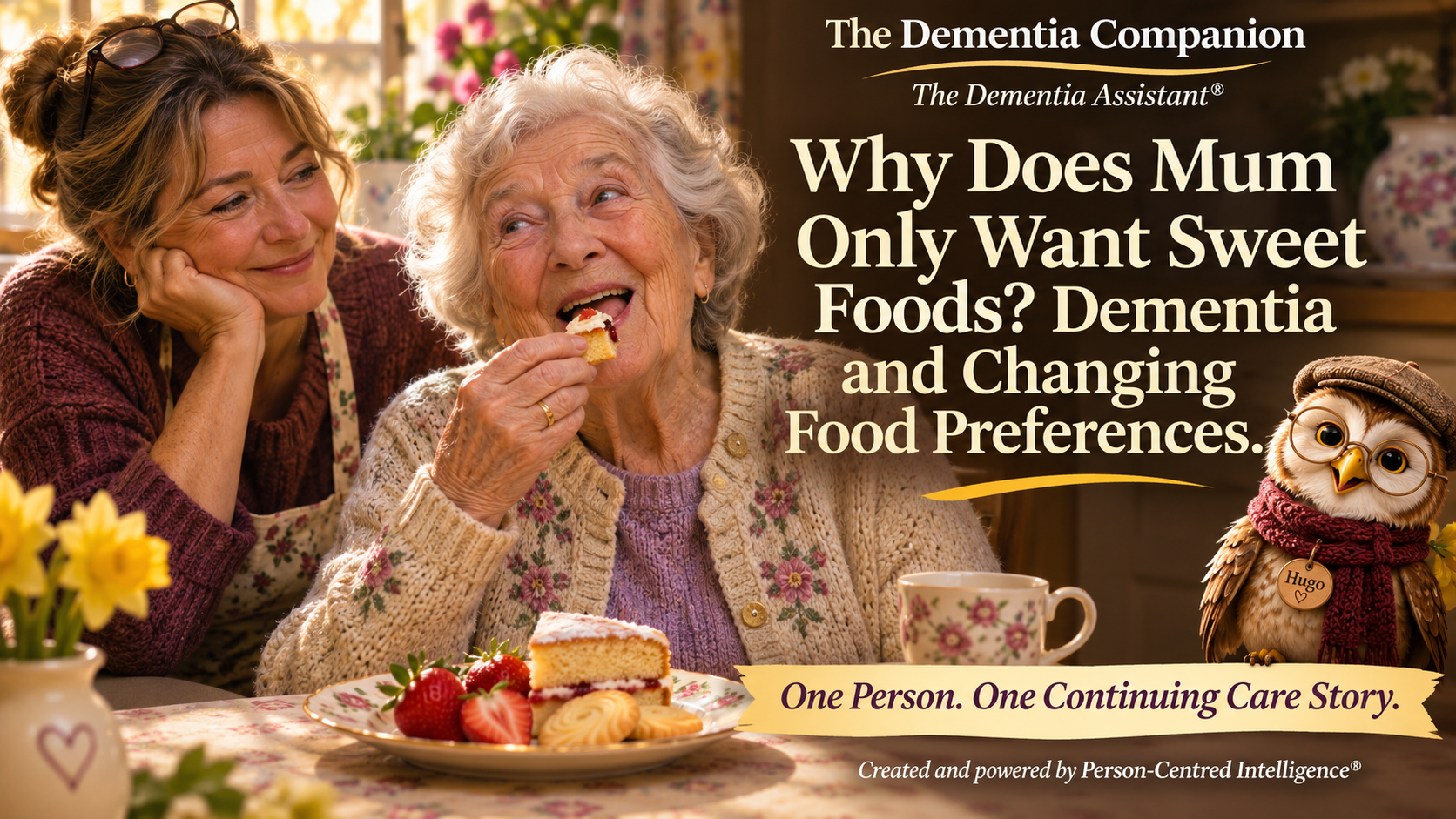
Why Does Mum Only Want Sweet Foods? Dementia and Changing Food Preferences.
By Louise Donaghy | The Dementia Companion | One Person. One Continuing Care Story.
There was a time when Mum enjoyed a proper Sunday roast, her vegetables, a nice bit of fish and perhaps a small pudding afterwards.
Now?
The roast dinner sits untouched, the vegetables receive a look of absolute disgust, and Mum is eyeing up the chocolate biscuits as though they are the most important part of the food pyramid.
You have spent an hour preparing her favourite meal. She takes one look, pushes the plate away and announces that she would rather have cake.
And not just any cake. The exact cake she had yesterday. Preferably served with another biscuit.
You might find yourself wondering, What on earth has happened to Mum’s appetite? Is she getting enough nutrition? Should I stop giving her sweets?
And perhaps, very quietly, Why did I bother cooking?
If this sounds familiar, you are certainly not alone.
Changes in food preferences are common in people living with dementia. Someone who previously enjoyed savoury meals may begin craving sweet foods, while familiar favourites suddenly become unappealing.
But there is something important to understand.
Mum is not necessarily being difficult, deliberately refusing your cooking or trying to live entirely on chocolate digestives. Her experience of food may genuinely have changed.
Understanding why gives us a better opportunity to support her nutritional needs without turning every mealtime into a battle.
Because food is about far more than calories. It is about comfort, familiarity, culture, pleasure, independence and sometimes one of the few remaining opportunities to make a choice.
And those things matter enormously.
Why does dementia change someone’s taste in food?
Dementia affects the brain, and the brain plays an important part in how we experience food.
It helps us recognise flavours, interpret smells, notice hunger, understand when we are full, make decisions and carry out the sequence of actions involved in eating.
As dementia progresses, some of these abilities can change.
The Alzheimer’s Society explains that changes in taste and smell can make familiar foods less appealing. Some people begin preferring stronger flavours, including sweeter foods.
There is no single explanation that applies to everyone.
- Sweet flavours may be more appealing
As people age, their sense of taste and smell may become less sensitive. Dementia can add further changes to how food is perceived.
A meal that once tasted delicious might now seem bland, unfamiliar or unpleasant.
Sweet foods may still be enjoyable because their flavour is appealing or easier for that individual to appreciate.
Imagine eating your favourite meal and discovering that it tastes nothing like you remember.
You might start looking for something else too.
- Changes in the brain may influence appetite and preferences
Different types of dementia affect different brain networks.
In some people, the changes can influence food choices, appetite, inhibition and the recognition of fullness.
For example, frontotemporal dementia can sometimes cause significant changes in eating behaviour, including a strong preference for sweet foods, overeating or repeatedly seeking food.
However, developing a sweet tooth does not mean someone has frontotemporal dementia.
Sweet cravings can occur with other types of dementia and for reasons unrelated to dementia.
If changes are sudden, marked or accompanied by other new symptoms, a healthcare professional should assess them rather than simply attributing them to the diagnosis.
- Familiar foods may feel reassuring
Food carries memories, emotions and associations.
Perhaps Mum grew up having bread and jam for tea.
Perhaps her grandmother baked cakes every Sunday.
Perhaps a particular biscuit reminds her of sitting beside the fire with her family.
She may not be able to explain these associations, and we should never assume that we know what she is remembering.
But familiar foods, smells and routines can sometimes provide comfort when other parts of life feel uncertain.
That slice of cake may represent more than something sweet.
It might be familiar, comforting or simply something she still thoroughly enjoys.
- Sweet foods may be easier to eat
Sometimes the attraction is not just sweetness.
Think about the difference between a soft sponge pudding and a plate of chewy meat.
A soft dessert may require less chewing.
If Mum has sore gums, dental problems, poorly fitting dentures, a dry mouth or difficulty managing certain textures, she may begin choosing foods that feel easier.
She may not be able to tell you that chewing hurts.
Instead, she might simply refuse the meal.
This is why a change in food preference deserves curiosity rather than assumptions.
And remember that not all sweet foods are easy or safe to swallow. Sticky sweets, crumbly biscuits and mixed textures can also present difficulties for someone with swallowing problems.
Is Mum choosing sweet foods because she has forgotten what she likes?
Possibly, but it would be too simple to assume that memory loss is the only explanation.
Dementia can affect recognition, decision-making, attention and the ability to communicate preferences.
Mum may look at a plate of food and struggle to identify what is there.
Too many different items might feel confusing.
She may also have difficulty understanding what to do next, especially if several things are happening around her.
Now imagine offering her a familiar piece of cake.
One item.
One recognisable shape.
One flavour she enjoys.
It might feel much easier.
This does not mean she has forgotten every food she once loved.
Her preferences may be changing, her ability to make choices may be changing, or the presentation of the meal may be making eating more difficult.
Sometimes the most helpful question is not:
Why won’t Mum eat her dinner?
It is:
What is Mum experiencing when we put this dinner in front of her?
That question can change the entire approach.
Should I stop giving Mum biscuits, chocolate and cake?
Not automatically.
We need to consider the person’s overall health, nutritional needs, personal wishes and quality of life.
Of course, eating almost nothing but sweets can leave someone short of important nutrients.
Protein supports muscle maintenance, while a varied diet helps provide vitamins, minerals and fibre.
Excessive sugary foods can also contribute to dental problems and may make diabetes management more difficult.
But there is another side to this conversation.
If Mum has a very poor appetite, is losing weight or is struggling to eat enough, the priorities may be different from those of someone who is eating well and gaining excessive weight.
A dietitian or other appropriate healthcare professional can help identify what matters most for her particular situation.
A little pleasure is not a nutritional failure
If Mum enjoys a small slice of cake with her afternoon tea, there may be no good reason to take that pleasure away.
Food should not become a constant negotiation about what she is allowed to have.
Consider the wider picture.
What has she eaten throughout the day?
Is she maintaining her weight?
Is she drinking enough?
Does she have diabetes, swallowing difficulties or other medical needs?
Does the food bring her pleasure?
The goal is not to eliminate every sweet food.
It is to support adequate nutrition, safety, dignity and enjoyment.
And sometimes that means allowing the chocolate biscuit to remain exactly where it belongs: beside a lovely cup of tea.
Seven practical ways to support someone who only wants sweet foods
- Work with the preference rather than against it
If Mum is enjoying sweet flavours, try incorporating naturally sweet ingredients into nutritious meals and snacks.
Depending on her dietary and swallowing needs, possibilities include:
- Porridge with mashed banana, stewed apple or cinnamon.
- Plain or Greek yoghurt with soft fruit.
- Rice pudding or custard alongside other nutritious foods.
- Smooth fruit yoghurt or a suitable fruit-and-milk drink.
- Soft pancakes with fruit and yoghurt.
- Mashed sweet potato alongside a savoury meal.
- Soft cooked carrots or butternut squash.
- A small portion of a favourite pudding after a meal.
These are examples, not a diet that will suit everyone.
If Mum is losing weight, ordinary lower-calorie substitutions may not be appropriate. If she has diabetes, kidney disease, allergies or swallowing problems, food choices may require professional advice.
The aim is to widen the range of foods she can enjoy, not to disguise everything she eats.
- Offer smaller portions more frequently
A large dinner can sometimes feel overwhelming.
Instead of insisting on three substantial meals, consider smaller meals and snacks across the day.
Perhaps Mum manages a little breakfast, yoghurt later in the morning, a small lunch and another snack in the afternoon.
If she is at risk of malnutrition, a dietitian can help develop a plan that provides sufficient energy and nutrients.
Smaller portions can also make the plate appear less intimidating.
And there is something rather lovely about finishing a meal and being offered a little more, rather than staring helplessly at a mountain of potatoes.
- Pay attention to texture and comfort
Notice which foods Mum accepts.
Does she enjoy soft foods but avoid chewy meat?
Does she struggle with crusty bread?
Does she take longer to chew?
Is she leaving food in her mouth?
Could a dental problem be making eating uncomfortable?
A dental assessment may be helpful, especially if there are signs of pain, sore gums or poorly fitting dentures.
If swallowing difficulties are suspected, seek advice from a speech and language therapist or speech-language pathologist.
Do not independently change someone to thickened drinks or a texture-modified diet without appropriate assessment and guidance.
- Reduce distractions during meals
Mealtimes can become surprisingly complicated.
The television is on.
Someone is asking questions.
A telephone is ringing.
Three different foods are touching on the plate.
And Mum is expected to concentrate, recognise the meal and use her cutlery.
Try creating a quieter environment.
Sit together if she enjoys company.
Offer simple choices rather than lots of questions.
Make sure the food is clearly visible, with suitable contrast between the plate and the food.
Give her time.
Sometimes making the environment easier can be more effective than changing the recipe.
- Respect independence
Mum may still be able to feed herself, choose between foods or take part in simple food preparation.
These abilities deserve encouragement.
Perhaps she enjoys spreading something on toast, stirring a bowl or selecting a biscuit from a plate.
Offer assistance when it is needed, but avoid taking over tasks she can still manage safely.
Having dementia does not mean someone stops being entitled to preferences.
We should be supporting choices, not removing them because they are inconvenient.
- Keep familiar food traditions
Perhaps Sundays were always roast-dinner days.
Perhaps Friday meant fish.
Perhaps Mum never considered an afternoon complete without tea and something homemade.
These traditions may remain important even when her tastes change.
Could you adapt the meal while keeping the familiar occasion?
A small portion of roast dinner with a favourite sweet accompaniment may work better than insisting she eat everything.
The family can still sit together.
The familiar routine can continue.
And Mum can still belong at the table.
- Notice what happens, rather than just what is left
A food diary can reveal patterns that are easy to miss.
You might discover Mum eats more in the morning.
Perhaps she refuses lunch because she is tired.
Maybe she eats better with one particular family member.
Perhaps she drinks more when offered a favourite cup.
Or maybe she enjoys food when she is allowed to eat at her own pace.
These observations can be useful when discussing changes with a healthcare professional.
They also help us see the person behind the behaviour.
What can I say when Mum refuses dinner and asks for cake?
It is completely understandable to feel frustrated.
You have prepared the food, you are worried about her nutrition, and now she is asking for a second pudding.
But correcting, arguing or insisting she finish everything may increase distress.
Consider a calmer approach.
Instead of:
“Mum, you’ve got to eat your dinner. You can’t just have cake.”
Try:
“You’re not fancying that today, are you? Shall we try a little something different?”
Instead of:
“You’ve already had three biscuits!”
Try:
“You’ve enjoyed those, haven’t you? Let’s have a little drink together, and we can see what you’d like next.”
Instead of:
“You used to love this. Why won’t you eat it?”
Try:
“That doesn’t seem to be what you fancy today. Would you prefer something softer?”
Instead of:
“You need vegetables. They’re good for you.”
Try:
“Would you like to try a little of this with me?”
The words are not magic solutions.
Mum may still refuse.
And that’s all right.
The important thing is to stay curious and respectful.
If the first approach does not work, consider whether the timing, environment, portion, texture or type of food could be changed.
Sometimes trying again later is better than pushing harder.
What if Mum wants to eat sweets all day?
A strong or persistent drive to eat can sometimes occur with dementia, particularly some forms of frontotemporal dementia.
A person may repeatedly seek food, forget they have eaten, struggle to recognise fullness or develop very strong preferences.
However, repeated requests for food can also have other explanations.
Mum might genuinely be hungry.
Her meals might not be satisfying.
She could be anxious or bored.
Or she may simply enjoy the food.
Before making assumptions, consider the pattern and whether her overall intake is adequate.
Practical support might include establishing predictable meals and snacks, offering satisfying alternatives, keeping suitable food accessible and finding enjoyable activities between meals.
If she is eating excessively, rapidly gaining weight, consuming unsafe quantities or experiencing a sudden change in behaviour, seek a medical assessment.
Avoid making food a punishment, hiding essential nourishment or using restrictions that unnecessarily remove the person’s autonomy.
If there are safety concerns, develop an individual plan with appropriate professional advice.
What about diabetes and other medical conditions?
This is an important area where individual guidance really matters.
If Mum has diabetes, a strong preference for sweet foods may make maintaining blood glucose levels more complicated.
However, removing every sweet food without considering her medications, appetite, weight, frailty and overall health may not be appropriate either.
Speak with her diabetes clinician or dietitian about balancing enjoyment with safe dietary management.
The same principle applies to other conditions requiring particular dietary approaches, including kidney disease, food allergies and coeliac disease.
Avoid changing prescribed medication or medical diets independently.
And remember, the needs of a person who is underweight and struggling to eat may be very different from those of someone whose intake is excessive.
Person-centred care means adapting the support to the individual, not expecting every individual to fit the same rules.
Why hydration matters just as much as food
When we become concerned about what someone is eating, it is easy to overlook what they are drinking.
Dementia can affect someone’s awareness of thirst, ability to recognise drinks and ability to ask for them.
Dehydration can contribute to weakness, constipation, dizziness and increased confusion.
Offer drinks regularly throughout the day, taking account of any professional advice about fluid restrictions or swallowing safety.
Some people enjoy familiar drinks more than plain water.
Others may prefer a warm milky drink, tea, flavoured water or another suitable option.
Foods containing fluid, including yoghurt and some soft fruits, may also contribute to hydration.
Notice what the person enjoys and what they can manage safely.
If fluid intake becomes very low, seek medical advice promptly.
When is a change in eating habits a warning sign?
Not every change is caused by dementia.
A sudden refusal of food, significant change in appetite or new difficulty eating should not automatically be accepted as part of the condition.
Possible contributing problems include:
- Dental pain, mouth ulcers or poorly fitting dentures.
- Constipation, reflux, nausea or other digestive discomfort.
- Infection or another acute illness.
- Side effects of medication.
- Low mood or depression.
- Dehydration.
- Difficulty recognising food or organising the actions needed to eat.
- Changes in chewing or swallowing.
- Problems with food texture, temperature or the eating environment.
Contact a healthcare professional if Mum is losing weight unintentionally, eating substantially less, refusing fluids, showing signs of pain or developing persistent changes in her eating habits.
Sudden confusion, unusual drowsiness or a rapid decline also require prompt medical assessment.
Signs of possible swallowing difficulties
Look out for coughing or choking during meals, a wet or gurgly voice after swallowing, repeated chest infections, food remaining in the mouth or increasing difficulty managing food and drinks.
Arrange a swallowing assessment if these occur.
If someone is choking and cannot breathe, speak or cough effectively, follow local emergency first-aid guidance and contact emergency services.
It is also important to recognise that eating difficulties may become more complex in advanced dementia. Decisions about nutrition and comfort should involve the person wherever possible, those appropriately involved in their care and relevant healthcare professionals.
The goal is always to support the individual’s needs, comfort and dignity.
A fictional example: When Margaret stopped eating her dinner
The following example is fictional and illustrates how a person-centred approach might work.
Margaret is 82 and lives with Alzheimer’s disease.
For years, she loved her roast dinners.
Her daughter Sarah still prepares one every Sunday because it has always been part of their family life.
Recently, Margaret has started refusing most of the meal.
She pushes the meat away, leaves the vegetables and asks for trifle.
Sarah worries that her mother is not eating properly.
At first, she tries to persuade Margaret to finish her dinner.
Margaret becomes upset, and Sundays begin to feel stressful.
Then Sarah changes her approach.
She starts noticing what Margaret actually manages.
The meat seems difficult to chew.
Large portions overwhelm her.
She appears more interested in eating earlier in the day.
Sarah arranges a dental check, makes a note of these observations and discusses Margaret’s changing appetite with her healthcare team.
She begins offering smaller portions of foods Margaret enjoys, with attention to nutrition and texture.
Sunday lunch becomes relaxed again.
Margaret still has her trifle.
But the conversation is no longer entirely about what she has refused.
Sarah has begun working with her mother’s changing needs rather than fighting them.
And that is an important difference.
How person-centred care planning can make mealtimes easier
One of the greatest difficulties families face is that knowledge about a person often becomes scattered.
One daughter knows Mum loves porridge.
Another knows she refuses cold drinks.
A care worker notices she struggles with certain textures.
A grandson discovers she will happily eat lunch when he sits beside her.
Meanwhile, the GP or primary-care clinician might only hear, “Mum isn’t eating properly.”
Every observation matters.
When those details are recorded together, they can help reveal patterns and support more consistent care.
This is the thinking behind The Dementia Assistant® and our campaign, One Person. One Continuing Care Story.
The person should not have to become a stranger every time someone new becomes involved in their care.
What a person-centred food and nutrition record might include
A useful care plan can record:
- Favourite foods and drinks, including cultural and religious preferences.
- Foods the person dislikes or is allergic to.
- Any medically advised dietary requirements.
- Important food traditions and comforting routines.
- Changes in appetite and taste.
- Preferred meal times.
- Foods and textures that appear easier or harder to manage.
- Any swallowing recommendations from qualified professionals.
- Dental concerns and discomfort.
- How much assistance the person wants or needs.
- Patterns of eating, drinking and weight changes.
- The person’s own expressed wishes and choices.
It should also record what helps someone enjoy a meal.
Perhaps Mum likes her tea in a particular cup.
Perhaps she prefers a familiar place at the table.
Perhaps she wants her pudding served separately.
These may sound like small details.
But to the person living with dementia, they can make a considerable difference.
Meet Hugo Intelligence™ — guidance that begins with understanding
Within The Dementia Assistant®, families can access Hugo Intelligence™, our person-centred conversational guidance system, created and powered by Person-Centred Intelligence®.
Hugo is designed to help families understand situations, explore possible explanations, consider practical responses and organise the information that matters.
He can help someone think through a difficult mealtime, understand changes in eating behaviour, prepare questions for a healthcare professional or consider ways to reduce distress.
And because family care does not conveniently happen between nine and five, families can return to guidance whenever they need it.
General guidance first. Personal guidance only when a care plan is selected.
There is an important distinction in how Hugo works.
Until a user explicitly selects an individual’s care plan, Hugo provides general guidance.
He does not automatically assume that a question concerns a particular person, and he should not present general advice as though he knows someone’s complete circumstances.
When the user deliberately selects the relevant care plan, Hugo can use the information available in that selected plan to help make responses more relevant to the individual.
For example, a general question might be:
“Why do people living with dementia sometimes prefer sweet foods?”
With Margaret’s care plan explicitly selected, a family member could ask:
“Margaret has started refusing savoury meals. Her care plan records that she enjoys porridge, soft fruit and traditional puddings. What could we consider, and what should we discuss with her healthcare team?”
Hugo can then help the family think through the situation using the context recorded for Margaret.
It is a difference between general information and guidance informed by the person’s continuing care story.
Hugo does not diagnose illness, prescribe treatment or replace a doctor, dietitian or swallowing specialist.
His role is to help families feel better informed, prepared and supported.
A family-held care plan that continues with the person
The Dementia Assistant® is built around a family-held person-centred care plan.
Rather than relying entirely on isolated appointments, pieces of paper or memories of previous conversations, the family can keep important information together.
The care plan can include routines, preferences, health information, observations, appointments and relevant documents.
That continuing record can support conversations with healthcare professionals and help families explain what has changed over time.
It does not automatically replace clinical records or mean that information is transmitted to a GP or another service without an appropriate sharing process.
The family remains central to how the story is organised and shared.
Daily notes — the small details that reveal the bigger picture
Daily observations can be especially useful when someone’s food preferences change.
Instead of simply recording “Mum refused dinner”, a more informative note might say:
“Monday, 12.30 pm: Mum declined chicken and vegetables. She seemed tired and had difficulty chewing the chicken. Later enjoyed a small bowl of yoghurt with banana. Drank tea with encouragement. No coughing observed.”
Another note might identify that she ate more comfortably the following morning.
Over time, these details may show whether the problem is related to timing, discomfort, texture, environment or another factor.
They also provide a clearer picture when seeking professional advice.
Daily notes should remain factual, respectful and relevant.
Not every refused meal is a crisis, but repeated changes may deserve attention.
Family Circle — helping everyone stay part of the same story
Families often share caring responsibilities.
One person shops.
Another attends appointments.
Someone else visits at weekends.
A professional carer may provide daily support.
Without coordination, important information can become lost or repeated.
The Family Circle supports a more joined-up approach to involving the people who are part of the person’s care, with appropriate access, consent and privacy.
Instead of different relatives relying on separate versions of events, they can work from agreed information about the person’s needs, preferences and recent changes.
For example, everyone involved can understand that Mum currently prefers smaller meals, has a dental appointment arranged and needs support with hydration.
The aim is not to overwhelm the family with paperwork.
It is to reduce confusion and help care remain consistent.
Life Story — because Mum is more than her diagnosis
Food is deeply personal.
A person’s Life Story can capture the experiences and traditions that have shaped their preferences.
Perhaps Mum lived abroad and loved Mediterranean cooking.
Perhaps her childhood involved Sunday baking with her own mother.
Perhaps certain dishes were part of family celebrations.
These details can inform conversation, mealtime choices and meaningful connections.
They remind us that care should not be built solely around symptoms.
It should also recognise relationships, identity, history and what has always mattered to the person.
Even if food preferences change, the person’s history deserves to remain part of their care.
Saved conversations and continuing support
Families do not always find answers immediately.
A particular approach might help one week and be less successful the next.
Hugo’s saved conversations allow users to return to earlier discussions, revisit guidance and continue exploring a concern rather than starting again every time.
A family might first ask about a sweet-food preference, later discuss reduced appetite and then prepare for a dietitian appointment.
That continuity can be valuable when circumstances are changing.
Multilingual support for international families
Dementia affects families around the world, and care conversations do not always happen in one language.
The Dementia Assistant® supports multilingual use, including 12 tested interface and voice languages and broader dictation and translation capabilities covering 201 languages in the platform’s language support.
This can help people communicate and capture information across different languages.
The system’s record-keeping approach uses English for stored records while retaining original translated content where applicable.
That can be particularly useful when family members or care professionals communicate in different languages.
However, translations of medical terms, medication instructions and important care information should always be checked for accuracy before being relied upon.
Language should not become another barrier between a person and the people trying to support them.
17 detailed questions to Ask Hugo about sweet foods and dementia
These questions can be copied into Hugo Intelligence™ to explore a concern.
Hugo can provide general guidance without an individual care plan. For responses informed by someone’s recorded personal circumstances, explicitly select their care plan first.
- Why has Mum suddenly developed a sweet tooth?
“Hugo, Mum used to enjoy savoury meals but now asks for biscuits, cake and chocolate. Explain how dementia, ageing, taste and smell changes, comfort and possible medical issues might influence this. What observations could help us understand her individual situation without assuming the cause?”
- Is this change normal in Alzheimer’s disease?
“Hugo, can a preference for sweet foods happen with Alzheimer’s disease? Explain what is known, why it varies between individuals, and which changes would suggest we should speak with a healthcare professional.”
- Could this be related to frontotemporal dementia?
“Hugo, I have read that people with frontotemporal dementia can develop strong sweet-food preferences. Explain how eating behaviour may change with this condition, why a sweet tooth alone is not diagnostic, and what information would be useful to share with a clinician.”
- How can I improve nutrition without removing Mum’s favourite foods?
“Hugo, Mum enjoys sweet foods but refuses many nutritious meals. Suggest practical ways to include protein, fibre and other nutrients while respecting her preferences. Explain when advice from a dietitian would be helpful.”
- What if Mum refuses every savoury meal?
“Hugo, Mum pushes away savoury food and repeatedly asks for dessert. Help me consider whether taste, chewing difficulties, portion sizes, tiredness, the environment or another issue might be contributing. What gentle changes could I try?”
- How do I know whether Mum is eating enough?
“Hugo, explain how families can monitor appetite, food intake, unintentional weight loss, hydration and changes in energy. What information should we record, and when should we request a nutritional assessment?”
- What if Mum has diabetes and wants chocolate?
“Hugo, Mum has diabetes and has developed a strong preference for sweet foods. Explain the general considerations around blood glucose management, nutritional needs and quality of life. Help me prepare questions for her diabetes clinician or dietitian without recommending medication changes.”
- Could Mum be choosing soft desserts because chewing hurts?
“Hugo, Mum is refusing meat and crunchy food but accepts custard and soft pudding. Help me understand possible dental, mouth, chewing and swallowing issues. What signs should we look for, and which professionals might help?”
- How can I tell whether swallowing is becoming difficult?
“Hugo, explain the warning signs of swallowing difficulties in dementia, including coughing, choking, holding food in the mouth and changes in voice after drinking. What should we do if these symptoms appear, and when is urgent help needed?”
- What can I say without upsetting Mum?
“Hugo, Mum becomes distressed when we encourage her to eat dinner instead of cake. Give me compassionate, natural phrases I could try. Explain how to offer choices and reassurance without arguing, misleading her or removing her dignity.”
- Why does Mum keep asking for biscuits after she has eaten?
“Hugo, Mum repeatedly requests biscuits even after a meal. Explain possible reasons, including hunger, memory changes, anxiety, habits and changes in recognising fullness. Suggest respectful ways to respond and signs that medical advice may be needed.”
- Could Mum’s medications be affecting her appetite?
“Hugo, Mum’s appetite and food preferences have changed. Explain how medicines and side effects can sometimes affect taste, dry mouth, nausea or appetite. Help me prepare for a medication review without making any changes ourselves.”
- How do I make mealtimes less stressful?
“Hugo, our family meals are becoming difficult because Mum refuses food and we are worried about her health. Suggest ways to simplify the environment, reduce pressure, respect choice and make eating more enjoyable for everyone.”
- What if Mum eats well in the morning but refuses dinner?
“Hugo, Mum seems interested in breakfast but loses interest in food later. Explain how tiredness, timing, discomfort and environmental changes might contribute. Help us consider a flexible mealtime routine and what patterns would be useful to record.”
- How can we keep family carers consistent?
“Hugo, several relatives and carers support Mum, and everyone approaches food differently. Help us develop a simple, respectful approach to recording her preferences, discussing concerns, sharing observations and keeping everyone informed without making her feel controlled.”
- How can we prepare for an appointment about Mum’s eating habits?
“Hugo, we are arranging an appointment because Mum’s eating habits have changed. Help us organise a concise summary covering her previous preferences, current eating pattern, hydration, weight changes, possible discomfort, medication concerns and questions for the clinician.”
- How can we preserve Mum’s independence and enjoyment as her needs change?
“Hugo, I want Mum to receive good nutritional care without every meal becoming a medical exercise. Help me explore ways to preserve her identity, familiar food traditions, involvement in decisions and enjoyment while recognising when additional professional support is necessary.”
One Person. One Continuing Care Story.
When someone begins refusing the meals they once loved, it is natural for families to worry.
We want them to be healthy.
We want them to eat properly.
We want them to have the nutrients they need.
And somewhere in the middle of all that concern, we can forget that food is also supposed to be enjoyable.
Mum is still Mum.
She is not a list of symptoms.
She is not a problem to be managed.
She is a person with a lifetime of preferences, experiences, routines, relationships and memories.
Some of those preferences may change.
Some familiar pleasures may become more important.
And some days, the most successful part of lunch might be watching Mum enjoy a small slice of cake with a smile on her face.
That smile matters too.
The important thing is to remain observant, respond with compassion and make sure changing preferences are not hiding an unmet health need.
We can support nutrition without turning food into a confrontation.
We can take medical concerns seriously while still allowing pleasure.
And we can make sure the knowledge families gather becomes part of an ongoing story of care.
One Person. One Continuing Care Story.
Continue your family’s care story with The Dementia Companion and The Dementia Assistant®
The Dementia Companion provides practical articles, education and compassionate guidance for people living with dementia, families and professionals.
The Dementia Assistant® brings together person-centred care planning, Hugo Intelligence™, continuing records, daily notes, Family Circle, Life Story and multilingual support.
Together, they are designed to help families move from isolated questions and scattered information towards a clearer, more connected understanding of the person they support.
You can explore our resources and discover Hugo at:
The Dementia Companion: https://thedementiacompanion.com/
The Dementia Assistant®: https://thedementiaassistant.com/
The Dementia Assistant® offers a 30-day complimentary trial, with the UK Family subscription costing £4.99 per month afterwards.
Families outside the UK can check the subscription options available in their region.
Because good dementia care should never be about one difficult moment alone.
It should be about understanding the whole person, every day.
And if Mum still wants her biscuit afterwards?
Well, sometimes a biscuit is simply a biscuit. ❤️
⸻
References and further reading
The health and nutrition information in this article is informed by the following authoritative resources.
1. Alzheimer’s Society — Changes in eating habits and food preference.
Information about changing tastes, preferences and supportive approaches to food in dementia.
https://www.alzheimers.org.uk/get-support/living-with-dementia/changes-eating-habits-food-preference
2. Dementia UK — Eating and drinking with dementia.
Guidance on eating difficulties, changing tastes, nutrition and practical support.
https://www.dementiauk.org/information-and-support/health-advice/eating-and-drinking/
3. NHS — Frontotemporal dementia: Symptoms.
Official information about changes in behaviour and food preferences associated with frontotemporal dementia.
https://www.nhs.uk/conditions/frontotemporal-dementia/symptoms/
4. NICE Guideline NG97 — Dementia: Assessment, management and support.
Recommendations on supporting nutritional needs and assessing swallowing concerns.
https://www.nice.org.uk/guidance/ng97/chapter/Recommendations
5. British Nutrition Foundation — Diet and dementia.
Information about nutrition, appetite and strategies for maintaining appropriate food intake.
https://www.nutrition.org.uk/health-conditions/diet-and-dementia/
6. Cambridge University Hospitals NHS Foundation Trust — Dietary information for carers of patients with dementia.
Practical dietary guidance, including supporting people who prefer sweet foods.
https://www.cuh.nhs.uk/patient-information/dietary-information-for-carers-of-patients-with-dementia/
7. ESPEN — Guideline on nutrition and hydration in dementia, 2024 update.
Evidence-based recommendations for nutritional and hydration care in dementia.
https://doi.org/10.1016/j.clnu.2024.04.039
8. Dementia UK — Hydration and dementia.
Practical guidance on fluid intake and recognising possible hydration difficulties.
https://www.dementiauk.org/information-and-support/health-advice/hydration/
This article provides general information and is not a substitute for individual medical, nutritional or swallowing assessment. Families internationally should seek advice from the appropriate local healthcare professional when concerns arise.
⸻
Louise, Hugo and Charlie ❤️🦉✨
Louise Donaghy
Founder & CEO of The Dementia Assistant®
Created and powered by Person-Centred Intelligence®
Creator of Hugo Intelligence™
You May Also Find Helpful
Need help with your own situation? Ask Hugo.
One Person. One Continuing Care Story. The Dementia Companion is where you discover guidance. Inside The Dementia Assistant®, talk with Hugo, save and categorise conversations, record daily notes and involve authorised supporters in a continuing care plan centred around the person.
Ask Hugo About This · Start Your Continuing Care Plan — Families · Continuing Care Planning — Professionals
Personal guidance requires the appropriate account and subscription access. Care-plan information is used only with authorised access and the required consent and selection steps. All subscription plans include a 30-day complimentary trial.