Dementia and Changes in Walking: Why Is Mum Slower, Shuffling or Freezing?
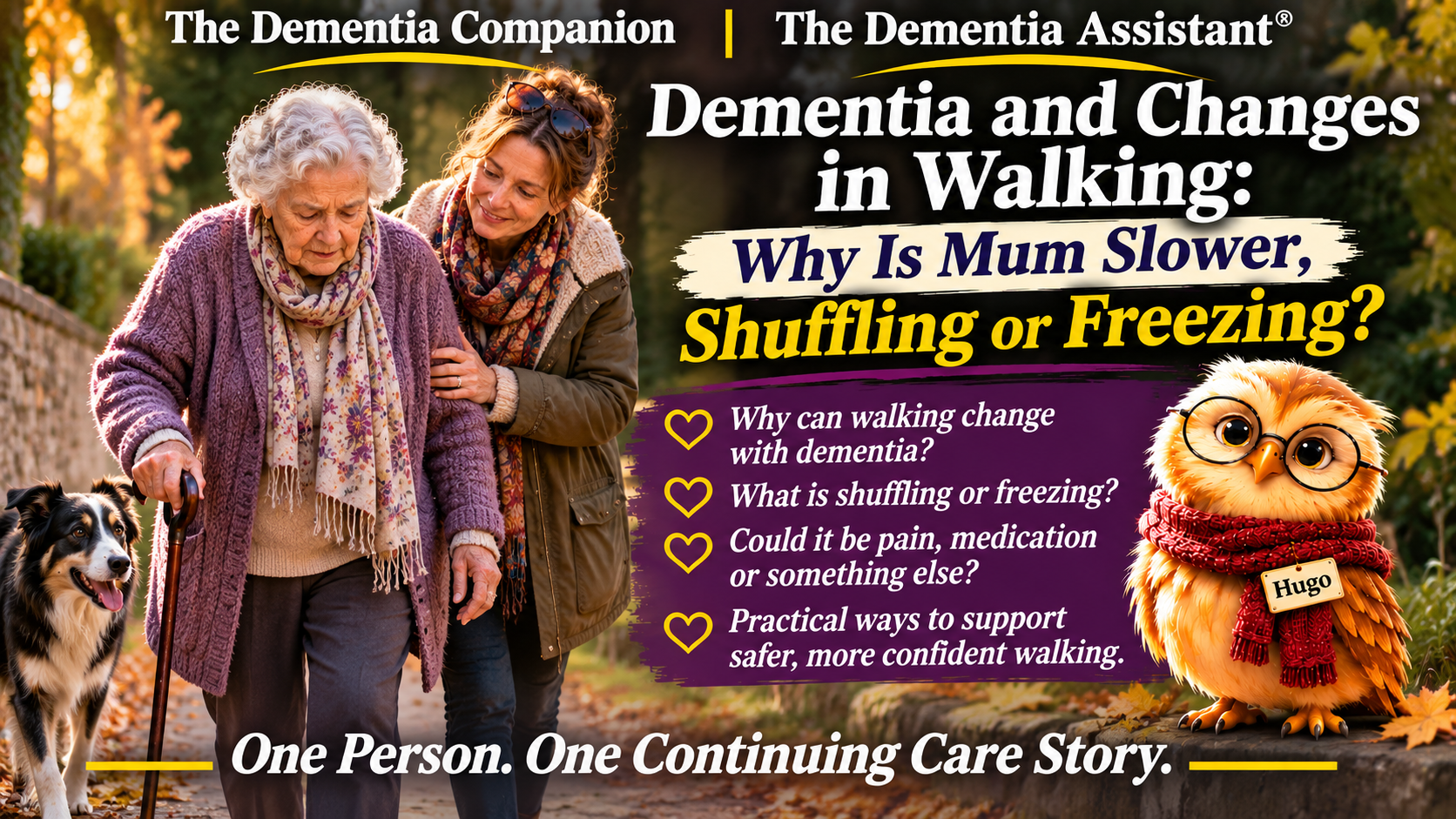
Dementia and Changes in Walking: Why Is Mum Slower, Shuffling or Freezing?
By Louise Donaghy | The Dementia Companion | One Person. One Continuing Care Story.
There was a time when Mum could walk faster than the rest of the family.
You’d be halfway through telling her something, turn around, and discover she’d already reached the end of the road.
“Come on, keep up!”
And there she’d be, handbag swinging, looking rather pleased with herself.
Now things have changed.
Her steps are smaller.
She shuffles rather than lifting her feet properly.
Sometimes she stops in a doorway and seems completely unable to take another step.
You gently encourage her.
“Come on, Mum. Just one more step.”
But her feet don’t move.
She looks down, perhaps a little frightened, and says:
“I can’t.”
And suddenly, something that used to happen without a second thought has become an enormous challenge.
You might wonder whether Mum is frightened of falling.
Perhaps her legs are weak.
Maybe she’s forgotten how to walk.
Or perhaps the dementia is progressing.
Changes in walking can happen with dementia, but they should never automatically be dismissed as an inevitable part of the condition.
There may be several explanations, including changes in brain function, balance, coordination, pain, medication, vision or another medical problem.
Some causes can be treated.
Others can be managed with rehabilitation, environmental adjustments and appropriate support.
And importantly, a dementia diagnosis does not mean we should stop encouraging safe movement and independence.
Walking is about so much more than getting from one room to another.
It’s about going into the garden.
Choosing what to wear.
Getting yourself a cup of tea.
Visiting a friend.
Walking the dog.
And maintaining some control over the ordinary little things that make life feel like your own.
So when Mum’s walking changes, we need to understand what might be happening.
Not simply assume that she can’t do it any more.
Because there may still be a great deal she can do with the right support.
Why can dementia affect someone’s walking?
Walking is an extraordinarily complicated activity.
Most of us never think about it.
We stand up, shift our weight, take a step and continue moving.
But the brain is working constantly.
It helps us coordinate muscles, judge distances, maintain balance, respond to obstacles and adjust our movements.
We also need attention and spatial awareness.
Think about walking through a crowded supermarket.
You avoid other people, steer around displays, recognise changes in flooring and decide where to go.
All while remembering whether you’ve bought the milk.
Dementia can affect some of the brain functions needed for these activities.
According to the Alzheimer’s Society, people in the middle and later stages of dementia may experience slower walking, shorter steps, poorer balance and an increased risk of falls.
However, the timing and nature of walking difficulties vary considerably.
Some people remain independently mobile for many years.
Others experience movement problems earlier, particularly with certain types of dementia.
And many walking difficulties have causes unrelated to dementia.
Understanding the difference is important.
Seven possible reasons Mum’s walking has changed
- Changes in coordination and movement
The brain helps organise the sequence of movements involved in walking.
As certain areas and networks are affected by dementia, movements may become slower or less coordinated.
Mum might take shorter steps.
She may hesitate before moving.
Perhaps turning becomes difficult.
She may need more time to respond when someone asks her to change direction.
This isn’t necessarily because she’s forgotten what walking is.
The process of organising and carrying out movement may have become more difficult.
- Balance and spatial awareness may be affected
Spatial awareness helps us understand where our body is in relation to the environment.
It allows us to judge whether a doorway is wide enough, where a step begins and how far away a chair is.
Some forms of dementia affect visual processing and spatial awareness.
Mum might hesitate at a dark rug because it looks like a hole.
She may struggle to judge a change in floor level.
Perhaps she’s uncertain about stepping through a doorway.
What looks like a walking problem may partly involve how she interprets what she sees.
An eyesight assessment and environmental review may be helpful.
- Muscle weakness and reduced activity
Someone who becomes less active may gradually lose muscle strength and physical confidence.
Perhaps Mum no longer walks to the shops.
Maybe she spends more time sitting.
Perhaps she has stopped going into the garden because she’s worried about falling.
Reduced activity can contribute to weakness and reduced balance, which in turn can make movement more difficult.
This can become a difficult cycle.
The less confident she feels, the less she moves.
The less she moves, the harder moving may become.
Where appropriate, a physiotherapist can help develop a safe programme suited to her abilities.
The goal is not to push Mum beyond her limits.
It is to preserve the movement she can still enjoy.
- Pain or physical discomfort
This is one of the first things I would encourage families to consider.
Mum might have arthritis.
Perhaps her hips or knees are painful.
Maybe she has back problems, foot pain, poorly fitting shoes or discomfort caused by another medical condition.
She may not be able to explain exactly what’s wrong.
Instead, she takes smaller steps.
She avoids standing.
She appears reluctant to walk.
Or she becomes distressed when someone encourages her to move.
Pain can change the way someone walks, even when they cannot tell us that something hurts.
Don’t assume every change is caused by dementia.
A medical assessment may identify a problem that can be treated or better managed.
- Medication, dizziness and changes in blood pressure
Some medicines can contribute to dizziness, sleepiness, stiffness or problems with balance.
A drop in blood pressure when standing, known as orthostatic or postural hypotension, can also make someone feel faint or unsteady.
This may be particularly important if Mum seems comfortable sitting but becomes dizzy when she stands.
Certain medications can sometimes cause Parkinson-like movement symptoms, including stiffness and slower walking.
A clinician or pharmacist can review possible side effects and interactions.
Never stop or alter prescribed medicines independently.
- Changes associated with specific types of dementia
Some dementias are more likely to involve movement difficulties.
Dementia with Lewy bodies can cause Parkinson-like symptoms such as stiffness, slowness, shuffling and changes in balance.
Parkinson’s disease dementia occurs in people who already have Parkinson’s disease, where movement problems may have existed before significant cognitive difficulties.
Vascular dementia can sometimes involve walking changes, particularly where strokes or damage to brain networks affect coordination and movement.
Other neurological conditions can also produce similar symptoms.
This is why the pattern of changes matters.
- Another medical condition may be responsible
Not every person with dementia who develops a shuffling walk is experiencing dementia progression.
One important example is normal pressure hydrocephalus (NPH).
This condition involves an abnormal accumulation of cerebrospinal fluid in spaces within the brain.
It can cause difficulties with walking, thinking and bladder control.
The person’s feet may appear almost stuck to the floor.
NPH is not the same as Alzheimer’s disease, and some people may benefit from specialist treatment.
It is one reason that new walking difficulties, particularly alongside urinary changes and cognitive symptoms, deserve proper medical investigation.
Other possible contributors include neuropathy, vitamin deficiencies, stroke, illness and musculoskeletal conditions.
The important message is simple:
A change in walking is a symptom worth understanding, not a diagnosis in itself.
What does shuffling mean in dementia?
A shuffling gait describes walking with short steps, often with reduced lifting of the feet.
Instead of stepping forward normally, the person may appear to slide or drag their feet along the floor.
You might notice:
- Smaller, shorter steps.
- Slower walking.
- Less arm movement.
- Difficulty turning.
- A stooped posture.
- Feet barely clearing the floor.
- Hesitation when starting to walk.
These changes can increase the likelihood of tripping.
Shuffling can occur with several neurological and physical conditions, including Parkinsonism and some types of dementia.
It does not identify one particular diagnosis.
If Mum develops a new shuffling walk, arrange a clinical assessment.
What is freezing of gait?
Freezing of gait is different from simply walking slowly.
It describes a sudden, temporary inability to initiate or continue stepping, despite wanting to move.
The person may feel as though their feet are glued to the floor.
It can happen when:
- Starting to walk.
- Approaching a doorway.
- Turning around.
- Moving through a narrow space.
- Approaching a chair.
- Walking while trying to do something else.
- Feeling rushed or anxious.
Freezing is particularly associated with Parkinson’s disease and related movement disorders.
It can also occur in some people with Lewy body-related conditions or other neurological disorders.
Imagine Mum is walking towards the kitchen.
She approaches the doorway.
Suddenly, she stops.
Her upper body may be ready to move, but her feet seem unable to follow.
You say:
“Come on, Mum.”
She tries.
Nothing happens.
You encourage her again.
She becomes frightened.
And perhaps you become frightened too.
Freezing is not necessarily a refusal to walk.
It may reflect a neurological difficulty coordinating movement.
Pushing, pulling or rushing someone during a freezing episode can increase the risk of falling.
Instead, focus on stability, reassurance and professional assessment.
What should I do if Mum suddenly freezes while walking?
First, remain calm.
If Mum is standing safely, give her time.
Avoid pulling her forward by the hands or arms.
That can disturb her balance and increase the risk of a fall.
Speak gently.
“You’ve stopped for a moment, Mum. That’s all right.”
“Take your time.”
“Let’s make sure you’re steady.”
Where freezing has been assessed as part of Parkinsonism, a physiotherapist may teach specific techniques.
These can include pausing, consciously shifting weight or using carefully chosen movement cues.
For example, some people benefit from counting or following a rhythm.
Others may respond to a visual cue that helps them initiate the next step.
However, these techniques are not automatically suitable for every person with dementia or every episode of immobility.
They should be taught and adapted by an appropriate professional, especially when there is a risk of falling.
If Mum cannot move safely, becomes faint or develops sudden weakness, seek medical advice according to the urgency of the situation.
Do not physically force her into taking a step.
Why are doorways particularly difficult?
Doorways may seem completely ordinary to us.
But they can require several adjustments at once.
The person needs to judge the opening, position their body, adjust their stride and move from one environment into another.
Changes in floor colour, lighting or visual contrast may make the transition more complicated.
For someone experiencing freezing, turning or navigating narrow spaces can be a trigger.
Mum may stop at the doorway.
She might look down.
Perhaps she makes several tiny movements without stepping through.
Before encouraging her to continue, consider whether the environment is contributing.
Is there a raised threshold?
Does the floor change colour?
Is the doorway cluttered?
Does she appear frightened?
Could a different route be easier?
An occupational therapist can help assess environmental challenges.
A physiotherapist can assess the walking difficulty itself and recommend appropriate strategies.
What if Mum is frightened of falling?
Fear of falling can be a significant barrier to movement.
Perhaps Mum has fallen before.
Maybe she has felt unsteady.
She might worry that her legs will give way.
Even without a previous fall, she may recognise that walking no longer feels as easy.
This fear deserves attention.
Simply saying:
“There’s nothing to worry about!”
may not be reassuring when Mum feels unsafe.
Instead, acknowledge her concern.
“You’re not feeling very steady today, are you?”
“Shall we sit for a moment?”
“Would you like some support?”
A physiotherapist can assess balance, strength and confidence.
Appropriate rehabilitation may help reduce falls risk and preserve mobility.
The aim is not to convince Mum that there is no danger.
It is to help her move as safely and confidently as possible.
Ten practical ways to support safer walking
- Arrange an assessment when walking changes
If Mum’s walking becomes noticeably slower, more unsteady or different from usual, contact her healthcare professional.
Consider whether she needs a physiotherapy assessment, medication review, vision assessment or falls evaluation.
NICE recommends an individualised falls assessment that considers gait, balance, muscle strength, medicines and other relevant factors.
Early assessment can help identify problems before they result in injury.
- Allow enough time
Rushing someone who is struggling to walk can increase anxiety and instability.
If Mum needs five minutes to reach the front door, plan for five minutes.
Not thirty seconds followed by an increasingly desperate chorus of:
“Come on, Mum, we’re going to be late!”
Give her time to stand, find her balance and begin walking.
The appointment will still be there.
And if you’re late by two minutes, the world is unlikely to stop turning.
- Encourage movement without pushing beyond her abilities
Safe, regular movement can help preserve strength, function and wellbeing.
Depending on Mum’s abilities and professional advice, activities might include:
- Short walks around the home.
- Walking in the garden.
- Gentle supervised exercises.
- Practising everyday movements.
- Suitable strength and balance activities.
- Meaningful outings with appropriate support.
Some people benefit from structured physiotherapy programmes.
Others may need seated exercises or a different rehabilitation approach.
Avoid attempting difficult balance exercises without appropriate assessment, particularly if Mum has already fallen.
- Review footwear
Shoes can make a considerable difference.
Check whether Mum’s shoes fit comfortably and provide suitable support.
Loose slippers, worn soles and shoes that don’t stay securely on the feet can increase risk.
Foot pain, swelling, bunions or reduced sensation may also affect walking.
A podiatrist or relevant clinician may be helpful.
And remember that Mum may have strong preferences about her shoes.
Rather than simply taking away her favourites, involve her in choosing comfortable, suitable alternatives.
- Make the home easier to navigate
Review walking routes.
Look for loose rugs, trailing cables, clutter and poorly lit areas.
Check whether thresholds or uneven floors create difficulties.
Consider suitable grab rails, handrails and lighting where professionally recommended.
A home assessment by an occupational therapist can identify changes that support both safety and independence.
Avoid rearranging familiar furniture unnecessarily.
Someone living with dementia may rely on familiar surroundings to navigate confidently.
- Use walking aids only when appropriately assessed
A walking stick or frame may help some people.
But the wrong aid can make walking more difficult.
A stick at the wrong height can affect posture.
A frame may be confusing or difficult to coordinate.
Certain walking aids may be unsuitable for particular freezing patterns.
A physiotherapist should assess whether an aid is appropriate and teach the person how to use it.
If Mum forgets to use her frame, don’t assume this is deliberate.
Consider how the aid is positioned, whether it is comfortable and whether she understands when it is needed.
- Support standing and sitting safely
Changes in walking often occur alongside difficulty standing up and sitting down.
Mum may struggle to rise from a low chair.
Perhaps she forgets where the chair is when sitting.
She might begin turning before she is safely positioned.
An occupational therapist or physiotherapist can assess transfers and recommend suitable techniques or equipment.
Avoid lifting someone by pulling on their arms.
If Mum requires physical assistance, carers should receive appropriate moving-and-handling guidance.
Safety matters for both the person and those supporting them.
- Reduce unnecessary distractions
Walking while talking, carrying items or navigating a busy environment can demand more attention.
Some people find it easier to concentrate on one task at a time.
If Mum is approaching a difficult doorway, consider pausing the conversation.
Allow her to focus on moving safely.
Offer simple prompts when needed.
Avoid giving several instructions simultaneously.
- Keep walking meaningful
This is especially important.
Movement should not become a clinical task performed simply because someone has been told to exercise.
Perhaps Mum loves her garden.
Maybe she enjoys going to the local café.
Perhaps she likes walking to see the flowers or feeding the birds where appropriate.
These activities provide purpose.
A person-centred rehabilitation approach should consider what matters to the individual.
The aim is not simply to improve a walking score.
It is to help Mum participate in the life she enjoys.
- Record changes and review support
Walking abilities may change over time.
An approach that works today may need adapting later.
Record new difficulties, near-falls, actual falls, pain and situations where Mum becomes stuck.
Share relevant observations with healthcare professionals.
And review mobility support when circumstances change.
Safe movement should be encouraged wherever possible, but never at the expense of comfort, dignity or appropriate risk assessment.
What should I say when Mum cannot take the next step?
Communication matters, particularly when someone feels frightened.
Instead of:
“Come on, Mum! Just move your feet!”
Try:
“You’re finding it difficult to get started, aren’t you? Let’s make sure you’re steady.”
Instead of:
“You were walking perfectly well yesterday!”
Try:
“Today seems a little harder. We’ll take our time.”
Instead of:
“Stop shuffling! Pick your feet up!”
Try:
“Let’s go at a pace that feels comfortable.”
Instead of:
“There’s nothing to be frightened of!”
Try:
“You’re feeling unsure. Shall we pause for a moment?”
Instead of:
“You have to keep walking!”
Try:
“Would you like to rest, or shall we think about another way to get there?”
For someone with a professionally assessed freezing problem, a therapist may recommend particular verbal cues.
Use those agreed strategies rather than improvising techniques when the person is unstable.
And remember that reassurance should never become pressure.
Mum may need more than encouragement.
She may need assessment, treatment, equipment or assistance.
What if Mum has had a fall?
Falls can be frightening for everyone.
Before trying to help Mum stand, check whether she may be injured.
Ask about pain where possible.
Look for signs of a head injury, serious limb injury or unusual confusion.
Do not rush to lift her.
If she may have injured her head, neck, back or hip, has severe pain, is unconscious or cannot safely be moved, seek emergency help.
In the UK, call 999 for an emergency. For other falls requiring urgent advice, NHS 111 or an appropriate urgent-care service may help.
Families internationally should follow their local emergency guidance.
If Mum takes blood-thinning medicines or has struck her head, medical assessment may be particularly important even when she initially seems well.
After a fall, arrange appropriate review of the possible causes.
A fall should not simply be recorded and forgotten.
NICE recommends assessing individual risk factors and offering appropriate prevention strategies.
When is a change in walking a medical emergency?
This is one of the most important parts of the article.
A gradual change in walking deserves assessment.
But a sudden change can indicate something serious.
Signs of a possible stroke
Call emergency services immediately if Mum develops sudden symptoms such as:
- Facial drooping.
- Weakness or numbness in an arm or leg, particularly on one side.
- Slurred speech or difficulty speaking.
- Sudden severe problems with balance or walking.
- Sudden visual disturbance or other acute neurological symptoms.
Remember FAST: Face, Arms, Speech, Time.
A stroke can happen to someone who already has dementia.
Do not assume new weakness or sudden difficulty walking is simply dementia progressing.
Even if symptoms improve, a transient ischaemic attack (TIA) may require emergency assessment.
Other changes needing prompt assessment
Seek prompt medical advice if Mum:
- Suddenly becomes much more unsteady.
- Develops new severe pain.
- Has repeated falls.
- Becomes newly confused or unusually drowsy.
- Experiences dizziness or fainting.
- Develops weakness after a recent illness.
- Shows new walking difficulty alongside urinary or other neurological changes.
The appropriate urgency depends on the symptoms.
When in doubt about a sudden or severe change, seek urgent professional help.
Can rehabilitation still help someone living with dementia?
Absolutely, rehabilitation should not be dismissed simply because someone has dementia.
However, the likely benefits and most appropriate approach depend on the individual.
A physiotherapist can assess strength, balance, walking patterns and physical abilities.
They may recommend exercises, movement strategies or suitable walking aids.
An occupational therapist can assess everyday activities, transfers, home safety and equipment.
Some people may benefit from rehabilitation support after illness, injury or hospital admission.
Others may need ongoing adaptations as dementia progresses.
And importantly, successful rehabilitation is not always about returning someone to exactly how they moved before.
Sometimes success is standing safely from a favourite chair.
Sometimes it is walking to the garden.
Sometimes it is reaching the bathroom with confidence.
And sometimes it is finding a comfortable alternative when walking is no longer safe.
Independence is about choice, participation and dignity, not simply whether someone can walk unaided.
A fictional example: When Margaret’s feet seemed stuck to the floor
The following example is fictional and illustrates a person-centred approach.
Margaret is 82 and lives with dementia.
She has always loved walking.
Her daughter Sarah remembers being dragged around garden centres for hours while Margaret inspected every plant.
No rose was safe from her expert opinion.
Recently, Sarah notices that her mother is walking differently.
Her steps are smaller.
She seems slower.
And sometimes she stops completely when approaching the kitchen doorway.
Sarah encourages her.
“Come on, Mum.”
Margaret looks worried.
“I can’t.”
At first, Sarah wonders whether her mother has simply lost confidence.
But she notices that the difficulty happens more often when Margaret turns or approaches a narrow space.
She also notices that Margaret has become less steady.
Rather than forcing her to continue, Sarah helps her pause safely and arranges a clinical assessment.
The healthcare team reviews Margaret’s walking, medication, physical health and possible neurological causes.
A physiotherapist evaluates her mobility and develops an individual support plan.
An occupational therapist reviews the home environment.
The family begins recording when Margaret struggles, what seems to contribute and how she responds to the recommended approaches.
The plan is reviewed as her needs change.
Margaret still enjoys looking at her flowers.
Her walks may be shorter.
She sometimes needs assistance.
But Sarah has learned not to assume that slower movement means her mother should stop enjoying the activities she loves.
And Margaret?
She still has plenty to say about the roses.
Particularly if Sarah forgets to deadhead them.
One Person. One Continuing Care Story. Why mobility observations matter
Imagine Mum’s walking has changed over several months.
Her daughter notices that she shuffles in the hallway.
A professional carer observes that she struggles to stand from her chair.
Her son sees her freeze in a doorway.
A physiotherapist identifies particular balance difficulties.
The GP reviews possible medical causes.
Each person holds an important part of the picture.
But unless those observations are brought together, the information may become fragmented.
The next person providing care might simply be told:
“Mum needs help walking.”
That tells us very little.
A more meaningful explanation might be:
“Mum walks more slowly and occasionally hesitates when turning or entering doorways. She has been assessed by a physiotherapist. Her current mobility plan includes agreed equipment and assistance. She enjoys short walks in the garden and needs time to move without being rushed.”
That is the difference between describing a difficulty and understanding a person.
One Person. One Continuing Care Story.
The Dementia Assistant® — keeping Mum’s mobility story connected
The Dementia Companion provides practical dementia education, compassionate guidance and resources for people living with dementia, families and professionals.
The Dementia Assistant® brings together family-held person-centred care planning, daily observations, continuing records and Hugo Intelligence™.
Its purpose is to help families keep important information organised as the person’s needs change.
Person-centred care planning
A family-held care plan may include:
- Mum’s usual mobility and walking pattern.
- Recent changes in speed, balance or coordination.
- Known medical and neurological conditions.
- Physiotherapy recommendations.
- Walking aids and equipment.
- Transfer and moving-and-handling requirements.
- Previous falls and near-falls.
- Pain, dizziness or other relevant symptoms.
- Preferred activities and meaningful destinations.
- Home adaptations.
- Relevant appointments and professional recommendations.
- The level of assistance she wants and needs.
The plan can be updated when new information becomes available.
It does not replace a professional mobility assessment or clinical record.
The family can use relevant information to support appropriate communication with healthcare and care services.
Daily notes — recognising changes over time
A daily note might say:
“Monday, 10.30 am. Mum walked from the living room to the kitchen using her assessed walking aid. She took smaller steps when approaching the doorway and paused before continuing. No fall occurred.”
Another might say:
“Wednesday, 2.15 pm. Mum reported discomfort in her right knee when standing. She appeared less steady than usual. Contacted her healthcare professional for advice.”
Or:
“Friday, 11.00 am. Mum enjoyed a short supervised walk in the garden using her current mobility plan. She appeared comfortable and pleased to be outside.”
These observations give a fuller picture than simply recording:
“Mobility poor.”
They can help families recognise changes and prepare useful information for clinicians.
Family Circle — helping everyone respond consistently
Different family members may support Mum at different times.
One person knows how she transfers from her chair.
Another knows where she struggles with doorways.
A visiting carer may have received instructions from the physiotherapist.
Family Circle is designed to support coordinated involvement of appropriate relatives and carers, subject to consent, permissions and privacy arrangements.
Relevant information can help everyone understand Mum’s agreed mobility support.
Family-held records should never be used to authorise untrained people to perform unsafe transfers or physical handling.
Professional instructions and appropriate training remain essential.
Life Story — remembering why walking matters to Mum
Mobility is not simply a physical ability.
It is often connected to identity.
Perhaps Mum has always loved walking her dog.
Maybe she spent years gardening.
Perhaps she enjoyed shopping, visiting friends or dancing.
Her Life Story can preserve those important interests.
A person-centred rehabilitation plan should consider what Mum wants to continue doing, rather than focusing entirely on what she can no longer manage.
The destination can matter just as much as the distance.
Saved conversations and continuing support
Hugo’s saved conversations allow families to return to earlier guidance and continue exploring concerns.
Perhaps the family first asks about slower walking.
Later, they want to understand freezing.
Then they need help preparing for a physiotherapy appointment.
Saved conversations, alongside care plans and daily notes, can help maintain continuity.
Meet Hugo Intelligence™ — guidance that begins with the person
Within The Dementia Assistant®, families can access Hugo Intelligence™, created and powered by Person-Centred Intelligence®.
Hugo provides conversational guidance designed to help families understand dementia-related concerns, explore possible explanations, consider practical approaches and prepare information for healthcare professionals.
He can help someone think through mobility changes, understand falls risks, organise observations and identify questions worth asking a clinician.
But there is an important distinction in how Hugo works.
General guidance until a care plan is explicitly selected
Hugo provides general guidance until the user explicitly selects an individual’s care plan.
He does not automatically assume that a question concerns a particular person.
For example, without a selected plan, someone might ask:
“Hugo, why do people living with dementia sometimes shuffle when walking?”
Hugo can explain general possibilities and when professional assessment is important.
When a family member deliberately selects Mum’s individual care plan, Hugo can use relevant information recorded in that selected plan to make guidance more specific to her documented circumstances.
For example:
“Hugo, Mum’s selected care plan records that she walks more slowly, sometimes freezes in doorways and has recently been assessed by a physiotherapist. Help us organise observations and questions for her next mobility review.”
Hugo can help the family think through those recorded details.
He should not invent clinical findings, diagnose the cause or prescribe rehabilitation exercises.
He does not replace a GP, neurologist, physiotherapist, occupational therapist or falls specialist.
His role is to support understanding, organisation and communication.
Multilingual support for international families
Dementia affects people across countries, cultures and languages.
The Dementia Assistant® supports 12 tested interface and voice languages, alongside broader dictation and translation capabilities covering 201 languages.
This can help families access guidance and record information across language differences.
Records are stored in English while original translated content is retained where applicable.
Important clinical instructions, particularly those involving mobility, equipment or moving and handling, should always be checked for translation accuracy.
A person’s preferred language and cultural background should remain part of their care.
Preparing useful summaries for healthcare professionals
The Dementia Assistant® supports family-held observations, relevant documents and summaries.
Instead of arriving at an appointment and saying:
“Mum isn’t walking properly.”
The family may be able to explain:
“Mum has developed smaller steps over the past six weeks. She occasionally stops when turning or entering doorways. She has had two near-falls and now needs more time to stand from her chair. We would like her walking, medication and falls risk assessed.”
This provides more useful context.
Healthcare professionals still need to examine and assess the person.
But a clear record can help families describe what has been happening between appointments.
17 detailed questions to Ask Hugo about changes in walking and dementia
These questions can be copied into Hugo Intelligence™.
For general guidance, simply ask Hugo.
For responses informed by an individual’s recorded circumstances, explicitly select their care plan first.
- Why has Mum started walking more slowly?
“Hugo, Mum is living with dementia and her walking has gradually become slower. Explain how dementia, reduced strength, balance difficulties, pain, medication and other medical conditions might contribute. Help me understand what to observe and when she should be assessed.”
- Why does Mum shuffle her feet?
“Hugo, Mum has started taking small, shuffling steps instead of lifting her feet normally. Explain possible neurological, physical and environmental causes. What signs should we record, and which healthcare professionals could help assess the change?”
- What does freezing of gait mean?
“Hugo, Mum occasionally stops walking and seems unable to move her feet despite wanting to continue. Explain freezing of gait, how it differs from ordinary hesitation and why it needs appropriate assessment.”
- What should we do when Mum freezes in a doorway?
“Hugo, Mum sometimes becomes stuck when approaching a doorway. Help us understand how to keep her safe, why we should avoid pulling her forward and which professionally assessed movement strategies might be considered.”
- Could this be related to Lewy body dementia?
“Hugo, explain how dementia with Lewy bodies can affect movement, including stiffness, slowness, shuffling and changes in balance. Why can walking changes alone not diagnose a particular type of dementia?”
- Could Mum have Parkinsonism?
“Hugo, Mum’s movements have become slower and she sometimes shuffles. Explain the difference between Parkinson’s disease, Parkinsonism and movement difficulties associated with dementia. What should we ask a clinician or neurologist?”
- Could pain be making Mum reluctant to walk?
“Hugo, Mum has become less willing to stand or walk and cannot always describe discomfort. Help us consider arthritis, foot pain, joint problems and other physical causes. What observations could suggest pain, and when should we request medical assessment?”
- Can medication cause walking difficulties?
“Hugo, Mum’s walking has changed since her medication was adjusted. Explain how medicines may affect dizziness, balance, alertness or movement. Help us prepare for a medication review without recommending that we alter prescribed treatment ourselves.”
- What is normal pressure hydrocephalus?
“Hugo, I’ve read that normal pressure hydrocephalus can cause shuffling, walking difficulties, cognitive changes and urinary problems. Explain the condition in accessible language and why appropriate specialist assessment may be important.”
- How can we support Mum’s confidence after a fall?
“Hugo, Mum has become frightened of walking since she fell. Suggest ways to acknowledge her fear, seek a falls assessment, support rehabilitation and preserve her independence without pushing her to take unsafe risks.”
- How do we know whether Mum needs a walking aid?
“Hugo, Mum sometimes seems unsteady and we are considering a stick or frame. Explain why walking aids need individual assessment, what a physiotherapist considers and why an unsuitable aid may increase falls risk.”
- How can we make the home safer for walking?
“Hugo, help us review Mum’s home for loose rugs, poor lighting, thresholds, clutter, stairs and difficult walking routes. Suggest changes that may reduce falls risk while preserving familiar surroundings and independence.”
- Can physiotherapy help someone with dementia?
“Hugo, explain how physiotherapy may support balance, strength, walking confidence and everyday movement for someone living with dementia. What types of goals can be person-centred, and how might recommendations change over time?”
- How can we support safe standing and sitting?
“Hugo, Mum struggles to stand from her favourite chair and sometimes sits before she is properly positioned. Explain why a transfer assessment may be helpful and how families can seek safe moving-and-handling guidance without attempting untrained lifting techniques.”
- When is a walking change a medical emergency?
“Hugo, help me recognise when a sudden walking difficulty could indicate a stroke, serious injury, acute illness or another emergency. Explain the warning signs and the importance of seeking urgent medical assessment.”
- How should we record changes in Mum’s mobility?
“Hugo, help us create factual daily notes recording walking speed, step changes, freezing, balance, falls, discomfort, equipment used and support provided. Include how to note possible triggers and when professional advice was requested.”
- How can we keep Mum’s mobility care person-centred?
“Hugo, Mum has always loved walking and gardening, but her mobility is changing. Help us develop a continuing care approach that respects her wishes, preserves meaningful activities, supports safe rehabilitation and keeps family members and professionals informed through her care plan, Life Story, Family Circle and daily notes.”
One Person. One Continuing Care Story.
Watching someone you love struggle with walking can be heartbreaking.
Especially when you remember how independent they once were.
Perhaps Mum used to stride ahead of everyone.
Maybe she loved taking the dog out.
Perhaps she enjoyed long walks, gardening or shopping.
And now, even getting through the kitchen doorway can feel difficult.
But I want families to remember something.
Slower walking does not mean Mum has stopped being the person she always was.
She still has preferences.
She still has things she enjoys.
And she still deserves opportunities to move, participate and make choices.
Sometimes she needs a little more time.
Sometimes she needs rehabilitation.
Sometimes a medical problem needs investigating.
And sometimes the safest, kindest thing is to recognise that her support needs have changed.
We should never assume that every difficulty is simply dementia progressing.
Nor should we push someone to walk when doing so is unsafe.
The aim is to understand the person, recognise what has changed and find the most appropriate support.
And when families and professionals record those changes together, care becomes more informed.
Because Mum should not have to begin her story again every time she sees a new clinician, therapist or carer.
Her history, her preferences, her abilities and her needs should remain connected.
One Person. One Continuing Care Story.
Continue your family’s care story with The Dementia Companion and The Dementia Assistant®
The Dementia Companion provides accessible dementia education, practical guidance and compassionate resources for people living with dementia, families and professionals.
The Dementia Assistant® brings together Hugo Intelligence™, person-centred care planning, family-held continuing records, daily notes, saved conversations, Family Circle, Life Story and multilingual support.
Together, they are designed to help families understand changing needs, preserve important information and prepare for conversations with healthcare professionals.
The Dementia Companion:
https://thedementiacompanion.com/
The Dementia Assistant®:
https://thedementiaassistant.com/
Every subscription includes a 30-day complimentary trial.
Afterwards, the UK Family subscription costs £4.99 per month.
Families in other countries can check the subscription options available in their region.
Because good dementia care should never focus only on what someone can no longer do.
It should also recognise what they can still enjoy, achieve and participate in.
And if Mum needs a little longer to reach the garden?
Then perhaps we take a little longer.
The roses aren’t going anywhere.
Although, knowing Mum, she may still have something to say if you haven’t pruned them properly.
Some things never change. ❤️
⸻
Authoritative references and further reading
- Alzheimer’s Society — Moving well with dementia: Why physical mobility matters.
Explains how dementia can affect movement, the importance of remaining physically active and the role of mobility support.
https://www.alzheimers.org.uk/blog/moving-well-dementia-why-physical-mobility-matters
- Alzheimer’s Society — The later stage of dementia.
Discusses slower movement, shuffling, reduced balance and changing mobility needs.
https://www.alzheimers.org.uk/about-dementia/stages-and-symptoms/later-stages-dementia
- Dementia UK — Dementia and falls.
Practical guidance about falls risks, assessment, physiotherapy, occupational therapy and home safety.
https://www.dementiauk.org/information-and-support/health-advice/dementia-and-falls/
- NICE Guideline NG249 — Falls: Assessment and prevention in older people and in people aged 50 and over at higher risk.
Recommendations covering individual falls assessment, gait, balance, medicines, strength and appropriate prevention.
https://www.nice.org.uk/guidance/ng249/chapter/recommendations
- NICE Guideline NG97 — Dementia: Assessment, management and support.
Person-centred dementia care recommendations and links to appropriate falls assessment and support.
https://www.nice.org.uk/guidance/ng97/chapter/Recommendations
- Parkinson’s UK — Freezing.
Explains freezing of gait, potential triggers and professionally supported movement strategies.
https://www.parkinsons.org.uk/information/symptoms/motor/freezing
- NHS — Dementia with Lewy bodies: Symptoms.
Explains movement symptoms including stiffness, slow movement and shuffling gait.
https://www.nhs.uk/conditions/dementia-with-lewy-bodies/symptoms/
- NHS — Hydrocephalus.
Information about normal pressure hydrocephalus, walking difficulties, cognitive symptoms and assessment.
https://www.nhs.uk/conditions/hydrocephalus/
- NHS — Symptoms of a stroke.
Official guidance about sudden neurological symptoms, FAST and emergency action.
https://www.nhs.uk/conditions/stroke/symptoms/
- NHS — Falls.
Advice on falls risks, when to seek help and ways to support safer mobility.
https://www.nhs.uk/conditions/falls/
- Parkinson’s Foundation — Trouble Moving or Walking.
International guidance on slower steps, shuffling, changes in movement and freezing.
https://www.parkinson.org/understanding-parkinsons/movement-symptoms/trouble-moving
- Dementia UK — Staying healthy.
Guidance on suitable activity, maintaining mobility, adapting exercise and balancing movement with rest.
https://www.dementiauk.org/information-and-support/health-advice/staying-healthy/
This article provides general educational information for international families. It does not replace individual medical, neurological, physiotherapy, occupational therapy or falls assessment. New or worsening walking difficulties should be reviewed by an appropriate healthcare professional. Sudden weakness, loss of balance or other stroke-like symptoms require emergency assessment.
⸻
Louise, Hugo and Charlie ❤️🦉✨
Louise Donaghy
Founder & CEO of The Dementia Assistant®
Created and powered by Person-Centred Intelligence®
Creator of Hugo Intelligence™
You May Also Find Helpful
Need help with your own situation? Ask Hugo.
One Person. One Continuing Care Story. The Dementia Companion is where you discover guidance. Inside The Dementia Assistant®, talk with Hugo, save and categorise conversations, record daily notes and involve authorised supporters in a continuing care plan centred around the person.
Ask Hugo About This · Start Your Continuing Care Plan — Families · Continuing Care Planning — Professionals
Personal guidance requires the appropriate account and subscription access. Care-plan information is used only with authorised access and the required consent and selection steps. All subscription plans include a 30-day complimentary trial.