I Keep Forgetting Things. Could It Be Dementia?
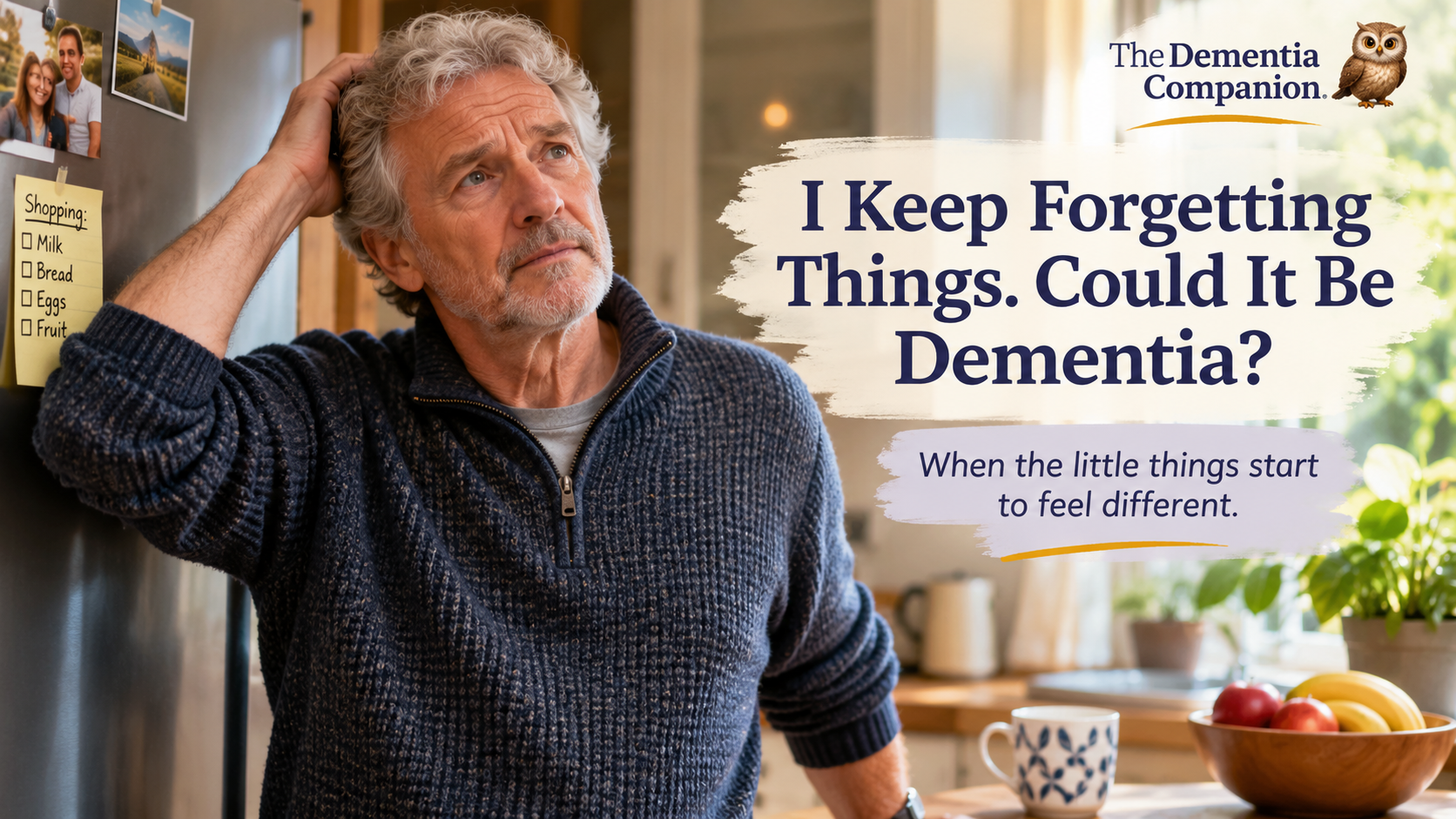
I Keep Forgetting Things. Could It Be Dementia?
I Am Me. | Article 1
One Person. One Continuing Care Story.
When the little things start to feel different
You walk into the kitchen and stop.
What did you come in here for?
You open a cupboard, close it again and hope that whatever you were looking for will magically announce itself.
We’ve all been there. Sometimes, the most effective way to remember why you went into a room is apparently to leave it again!
But what happens when these little moments become more frequent? When forgetting something stops being funny and starts becoming frightening?
Perhaps you’re reading this because you’ve noticed changes in yourself that you haven’t told anyone about.
Perhaps you’ve quietly searched the internet, wondering whether you might be developing dementia.
Before we go any further, there is something important you need to know.
Memory difficulties do not automatically mean you have dementia.
However, your concerns deserve to be taken seriously.
Why am I becoming more forgetful?
Our brains are remarkable, but they are not immune to everything happening around us.
Memory and concentration can be affected by many things, including:
- Stress and anxiety.
- Depression and emotional distress.
- Poor sleep and exhaustion.
- Hormonal changes.
- Certain medications.
- Vitamin deficiencies.
- Thyroid problems.
- Hearing or vision difficulties.
- Other underlying health conditions.
Sometimes, memory difficulties have a treatable cause. Sometimes, further investigation is needed.
This is why seeking professional advice is important rather than trying to diagnose yourself.
Is it normal ageing or an early sign of dementia?
There is a difference between occasionally forgetting something and experiencing changes that increasingly interfere with everyday life.
For example, occasionally forgetting someone’s name but remembering it later can happen as we age.
However, repeatedly struggling to remember recent conversations, becoming lost in familiar places or finding previously manageable tasks increasingly difficult may indicate that further assessment is needed.
Other changes worth discussing with your doctor include:
- Frequently repeating questions without realising it.
- Finding it increasingly difficult to follow conversations.
- Struggling to manage familiar household tasks.
- Losing track of appointments more frequently.
- Having difficulty finding familiar words.
- Experiencing unexpected changes in mood or confidence.
- Finding planning and decision-making more difficult than before.
Dementia is not always first recognised through memory loss. Different types of dementia can affect communication, behaviour, perception and thinking in different ways.
Experiencing any of these difficulties does not necessarily mean you have dementia.
What matters is understanding what has changed for you.
When the worry becomes bigger than the forgetfulness
Sometimes, it isn’t the forgotten word or misplaced keys that causes the greatest distress.
It’s the question that follows.
What if something is happening to me?
You might start monitoring every little mistake. Every forgotten name becomes evidence of something you fear. Every misplaced item feels like another warning sign.
You may even begin avoiding conversations or social situations because you’re frightened of embarrassing yourself.
That worry can become exhausting.
You deserve an opportunity to talk about what you’re experiencing without feeling judged, dismissed or immediately labelled.
You do not have to have all the answers before asking for help.
How do I tell my doctor that I’m worried about my memory?
Starting the conversation can feel difficult, particularly if you are frightened of what the answer might be.
You could begin with something as simple as:
“I’ve noticed some changes in my memory recently. They’re beginning to worry me, and I’d like to understand what might be causing them.”
You don’t need to arrive with a diagnosis.
That’s not your job.
Before your appointment, it may help to write down:
- What changes you have noticed.
- When you first became aware of them.
- Whether they are becoming more frequent.
- Any difficulties affecting your everyday life.
- Changes in your sleep, mood or general health.
- Medications and supplements you take.
- Whether someone close to you has noticed similar changes.
You can take someone you trust with you if you wish.
But remember, this is your appointment. You should be included in conversations about your health and supported to ask your own questions.
What happens during a memory assessment?
Your doctor may ask about your medical history, current health, medications and the changes you have experienced.
They may arrange blood tests, carry out an assessment of your memory and thinking or investigate other possible causes.
If further assessment is needed, you may be referred to a memory clinic or another specialist.
There is no single test that can independently establish every type of dementia. Healthcare professionals consider your symptoms, medical history and assessment findings together.
Seeking an assessment does not mean you will receive a dementia diagnosis.
It means you are taking an important step towards understanding your health.
What can I do while waiting for answers?
Waiting for an appointment or assessment can be unsettling.
Life, however, does not need to be placed entirely on hold.
Continue doing the things you enjoy, with any support or adjustments you need.
Spend time with people who make you feel comfortable. Maintain familiar routines. Look after your sleep, nutrition and hydration, and remain physically and socially active where possible.
Use practical reminders if they help you.
A calendar, notebook, phone reminder or designated place for your keys can make everyday life a little easier.
These are useful tools, not admissions of defeat.
After all, most of us would struggle to remember half our appointments without the assistance of a calendar!
When should I seek urgent medical help?
Gradual memory changes should be discussed with a healthcare professional.
However, sudden confusion, an abrupt change in thinking or awareness, or new difficulties with speech or movement may indicate a medical emergency.
Do not assume these changes are dementia.
Seek immediate medical assistance. In the UK, call 999. In the USA, call 911. Elsewhere, contact your local emergency service.
Do I need a diagnosis to begin my own continuing care story?
Absolutely not.
Your story began long before anyone asked you a memory assessment question.
You have a history, relationships, experiences, preferences, routines, values and ambitions.
You know what makes you comfortable, what irritates you, how you like your tea and whether you want conversation before your morning coffee!
These little details matter.
Recording what is important to you can be valuable regardless of whether you eventually receive a dementia diagnosis.
You might choose to record:
- Your personal history and important memories.
- The people who matter to you.
- Your preferred routines.
- Your interests and hobbies.
- Your cultural or spiritual preferences.
- What helps you feel comfortable and reassured.
- How you would like to be supported.
- Your wishes and preferences for the future.
This is not about assuming you will lose your independence.
It is about protecting your voice and ensuring that, should you ever need additional support, the people supporting you understand who you are.
Your continuing person-centred care plan should belong to you, remain accessible to you and, with appropriate permissions, be shared with the people you choose.
It should follow you throughout your journey rather than being repeatedly recreated whenever your care provider changes.
One Person. One Care Plan. One Continuing Care Story.
Meet Hugo — you don’t need a dementia diagnosis to start a conversation
Sometimes, questions arrive at inconvenient times.
Perhaps it’s late at night. Perhaps you don’t want to worry your family. Perhaps you simply need somewhere to organise your thoughts before speaking to someone.
This is where Hugo can help.
Hugo Intelligence™ is the AI-powered dementia guidance companion within The Dementia Assistant®, developed around the principles of Person-Centred Intelligence®.
Hugo is not a diagnostic tool. He cannot determine whether you have dementia, but he can help you explore your concerns, understand information and prepare questions for your healthcare professional.
You might ask Hugo:
- “I’ve started forgetting familiar words. What should I discuss with my doctor?”
- “How can I prepare for a memory clinic appointment?”
- “How do I explain my memory concerns to my family?”
- “What information should I start recording?”
- “How can I maintain my confidence while waiting for an assessment?”
- “Can you help me start my own person-centred care plan?”
You can communicate with Hugo in your preferred supported language and save conversations so that you can return to them later.
Through The Dementia Assistant®, you can begin building your own continuing care plan, recording your preferences, observations, experiences and what matters most to you.
When you choose to select your care plan during a conversation, Hugo can use that context to provide more personalised, relevant guidance.
Person-Centred Intelligence® brings the individual’s circumstances, preferences and personal story into the guidance they receive.
Because understanding dementia is important, but understanding the person comes first.
Your life. Your choices. Your story.
Perhaps your memory difficulties will have a treatable explanation.
Perhaps you will need further investigations.
Perhaps you will eventually receive a dementia diagnosis.
Whatever happens next, you remain the person you have always been, with your own individuality, preferences, feelings and right to participate in decisions about your life.
A diagnosis should never become the loudest voice in the room.
Yours should always have a place.
You are more than a memory assessment.
You are more than a medical record.
You are more than a diagnosis.
I Am Me.
Discover The Dementia Companion and meet Hugo
The Dementia Companion is home to The Dementia Assistant®, Hugo Intelligence™ and Person-Centred Intelligence®.
Together, they provide practical dementia guidance, person-centred continuing care planning, educational resources and support for individuals, families, carers and professionals.
Explore The Dementia Assistant® with a 30-day complimentary trial and discover ongoing support for around the price of a cup of coffee per month, depending on your chosen package.
Explore The Dementia Companion:
https://thedementiacompanion.com/
Meet Hugo Intelligence™:
https://thedementiaassistant.com/hugo
Start your continuing care story:
https://thedementiaassistant.com/
One Person. One Continuing Care Story.
Always the person before the diagnosis.
⸻
Trusted information and further reading
- NHS – Memory loss: https://www.nhs.uk/symptoms/memory-loss-amnesia/
- NHS – How to get a dementia diagnosis: https://www.nhs.uk/conditions/dementia/symptoms-and-diagnosis/diagnosis/
- NHS – Sudden confusion: https://www.nhs.uk/symptoms/confusion/
- Alzheimer’s Society – Causes of memory problems: https://www.alzheimers.org.uk/about-dementia/worried-about-memory-problems/causes-of-memory-problems
- National Institute on Aging – Memory Problems, Forgetfulness, and Aging: https://www.nia.nih.gov/health/memory-loss-and-forgetfulness/memory-problems-forgetfulness-and-aging
The Dementia Companion, The Dementia Assistant® and Hugo Intelligence™ provide educational information and practical guidance. They do not replace professional medical advice, clinical assessment, diagnosis, treatment or emergency services.
I Am Me. — An original educational series by The Dementia Companion.
Need help with your own situation? Ask Hugo.
One Person. One Continuing Care Story. The Dementia Companion is where you discover guidance. Inside The Dementia Assistant®, talk with Hugo, save and categorise conversations, record daily notes and involve authorised supporters in a continuing care plan centred around the person.
Ask Hugo About This · Start Your Continuing Care Plan — Families · Continuing Care Planning — Professionals
Personal guidance requires the appropriate account and subscription access. Care-plan information is used only with authorised access and the required consent and selection steps. All subscription plans include a 30-day complimentary trial.