When Parkinson’s Disease and Dementia Meet: Understanding the Overlap
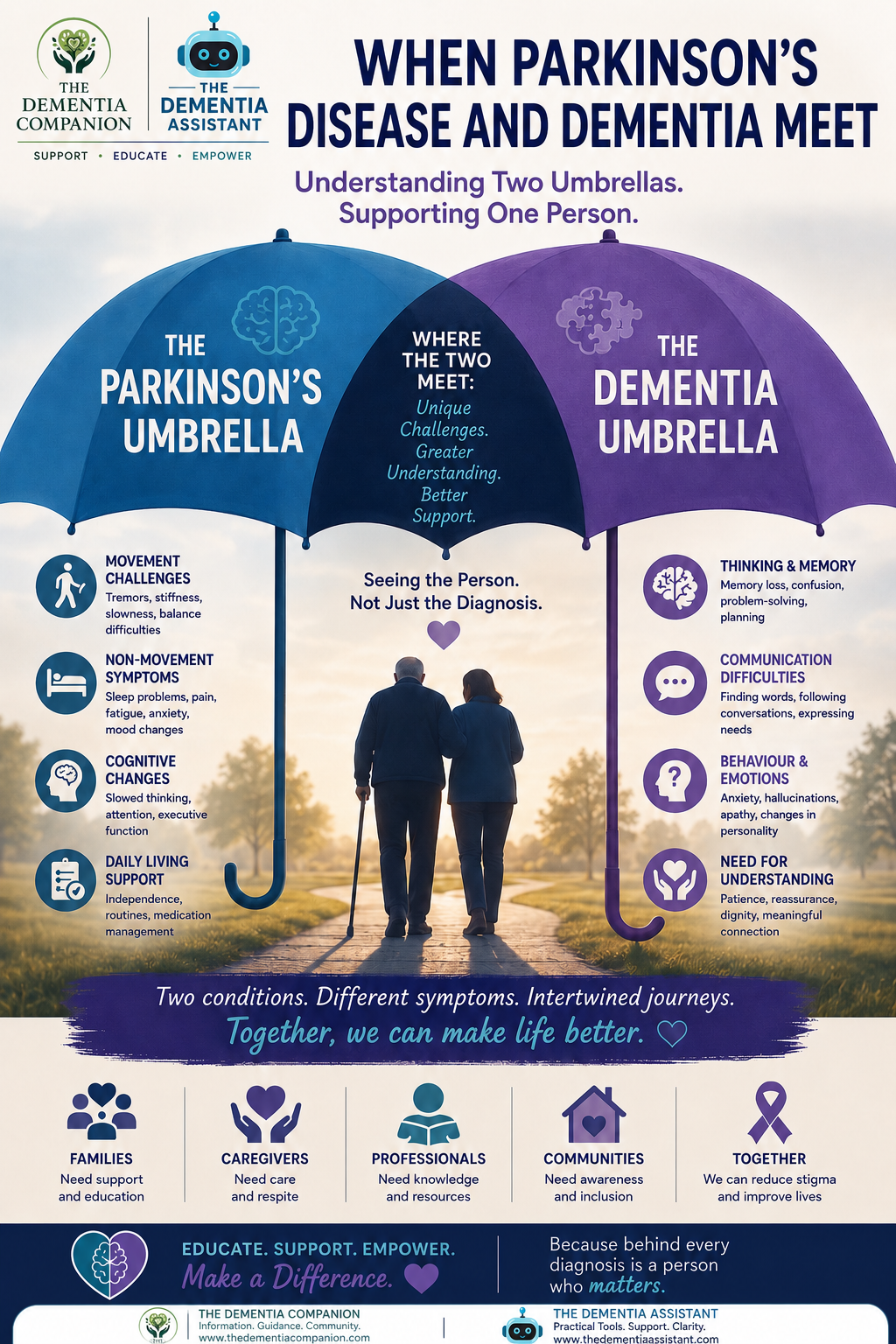
When Parkinson’s Disease and Dementia Meet: Understanding Two Different Umbrellas and the Challenges Families Face
Many people think of Parkinson’s disease and dementia as completely separate conditions. In reality, they are two large umbrellas that sometimes overlap, creating unique and often complex challenges for the person living with the condition, their family, and the professionals supporting them.
Understanding where these umbrellas overlap can help families better prepare for the journey ahead and respond with greater confidence and compassion.
The Parkinson’s Disease Umbrella
Parkinson’s disease is primarily known as a neurological movement disorder.
It occurs when nerve cells in a part of the brain called the substantia nigra gradually stop producing enough dopamine, a chemical messenger responsible for smooth movement and coordination.
When most people think of Parkinson’s disease, they think about:
* Tremors
* Muscle stiffness
* Slowed movement (bradykinesia)
* Balance difficulties
* Shuffling gait
* Reduced facial expression
* Soft speech
For many years, these physical symptoms may be the most noticeable challenges.
However, Parkinson’s disease is much more than a movement disorder.
It can also affect:
* Sleep
* Mood
* Anxiety levels
* Blood pressure regulation
* Sense of smell
* Bladder and bowel function
* Cognitive abilities
This is where the Parkinson’s umbrella begins to overlap with the dementia umbrella.
The Dementia Umbrella
Dementia is not a single disease.
Instead, dementia is an umbrella term used to describe a collection of symptoms affecting memory, thinking, communication, reasoning, and the ability to carry out everyday tasks.
Under the dementia umbrella sit many different conditions, including:
* Alzheimer’s disease
* Vascular dementia
* Lewy body dementia
* Frontotemporal dementia
* Mixed dementia
* Parkinson’s disease dementia
Each type affects the brain differently and produces different symptoms.
This is why two people living with dementia may appear completely different from one another.
Where the Two Umbrellas Meet
Not everyone with Parkinson’s disease develops dementia.
However, research suggests that a significant number of people living with Parkinson’s for many years will eventually experience some degree of cognitive decline.
When dementia develops after a person has been living with Parkinson’s disease for at least a year, it is usually referred to as Parkinson’s Disease Dementia (PDD).
Common symptoms may include:
* Memory difficulties
* Slowed thinking
* Problems with planning and organisation
* Difficulty following conversations
* Reduced attention and concentration
* Visual hallucinations
* Delusions
* Changes in judgement
* Increased confusion
* Anxiety and depression
For families, this can feel like a completely new stage of the disease.
Many tell me they felt prepared for wheelchairs, walking aids, tremors, and falls.
What they were not prepared for was the confusion.
The Family Perspective
As a Dementia Practitioner, I often hear family members say:
“We knew Parkinson’s affected movement. Nobody told us it could affect his thinking too.”
The cognitive changes can sometimes be harder to cope with than the physical symptoms.
A husband may begin struggling to manage finances.
A wife who once organised the entire household may become unable to follow simple instructions.
A parent who was always calm and logical may become suspicious, fearful, or convinced people are stealing from them.
Families can find themselves grieving multiple losses at the same time.
The loss of independence.
The loss of shared conversations.
The loss of the person they once knew.
Yet despite these changes, the person is still there.
They still experience emotions.
They still need connection.
They still need purpose and belonging.
The Caregiver Perspective
Caregivers often find themselves supporting two very different sets of challenges simultaneously.
On one side there are the physical symptoms:
* Falls risk
* Mobility problems
* Personal care difficulties
* Fatigue
* Swallowing problems
* Medication management
On the other side there are the cognitive and behavioural symptoms:
* Repeated questions
* Confusion
* Hallucinations
* Sleep disturbances
* Anxiety
* Emotional distress
This combination can be exhausting.
A caregiver may spend the morning helping someone walk safely to the bathroom and the afternoon reassuring them that strangers are not living in the house.
The physical workload is significant.
The emotional workload is often even greater.
The Clinical Perspective
Clinically, Parkinson’s disease dementia differs from Alzheimer’s disease in several important ways.
While memory loss is often the first symptom families notice in Alzheimer’s disease, people with Parkinson’s disease dementia frequently experience:
* Slower thinking speed
* Executive dysfunction (planning and problem-solving difficulties)
* Visual-spatial problems
* Attention difficulties
* Hallucinations
Memory can certainly be affected, but it may not always be the earliest or most prominent symptom.
Many people also experience fluctuations.
One hour they may seem alert and engaged.
The next they may appear confused, withdrawn, or unable to process information.
These fluctuations can be particularly distressing for families because the person’s abilities seem to change from day to day or even hour to hour.
What Helps When Parkinson’s and Dementia Coexist?
There is no single solution, but several approaches consistently improve quality of life:
Consistent Routines
Predictability reduces anxiety and confusion.
Simplified Communication
Short sentences, one-step instructions, and extra processing time can significantly reduce frustration.
Physical Activity
Movement remains important for maintaining mobility, strength, mood, and confidence.
Cognitive Engagement
Meaningful activities tailored to the individual’s abilities help maintain independence and purpose.
Environmental Adaptations
Good lighting, reduced clutter, clear signage, and visual cues can make daily life easier.
Family Education
Understanding why behaviours occur often reduces fear and improves responses.
Caregiver Support
One of the most important interventions is supporting the caregiver.
A burned-out caregiver cannot continue providing effective care indefinitely.
Looking Beyond the Diagnosis
Whether someone is living with Parkinson’s disease, dementia, or both, one principle remains unchanged:
The diagnosis should never become the whole story.
Behind every diagnosis is a person who has lived a lifetime.
A parent.
A partner.
A friend.
A grandparent.
A neighbour.
A person with memories, relationships, achievements, fears, and dreams.
The most effective care happens when we look beyond the symptoms and continue seeing the individual.
Because while Parkinson’s disease and dementia may change how someone moves, thinks, or communicates, they do not take away their humanity.
And that is something every family, caregiver, and professional should remember.
⸻
Louise Donaghy
Founder, The Dementia Companion & The Dementia Assistant
https://thedementiacompanion.com
https://thedementiaassistant.com
Learn the differences between Parkinson’s disease and dementia, how Parkinson’s disease dementia develops, and the challenges faced by families, caregivers, and healthcare professionals.
Parkinson’s disease dementia, Parkinson’s and dementia, dementia practitioner, Parkinson’s disease symptoms, Parkinson’s dementia symptoms, caregiver support, Lewy body dementia, cognitive decline in Parkinson’s