What If the Dementia Care Solution You’re Looking For Exists?
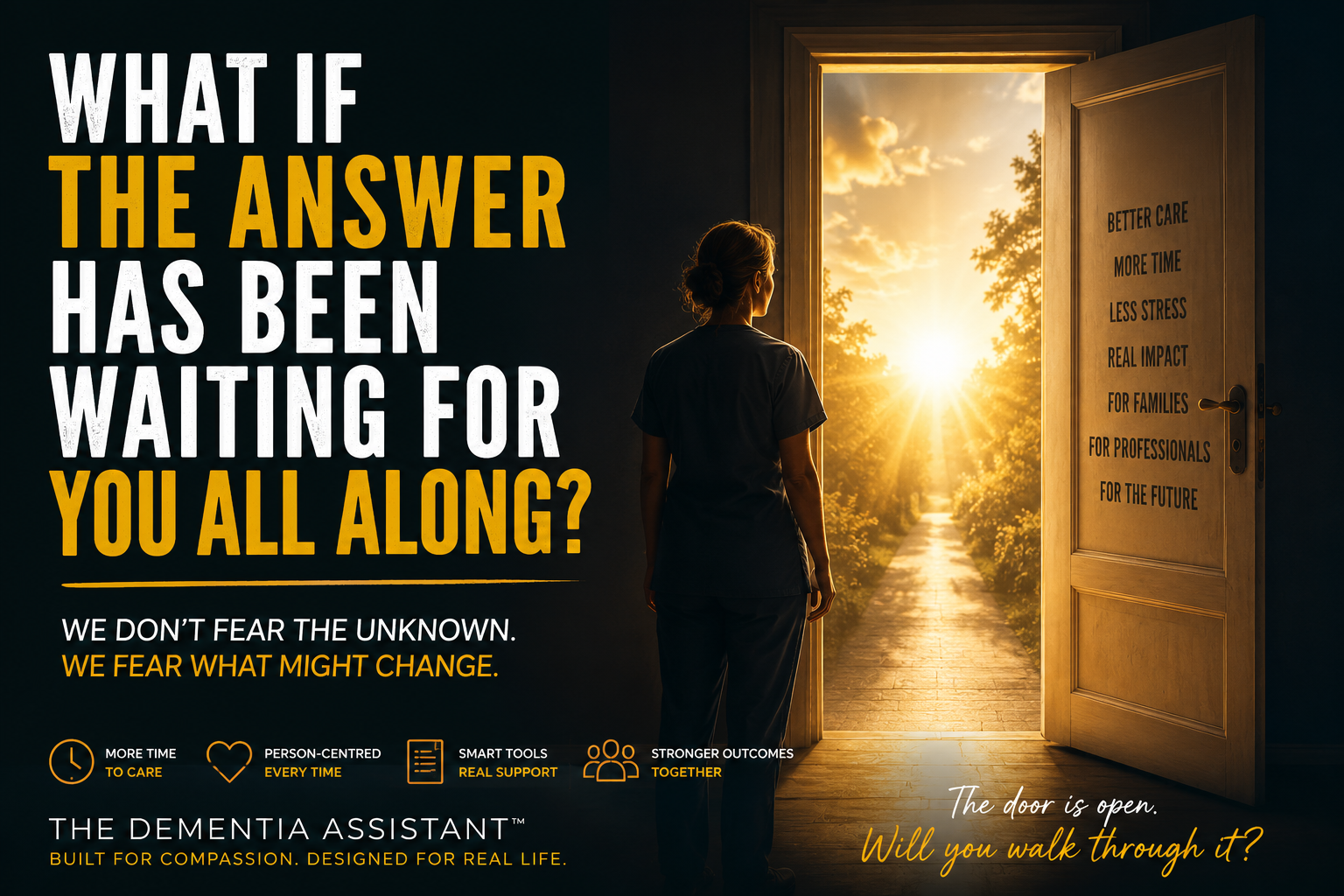
What If What You Need Has Already Been Built?
What if the answer you’ve been searching for is already here?
Not next year.
Not after another meeting.
Not after another report.
Not after someone else gives you permission.
What if it’s simply waiting for you to open the door?
That first step is often the hardest.
Not because the door is locked, but because we don’t know what waits on the other side.
As human beings, we’re naturally cautious. For thousands of years, that instinct kept us alive. Our minds are designed to look for risk before reward, to question before we trust, and to protect us from the unknown.
So when something new appears, our minds begin asking questions.
What if it doesn’t work?
What if I don’t understand it?
What if I waste my time?
What if I look foolish?
What if it changes the way I’ve always done things?
Sometimes we call it hesitation.
Sometimes we call it caution.
But often, it’s simply fear.
Not necessarily fear of failure.
Sometimes it’s fear of success.
Sometimes it’s fear of change.
Sometimes it’s fear of discovering that there really is a better way.
And perhaps there’s another fear we rarely admit.
Is it the expense?
Or is it simply the fear that the expense will be too high?
How many opportunities do we dismiss before we’ve even explored them?
How many solutions do we walk away from because we’ve already convinced ourselves they’re beyond our reach?
We assume.
We guess.
We create barriers that may not even exist.
Yet often, one conversation, one demonstration or one click is enough to replace uncertainty with understanding.
The greatest cost isn’t always financial.
Sometimes the greatest cost is continuing to struggle with the same problems because we’re too afraid to see whether there’s another way.
I understand that feeling more than most.
The Dementia Assistant® didn’t begin as software.
It began as a question.
“There has to be a better way.”
For years, that question stayed in my mind.
I carried it through every conversation with families.
Every visit with someone living with dementia.
Every moment I saw exhausted carers trying to balance compassionate care with endless paperwork.
I could see what was missing.
But seeing something and building it are two very different things.
It took years to find the courage to create it.
Not because the technology was impossible.
But because creating something completely new means stepping into the unknown yourself.
There were moments of doubt.
Moments when I questioned whether anyone else would understand the vision.
Moments when I wondered whether it would ever become more than an idea.
Then I realised something.
The greatest risk wasn’t building it.
The greatest risk was leaving it unfinished.
Today, The Dementia Assistant® exists because that fear didn’t win.
It has been built around one simple belief:
Technology should strengthen compassionate care, not replace it.
It helps families keep their loved one’s story together.
It helps professionals create genuinely person-centred care plans.
It allows carers to dictate care notes in their own language, automatically translating them into the country’s language, making communication easier across diverse care teams.
It brings together knowledge, guidance and intelligent support while ensuring that people remain at the heart of every decision.
Yet even now, I find myself asking another question.
Why are people sometimes afraid to try something that has been created to help them?
I don’t believe it’s because they don’t care.
I think it’s because every meaningful change begins with uncertainty.
Every innovation once felt unfamiliar.
The internet.
Online banking.
Video calls.
Smartphones.
Artificial intelligence.
At one time, each of these felt uncomfortable.
Today, most of us use them without a second thought.
Perhaps The Dementia Assistant® is simply at that same moment.
Not because people don’t need it.
But because taking the first step always feels harder than taking the second.
Maybe what stands between someone and a tool that could genuinely make life easier isn’t the technology at all.
Maybe it’s simply the courage to ask for a demonstration.
To explore.
To remain curious.
To imagine that things could be different.
Because here’s another thought.
What if the thing you’re avoiding is the very thing that gives you back time?
What if it helps you understand the person behind the diagnosis?
What if it reduces stress for families?
What if it gives carers greater confidence?
What if it allows professionals to spend less time completing paperwork and more time doing what they entered care to do—care?
These aren’t really questions about technology.
They’re questions about possibility.
Every meaningful step forward begins with someone willing to say,
“I’ll have a look.”
Not because they know exactly what they’ll find.
But because they’re willing to believe tomorrow could be better than today.
So perhaps the question isn’t whether The Dementia Assistant® is ready.
It is.
The real question is this.
What are you actually afraid of?
Is it the technology?
Is it the change?
Is it the cost?
Or is it the possibility that what you’ve been searching for has already been built… and it’s simply waiting for you to open the door?
Sometimes the greatest leap we ever take isn’t into danger.
It’s into possibility.
Request a demo today break the fear https://thedementiaassistant.com