What Happens If My Parents Develop Dementia and There Is No LPA in Place?
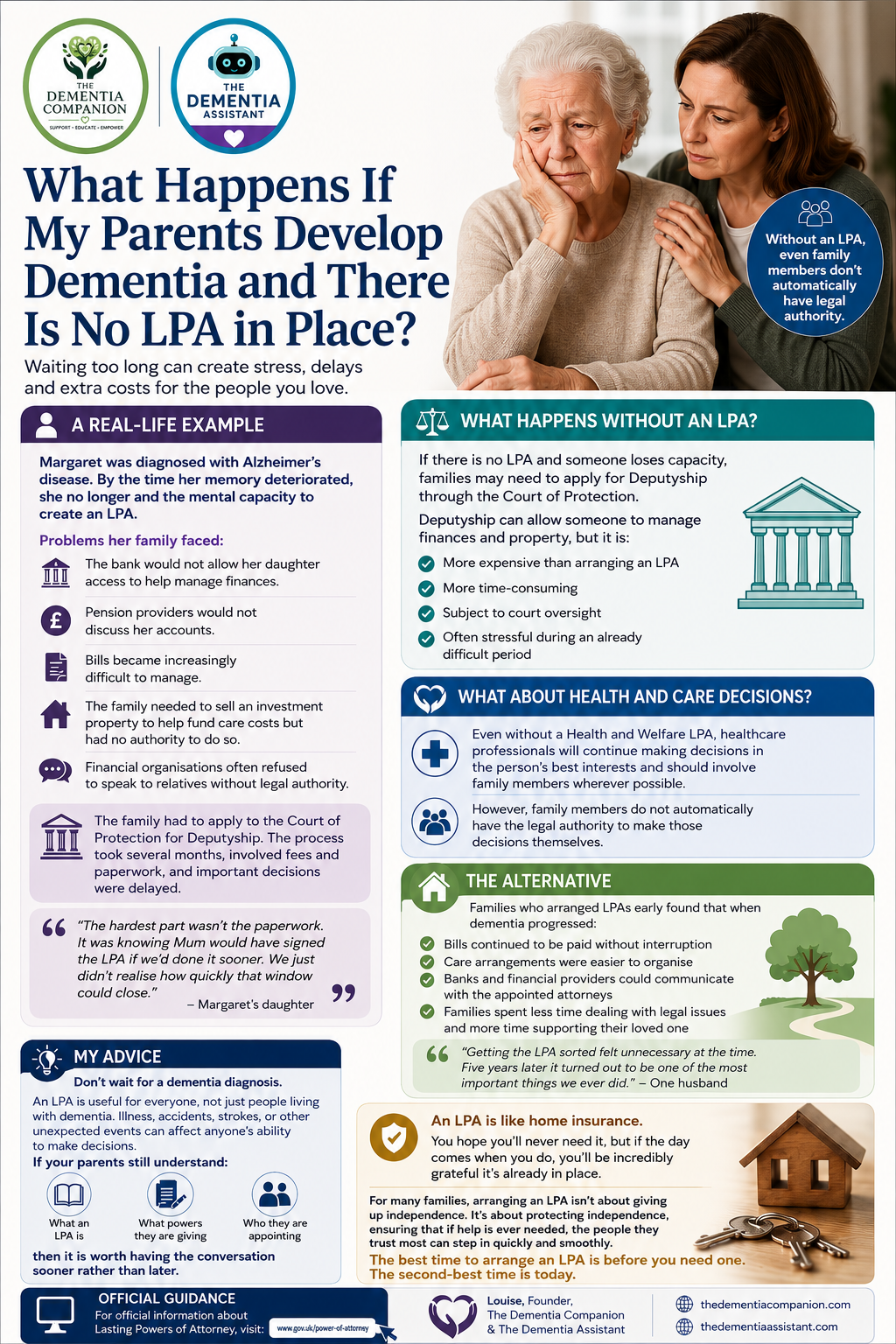
What Happens If My Parents Develop Dementia and There Is No LPA in Place?
This is one of those conversations that many families avoid because nobody likes thinking about a future where a parent may need help making decisions. Unfortunately, waiting too long can create significant challenges later on.
If a person develops dementia and loses the mental capacity to understand and sign legal documents, it is usually too late to create a Lasting Power of Attorney (LPA). At that point, even a husband, wife, son, or daughter does not automatically have the legal right to manage finances, access bank accounts, sell property, or make certain decisions on their behalf.
Many families are surprised by this.
A Real-Life Example
Margaret was diagnosed with Alzheimer’s disease in her late seventies. Her family had discussed arranging LPAs several times, but life got busy and it was always something they planned to do “later.”
A couple of years after her diagnosis, Margaret’s memory deteriorated. She could no longer understand what an LPA was, what powers she would be giving someone, or the consequences of signing it. Because of this, she no longer had the mental capacity required to create one.
The family assumed her husband and daughter would automatically be able to manage things for her.
Unfortunately, that wasn’t the case.
Problems soon began to arise:
• The bank would not allow her daughter access to help manage finances.
• Pension providers would not discuss her accounts.
• Bills became increasingly difficult to manage.
• The family needed to sell an investment property to help fund care costs but had no authority to do so.
• Financial organisations often refused to speak to relatives without legal authority.
The family eventually had to apply to the Court of Protection for Deputyship.
The process took several months and involved application fees, paperwork, and ongoing reporting requirements. During that time, important financial decisions were delayed while the family waited for approval.
Margaret’s daughter later said:
“The hardest part wasn’t the paperwork. It was knowing Mum would have signed the LPA if we’d done it sooner. We just didn’t realise how quickly that window could close.”
What Happens Without an LPA?
If there is no LPA and someone loses capacity, families may need to apply for Deputyship through the Court of Protection.
Deputyship can allow someone to manage finances and property, but it is:
• More expensive than arranging an LPA.
• More time-consuming.
• Subject to court oversight.
• Often stressful during an already difficult period.
What About Health and Care Decisions?
Even without a Health and Welfare LPA, healthcare professionals will continue making decisions in the person’s best interests and should involve family members wherever possible.
However, family members do not automatically have the legal authority to make those decisions themselves.
The Alternative
I’ve also seen families who arranged LPAs early, often shortly after noticing memory problems or receiving a diagnosis.
When dementia later progressed:
• Bills continued to be paid without interruption.
• Care arrangements were easier to organise.
• Banks and financial providers could communicate with the appointed attorneys.
• Families spent less time dealing with legal issues and more time supporting their loved one.
One husband told me:
“Getting the LPA sorted felt unnecessary at the time. Five years later it turned out to be one of the most important things we ever did.”
My Advice
Don’t wait for a dementia diagnosis.
An LPA is useful for everyone, not just people living with dementia. Illness, accidents, strokes, or other unexpected events can affect anyone’s ability to make decisions.
If your parents still understand:
• What an LPA is,
• What powers they are giving,
• Who they are appointing,
then it is worth having the conversation sooner rather than later.
I often tell families that an LPA is like home insurance. You hope you’ll never need it, but if the day comes when you do, you’ll be incredibly grateful it’s already in place.
For many families, arranging an LPA isn’t about giving up independence. It’s about protecting independence, ensuring that if help is ever needed, the people they trust most can step in quickly and smoothly.
The best time to arrange an LPA is before you need one. The second-best time is today.
Official Guidance
For official information about Lasting Powers of Attorney, visit:
https://www.gov.uk/power-of-attorney
⸻
Louise, Founder, The Dementia Companion & The Dementia Assistant
🌐 https://thedementiacompanion.com
🌐 https://thedementiaassistant.com