Walking Into Their Reality: Person-Centred Dementia Care in Practice
Walking Into Someone Else’s Reality: What Person-Centred Dementia Care Really Looks Like
By Louise Donaghy, Founder of The Dementia Assistant® and Creator of Hugo Intelligence™
People talk a lot about person-centred dementia care.
But what does it actually look like when you are standing in somebody’s living room and the reality they are experiencing is completely different from the one you can see?
I work on a daily basis with people living with dementia, and one of my most wonderful clients is a Greek lady who experiences delusions and hallucinations.
When I arrive at her home, I genuinely never know who is going to be there.
At least, who is going to be there in her reality.
Sometimes I Walk Into a House Full of People
One day her grandchildren may be visiting.
Another day, her brother, who has died, and his wife may be staying over.
Sometimes the entire family is gathered around the dining table having dinner.
To me, the room may appear empty.
But to her, it isn’t empty at all.
Around the table are chairs, food, drinks and photographs. On individual chairs there may be photographs of the people she believes are sitting with us.
That means I cannot simply walk in, pull out a chair and sit down.
What if somebody is already sitting there?
I have learned to scan the table, work out where everybody is supposed to be and strategically find myself an empty chair.
Then I join them.
Thankfully, I have a very good imagination.
I have attended some incredible family gatherings in that room. I’ve had tea parties, conversations and meals with people I cannot see. I’ve encountered unexpected visitors and relatives staying overnight.
Someone looking through the window might wonder what on earth I am doing.
But I am not there to make the situation make sense to me.
I am there to support the person in front of me.
And then, one morning, something completely different happened.
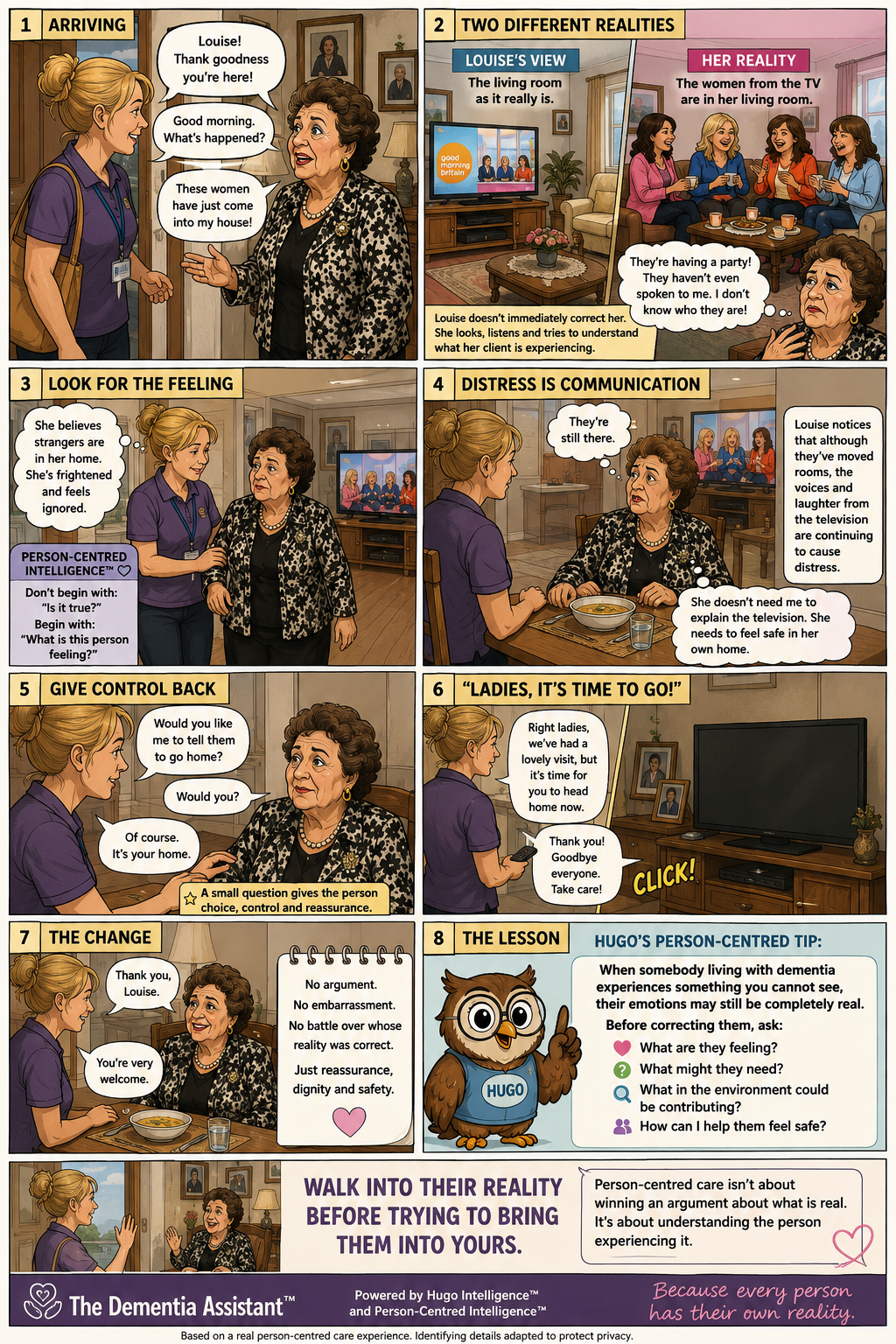
“Who Are These Women in My House?”
I arrived and could hear the television playing in the background.
My client answered the door beautifully dressed. Her hair was done, her make-up was on, she had chosen a lovely outfit and shoes.
But immediately I knew something was wrong.
She was distressed.
There were women in her living room, she told me.
They had apparently let themselves into her house and were sitting there having a party, laughing and talking among themselves.
Worse still, they were completely ignoring her.
She didn’t know who they were.
She didn’t know why they were in her home.
And she wanted them gone.
I quickly looked around the room.
There wasn’t anybody there.
Then I looked at the television.
A daytime panel programme was playing. Several women were sitting together, chatting and laughing.
I realised what was happening.
She was experiencing the people on the television as though they were physically present in her living room.
But here’s the important part.
Telling her:
“There’s nobody there. They’re only on the television.”
would not necessarily have solved anything.
Because while I knew they weren’t sitting in her living room, she was experiencing them as if they were.
And the distress that experience was causing was absolutely real.
I Didn’t Correct Her. I Looked for What She Needed.
We walked through the living room together.
As far as she was concerned, we were walking straight past these unwanted visitors.
We continued into the dining room and kitchen, chatting as we went.
We went through our normal morning routine. I asked how she was. I prepared her lunch. She had her medication.
But I continued observing her.
The women were still talking and laughing behind me on the television.
And I could see my client’s agitation increasing.
That’s when I asked her a very simple question.
“Would you like me to tell them to go home?”
Her response was immediate.
Would I?
Of course I would.
It was her home.
If these people weren’t welcome, then as far as she was concerned, somebody needed to ask them to leave.
So while she ate her lunch, I found the remote control.
And then I had a full conversation with the women on the television.
I politely told them that it was time to go.
I said goodbye.
And then I switched off the television.
If somebody had walked into the room at that exact moment, they might have thought I’d completely lost the plot.
But something remarkable happened.
My client relaxed.
The unwanted visitors had gone.
She was thankful.
She was calmer, happier and more settled than I had seen her in a long time.
Her Reality Didn’t Need an Argument
I could have corrected her.
I could have explained television screens.
I could have repeatedly told her that nobody had entered her home.
I could have tried to bring her into my reality.
But what purpose would that have served in that moment?
She wasn’t asking me for a technical explanation of what a television was.
She was telling me:
There are strangers in my home. I don’t feel comfortable. I want them to leave.
That was the message underneath the words.
Once I understood that, the response became very different.
I wasn’t agreeing with her simply for the sake of agreeing.
I was responding to the emotion and need behind what she was experiencing.
She needed to feel safe.
She needed to feel heard.
And, importantly, she needed to feel that she still had control over her own home.
So I gave that control back to her.
This Is What I Mean by Walking Into Someone Else’s Reality
For me, person-centred dementia care isn’t something that exists only in a care plan, policy document or training course.
It is something you have to live.
It means noticing the person’s face, voice, body language and environment.
It means listening to what is being communicated underneath the words.
It means understanding that behaviour has meaning.
And sometimes it means temporarily stepping outside everything that makes logical sense to you and asking:
What does this situation feel like to this person?
Because once you understand that, you can begin to understand what they may need from you.
Tomorrow, I could arrive and find the dining room filled with relatives again.
Someone may already be sitting in my usual chair.
We might be having a family dinner.
Or there may be nobody there at all.
That’s dementia.
The response cannot always be scripted because the person and their experience come first.
This Is Why I Created The Dementia Assistant® and Taught Hugo Differently
Experiences like this have shaped how I have developed The Dementia Assistant® and Hugo Intelligence™.
I didn’t want Hugo simply to know information about dementia.
There is an enormous difference between knowing dementia theory and knowing how to respond to a human being experiencing dementia in a particular moment.
A generic response might say:
“The person may be hallucinating. Reassure them and avoid confrontation.”
That’s useful knowledge.
But in someone’s home at lunchtime, when they believe several television presenters have invaded their living room, you need more than a definition.
You need to think about the person.
What are they seeing?
What are they feeling?
What is frightening or upsetting them?
What does their behaviour communicate?
What is happening in the environment?
What could reduce the distress without unnecessarily correcting, humiliating or arguing with them?
And what response preserves their dignity, autonomy and sense of safety?
That is the thinking I have tried to put into Hugo.
Not simply:
“What does dementia guidance say?”
But:
“What might this particular person need from me right now?”
That is Person-Centred Intelligence®.
And sometimes, person-centred dementia care looks highly professional and clinical.
Sometimes it looks like sitting quietly and listening.
Sometimes it means finding the one empty chair at a table filled with people only one person can see.
And occasionally, it means politely asking the Loose Women to leave someone’s house.
Because if it restores someone’s safety, dignity and peace, that seemingly ridiculous conversation might just be the most person-centred thing you do all day.
Louise Donaghy
Founder & CEO, The Dementia Assistant®
Creator of Hugo Intelligence™ and Person-Centred Intelligence®