UTIs are one of the most common issues I come across when supporting people living with dementia, and they can cause some of the most dramatic changes in behaviour.
UTIs are one of the most common issues I come across when supporting people living with dementia, and they can cause some of the most dramatic changes in behaviour.
I remember supporting a lady with dementia who suddenly became convinced that strangers were living in her house. She was frightened, accusing family members of stealing, and became very distressed. Her family thought her dementia had suddenly progressed overnight. A urine sample confirmed a UTI, and after treatment she gradually returned to her usual self. The dementia was still there, but the hallucinations and extreme confusion settled significantly.
Another gentleman I supported became unusually aggressive and refused all care. This was completely out of character. His family were heartbroken and thought they were “losing him” to dementia. It turned out he had a severe UTI and was unable to explain that he was uncomfortable. Once treated, he became much calmer and more cooperative again.
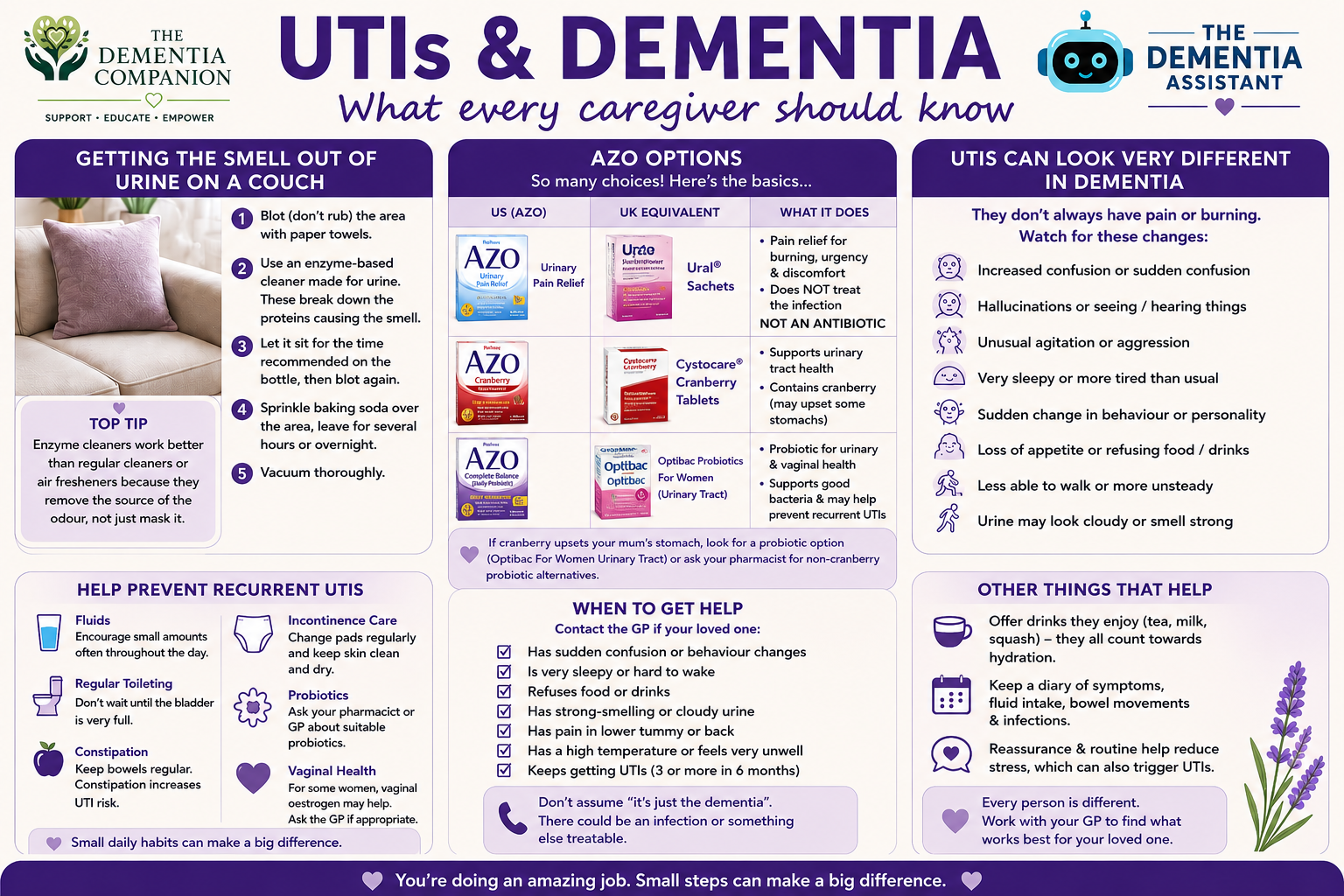
For the couch smell, unfortunately many families dealing with dementia and incontinence know exactly what you’re talking about. One family I worked with tried every air freshener available, but the smell always came back. The issue was that urine had soaked deep into the sofa cushions. An enzyme cleaner designed specifically for urine worked much better because it actually broke down the urine proteins rather than masking the smell.
As for preventing recurrent UTIs, some things I’ve seen help include:
💜 Encouraging small amounts of fluid frequently throughout the day rather than expecting someone with dementia to drink a large glass all at once.
💜 Leaving drinks visible and within reach. If they can’t see it, they often forget to drink it.
💜 Offering drinks they enjoy rather than focusing only on water. Tea, milk, squash, and some fruit can all contribute to hydration.
💜 Watching for constipation. Constipation is a huge but often overlooked contributor to UTIs.
💜 Prompting regular toileting, as some people with dementia forget they need to go or delay using the toilet.
💜 Ensuring continence products are changed regularly.
💜 Looking for early warning signs such as increased confusion, sleeping more than usual, hallucinations, paranoia, agitation, or sudden changes in mobility.
One thing I often tell families is this:
Not every change is “the dementia getting worse.”
When somebody with dementia suddenly changes over hours or a few days, I always think about infection, dehydration, constipation, pain, medication changes, or other illnesses before assuming it’s disease progression.
I’ve lost count of how many times families have told me, “We thought we were at the next stage of dementia,” only to discover that a UTI, chest infection, dehydration, or constipation was the real culprit.
If your loved one is having repeated UTIs, it’s worth keeping a simple diary of:
📝 Dates of infections
📝 Symptoms
📝 Fluid intake
📝 Bowel movements
📝 Antibiotics prescribed
Patterns often emerge that can help the GP identify what’s contributing to the problem.
And remember, if someone with dementia suddenly becomes much more confused, develops hallucinations, becomes very sleepy, stops eating or drinking, or seems significantly different from their usual self, it’s always worth considering a UTI or another underlying illness.
For more dementia support, practical guidance, and real-life caregiving advice:
The Dementia Companion
The Dementia Assistant
Louise, Founder, The Dementia Companion & The Dementia Assistant 💜