The Dementia Assistant | Person-Centred AI Platform
AI Can Answer Questions. But Can It Understand the Person?
The Next Generation of Dementia AI Has Arrived
Artificial intelligence is changing healthcare at an incredible pace.
Every week another AI assistant appears.
Another chatbot.
Another promise to revolutionise care.
But there is one question I rarely see being asked.
Who is the AI actually designed for?
As someone who has spent decades working alongside people living with dementia, families and care professionals, I’ve learned something that no algorithm should ever forget.
The person always comes before the condition.
That belief has become the foundation of everything we’re building inside The Dementia Assistant.
Not simply an AI that provides answers.
But an AI that helps people understand.
⸻
We Didn’t Want Another Chatbot
There are now thousands of AI systems capable of producing information.
Information has become easy.
Understanding has not.
Many AI systems can explain what dementia is.
Far fewer can help someone understand why Mary suddenly became distressed when personal care began.
Even fewer will suggest that perhaps she wasn’t refusing support at all.
Perhaps she was frightened.
Perhaps she didn’t recognise the person standing beside her.
Perhaps she simply needed more time.
That change in thinking changes everything.
⸻
A Different Philosophy
Every AI feature inside The Dementia Assistant begins with six simple principles.
Person before condition.
Strengths before limitations.
Abilities before disabilities.
Choice before routine.
Dignity before documentation.
Understanding before judgement.
These principles sit underneath Hugo, Behaviour Detective, Risk Assessments, Care Planning, Daily Care Notes, Voice Dictation and Care Coach.
They aren’t optional.
They are the foundation.
⸻
Education Hidden Inside Every Answer
One of the biggest problems in dementia care is that people are often told what to do…
…without understanding why.
We wanted to change that.
Whenever appropriate, our AI explains the reasoning behind its suggestions using clear, evidence-informed language.
That means every interaction becomes a learning opportunity.
Families become more confident.
New carers develop skills.
Experienced professionals gain fresh perspectives.
Education is no longer something you complete once.
It becomes part of everyday care.
⸻
Imagine the Difference
Instead of documenting:
“Mary refused personal care.”
Our AI might suggest:
“Mary appeared anxious during personal care this morning. After reassurance and allowing more time, she became more relaxed and accepted support. Gentle conversation about her family appeared to reduce her anxiety.”
The facts haven’t changed.
The understanding has.
And better understanding often leads to better care.
⸻
A Voice That Gives Time Back
Documentation is one of the greatest pressures facing health and social care.
Too often carers spend more time looking at screens than looking at people.
With one-tap person-centred voice dictation, carers can simply talk naturally while supporting someone.
The AI listens.
Structures the information.
Improves the wording.
Removes judgemental language.
Produces professional documentation.
That means more eye contact.
More conversation.
More human connection.
Exactly where care should be.
⸻
Looking Through Different Eyes
One situation.
Many perspectives.
The Person Living with Dementia
“I don’t know why everyone keeps rushing me.”
Their Daughter
“Mum has never behaved like this before.”
The Professional Carer
“I need to understand what triggered today’s distress.”
The Nurse
“Could pain, infection or medication be contributing?”
The Occupational Therapist
“Is the environment making this more difficult?”
The AI
“What might this behaviour be communicating?”
The aim isn’t to replace professional judgement.
It’s to encourage curiosity before conclusions.
⸻
Built for Families
Families often tell me they don’t need more medical terminology.
They need someone to explain why their loved one wants to go home.
Why they think someone has stolen their handbag.
Why evenings become more difficult.
Our AI combines education with practical guidance, helping families respond with understanding rather than fear.
⸻
Built for Professionals
Professional users gain tools that support better practice without replacing clinical judgement.
Including:
• Voice Dictation
• Daily Care Notes
• Risk Assessments
• Behaviour Detective
• Communication Profiles
• Hospital Passports
• Care Planning
• Reflective Documentation
• Professional Resources
• Dementia Academy
The aim is simple.
Better documentation.
Better understanding.
Better outcomes.
⸻
Learning Never Stops
One of the things I’m most proud of is that education is becoming part of everyday care.
Whether someone is:
Using Hugo…
Completing a Care Plan…
Writing Daily Notes…
Completing Dementia Academy…
Reviewing behaviour…
Or simply asking a question…
They’re learning.
Confidence grows naturally.
Knowledge builds every day.
Better care follows.
⸻
What’s Already Live
We’re proud to announce another major milestone.
Person-centred care is now embedded across every carer-facing AI surface.
Already available:
✅ Person-Centred Review
✅ Reflective Documentation Prompts
✅ One-Tap Person-Centred Voice Dictation
✅ Behaviour Detective Person-Centred Lens
✅ Risk Assessment Person-Centred Lens
✅ Global Person-Centred AI Framework
✅ Automatic Language Review
✅ Eight-language support
This isn’t another feature.
It’s the operating system behind every AI response.
⸻
Looking One Step Ahead
Innovation doesn’t stop here.
The next generation of The Dementia Assistant is already being designed.
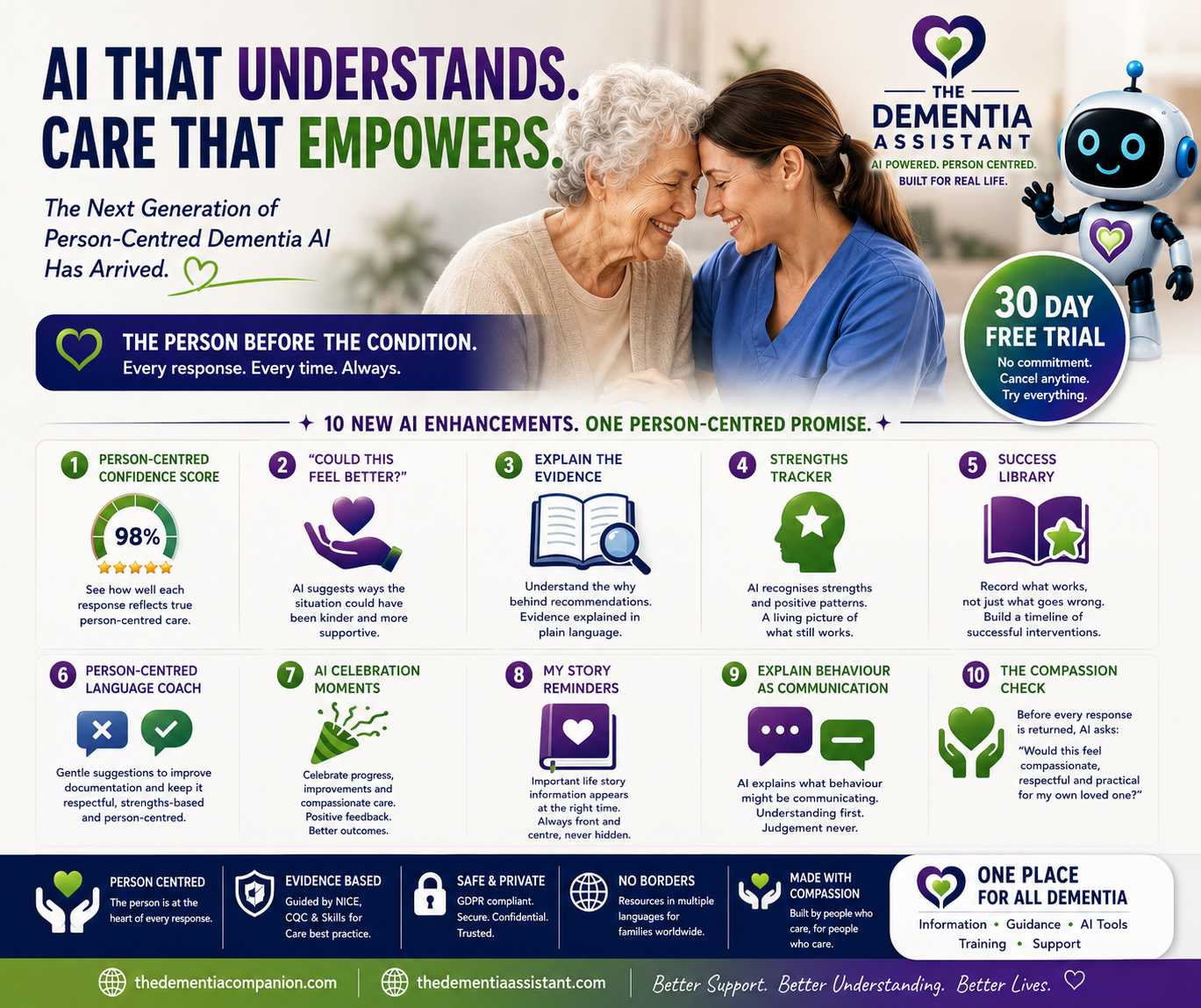
⭐ Person-Centred Confidence Score
Every response will display how strongly it reflects person-centred care based on dignity, independence, communication, life story, emotional wellbeing and strengths.
Not as a gimmick.
As another learning opportunity.
⸻
❤️ “Could This Feel Better?”
Before documentation is completed, the AI will ask:
Could this situation have been made easier for the person?
Perhaps:
• More time
• Different communication
• Music
• Less noise
• Family involvement
• Better timing
Instead of recording what happened…
we begin exploring what could help.
⸻
📚 Explain the Evidence
Recommendations won’t simply appear.
Users will be able to see why.
Evidence.
Best practice.
Plain English.
Helping people build confidence rather than dependency.
⸻
🌱 Strengths Tracker
Instead of only recording problems…
The AI will remember successes.
Still enjoys gardening.
Responds well to grandchildren.
Independent with dressing.
Loves music before breakfast.
A living picture of what still works.
⸻
⭐ Success Library
Most systems remember incidents.
We also want to remember victories.
What worked?
What reduced distress?
What brought joy?
What increased independence?
Those successes become personalised care knowledge.
⸻
✍️ Person-Centred Language Coach
The AI will gently improve documentation.
Instead of:
“Assisted with feeding.”
It may suggest:
“Supported John to enjoy his lunch at his own pace while encouraging independence wherever possible.”
Small changes.
Huge difference.
⸻
🎉 AI Celebration Moments
Care is emotionally demanding.
Sometimes people need reminding they’re doing well.
The platform will celebrate progress.
Excellent documentation.
Growing confidence.
Improved communication.
Outstanding person-centred care.
Because encouragement matters too.
⸻
❤️ My Story Reminders
Before major care planning…
Life story reminders appear automatically.
“Mary loves gardening.”
“John always prefers tea before personal care.”
“Margaret feels calmer with classical music.”
The person remains visible.
Always.
⸻
💬 Behaviour as Communication
Rather than asking:
“How do we stop this behaviour?”
The AI asks:
“What might this behaviour be communicating?”
That single question can completely change someone’s care experience.
⸻
🌿 The Compassion Check
Before every response is returned…
One final question.
If this advice were for my own loved one…
Would it still feel compassionate?
If not…
The response improves before anyone ever sees it.
⸻
What Makes This Different?
Many AI systems begin with one question.
What can AI do?
We begin with another.
What does this person need?
One builds technology.
The other builds trust.
⸻
Our Vision
We’re not trying to build the cleverest dementia AI.
We’re trying to build the most compassionate.
One that protects dignity.
Encourages independence.
Strengthens families.
Supports professionals.
Builds confidence through education.
Explains behaviour instead of judging it.
And never loses sight of the person behind the diagnosis.
Because in dementia care…
The greatest innovation isn’t artificial intelligence.
It’s using intelligence—human and artificial—to help another human being feel understood.
That is the future we’re building.
One person.
One family.
One conversation at a time.
⸻
Louise Donaghy
Founder, The Dementia Companion & The Dementia Assistant
One Place for All Dementia.
Every Person. Every Family. Everywhere.