The Day My Baby Graduated – The Story Behind The Dementia Assistant®
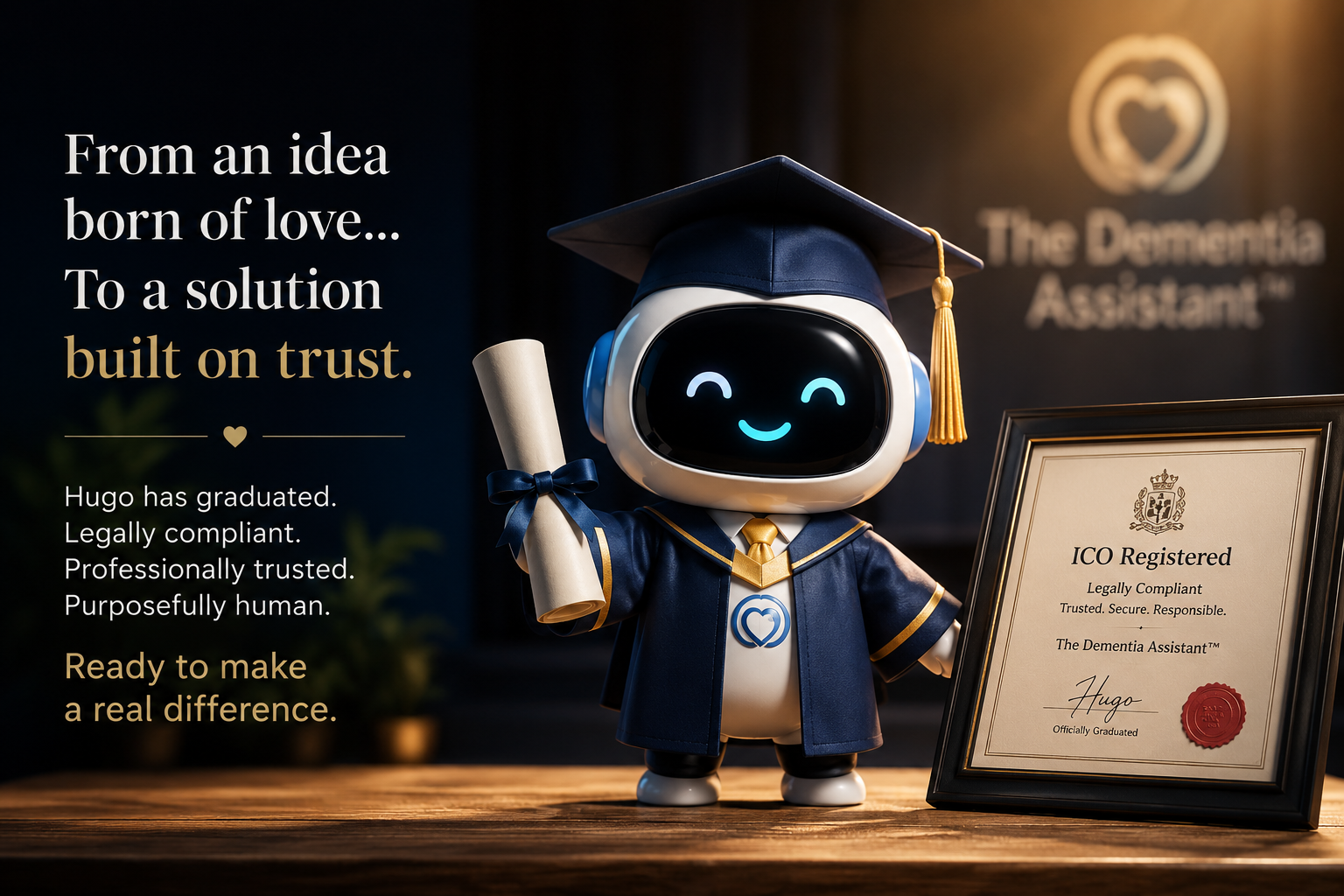
The Day My Baby Graduated
There are moments in life that seem almost invisible to everyone else.
A single email.
A reference number.
A notification that quietly lands in your inbox before the world carries on as though nothing has changed.
For me, that moment arrived with my ICO registration reference.
To most people, it was just another number.
To me, it represented years of determination, sacrifice, learning, fear and hope. It marked the moment I realised that something which had once existed only in my imagination had become something real—something accountable, something responsible and something ready to be trusted.
I stared at the screen for longer than I care to admit.
Then I cried.
Not polite tears.
Not the sort you quietly wipe away before anyone notices.
The kind that arrive when your heart finally allows itself to believe that you’ve made it through the hardest part of the journey.
Because in that moment, The Dementia Assistant®—created and powered by Person-Centred Intelligence® and guided by Hugo Intelligence™—was no longer simply an idea.
My baby had graduated.
Nobody Tells You About This Part
People often tell me how exciting it must have been building a technology platform.
They’re right.
For about three days.
After that, excitement gives way to reality.
Reality looks remarkably like hundreds of pages of policies, governance documents, security reviews, legal requirements, privacy legislation, accessibility standards, compliance frameworks and questions you never imagined existed.
Every answer creates three more questions.
Every completed document leads to another.
Somewhere along the journey I found myself wondering whether I’d accidentally retrained as a solicitor, a cyber security consultant and a data protection officer—all without the salary that usually comes with those job titles.
Building software, as it turns out, isn’t the difficult part.
Building trust is.
Trust cannot be designed with beautiful graphics.
It cannot be programmed into code.
It has to be earned, document by document, decision by decision and promise by promise.
The public never sees that side of a founder’s life.
They don’t see the evenings spent reading the same paragraph for the fifteenth time because you’re no longer certain whether you’ve written it correctly or whether your eyes have simply stopped cooperating.
They don’t see the moments where you close your laptop convinced everything is finally finished, only to wake up at three o’clock in the morning wondering if you’ve forgotten something important.
If overthinking were an Olympic event, I’d almost certainly have brought home a medal wrapped in a Union Jack.
The Quiet Fear Behind Every Founder
People sometimes imagine founders as fearless.
The truth is very different.
Most of us are simply good at smiling while quietly worrying.
Every decision carries responsibility.
Every new feature raises another question.
Every policy makes you wonder whether you’ve considered every possible scenario.
There were countless moments when I asked myself:
“Have I missed something?”
“Is this good enough?”
“Would I trust this if I were someone else’s family?”
Those questions became the standard I worked towards.
Not perfection.
Trust.
Because dementia care isn’t just about technology.
It’s about people’s lives.
Their parents.
Their partners.
Their grandparents.
Their futures.
Nothing about that responsibility should ever be taken lightly.
The Moment Everything Changed
Slowly, things began to come together.
The governance framework was completed.
The security controls were documented.
The evidence library grew.
The compliance publications took shape.
Every policy strengthened another foundation.
Every review made the platform stronger.
Every improvement brought me one step closer to the platform I’d imagined years earlier.
Then the email arrived.
My ICO registration reference.
Again, to almost everyone else it was simply another administrative step.
To me, it represented years of wondering whether I could genuinely build something worthy of people’s confidence.
That single email confirmed something far bigger than registration.
It confirmed accountability.
It confirmed responsibility.
It confirmed that this dream had become a real organisation.
And once again…
I cried.
The Feedback That Meant Everything
Then something happened that no compliance certificate, policy or legal document could ever provide.
People began talking about Hugo.
Not because I’d asked them to.
Not because I’d marketed him.
Because they’d used him.
Professionals I’d never met began sharing their experiences.
They told me:
“The dictation is incredible.”
“It understands exactly what I’m trying to say.”
“The translations are brilliant.”
“It actually teaches you while you’re completing the documentation.”
“It’s like having another experienced colleague sitting beside you.”
“I’ve never completed care documentation this quickly.”
Those comments meant more than they probably realised.
Because they weren’t compliments about technology.
They were confirmation that compassion had survived the journey from an idea into something people could genuinely experience.
Every one of those comments took me back to my Granda
Back to sitting beside him that smile even when he didn’t know my name, he knew me.
Back to watching dementia slowly change the person I loved, more than anything.
Back to asking myself the question that ultimately started this entire journey:
“Surely we can do better than this?”
Technology Should Never Replace Compassion
I never wanted to create another digital form.
There are plenty of those.
I never wanted artificial intelligence to replace professional judgement.
It shouldn’t.
Instead, I wanted to create something that quietly supports people while they work.
Something that helps families feel less alone.
Something that gives professionals confidence rather than criticism.
Something that encourages better thinking instead of replacing it.
Behind every care plan sits Hugo Intelligence™, bringing together Person-Centred Intelligence®, evidence-informed dementia knowledge and practical guidance.
Not to tell someone what to write.
But to help them think.
To encourage reflection.
To build confidence.
To strengthen professional practice.
Most importantly, to keep the individual—not the diagnosis—at the centre of every conversation.
The dictation system allows people to speak naturally before transforming those thoughts into clear, structured documentation.
The platform doesn’t simply record information.
It supports learning.
It encourages reflection.
It quietly coaches while people work.
That has always been the vision.
Not technology for technology’s sake.
But technology designed with humanity at its heart.
Looking Back
Looking back now, I realise I wasn’t simply building software.
I was building the platform I desperately wish had existed years ago.
A place where families could find guidance without judgement.
Where professionals could feel supported rather than criticised.
Where learning happens naturally while delivering care.
Where knowledge, compassion and technology work together instead of competing.
That dream became The Dementia Assistant®—created and powered by Person-Centred Intelligence® and guided by Hugo Intelligence™.
Today, the platform is live.
It is supporting families.
It is helping professionals.
It is growing every single day.
Most importantly, with every person it helps, trust continues to grow alongside it.
For the first time since this journey began, I allowed myself to stop.
Just for a moment.
To breathe.
To smile.
And quietly whisper to myself,
“We actually did it.”
Tomorrow there will be another update.
Another feature.
Another improvement.
That’s simply the life of a founder.
But tonight…
Tonight I’m just someone feeling incredibly proud of what has been achieved.
And if you happen to find me celebrating with an enormous mug of tea, a family-sized bar of chocolate and a smile that refuses to disappear…
Please don’t judge.
I’ve earned every single square.
Success Looks Different
Success isn’t always measured by downloads.
Or awards.
Or headlines.
Sometimes success arrives quietly.
Sometimes it arrives as a reference number in an email.
Sometimes it’s hearing a care professional say they’ve completed their documentation with more confidence than ever before.
Sometimes it’s knowing that a family felt a little less frightened because they found the support they needed.
Those are the moments that matter.
The Dementia Assistant® wasn’t built to become another app.
It was built to become a trusted companion for families, carers and professionals navigating one of life’s most challenging journeys.
This platform was born from grief.
It was shaped by hope.
Strengthened through determination.
Built with compassion.
Grounded in governance.
And inspired every single day by the people living with dementia who deserve better.
Today, my baby graduated.
Tomorrow, the work continues.
Because dementia care deserves nothing less.
⸻
With love,
Louise Donaghy, Founder & CEO of The Dementia Assistant®—created and powered by Person-Centred Intelligence®—and Creator of Hugo Intelligence™.
In loving memory of Albert Geehan (My Granda).
“Your kindness, strength and love continue to inspire everything I do. This journey carries a part of you with it, every single day.”