Should You Tell Someone With Dementia That They Are Hallucinating? A Dementia Practitioner’s Perspective
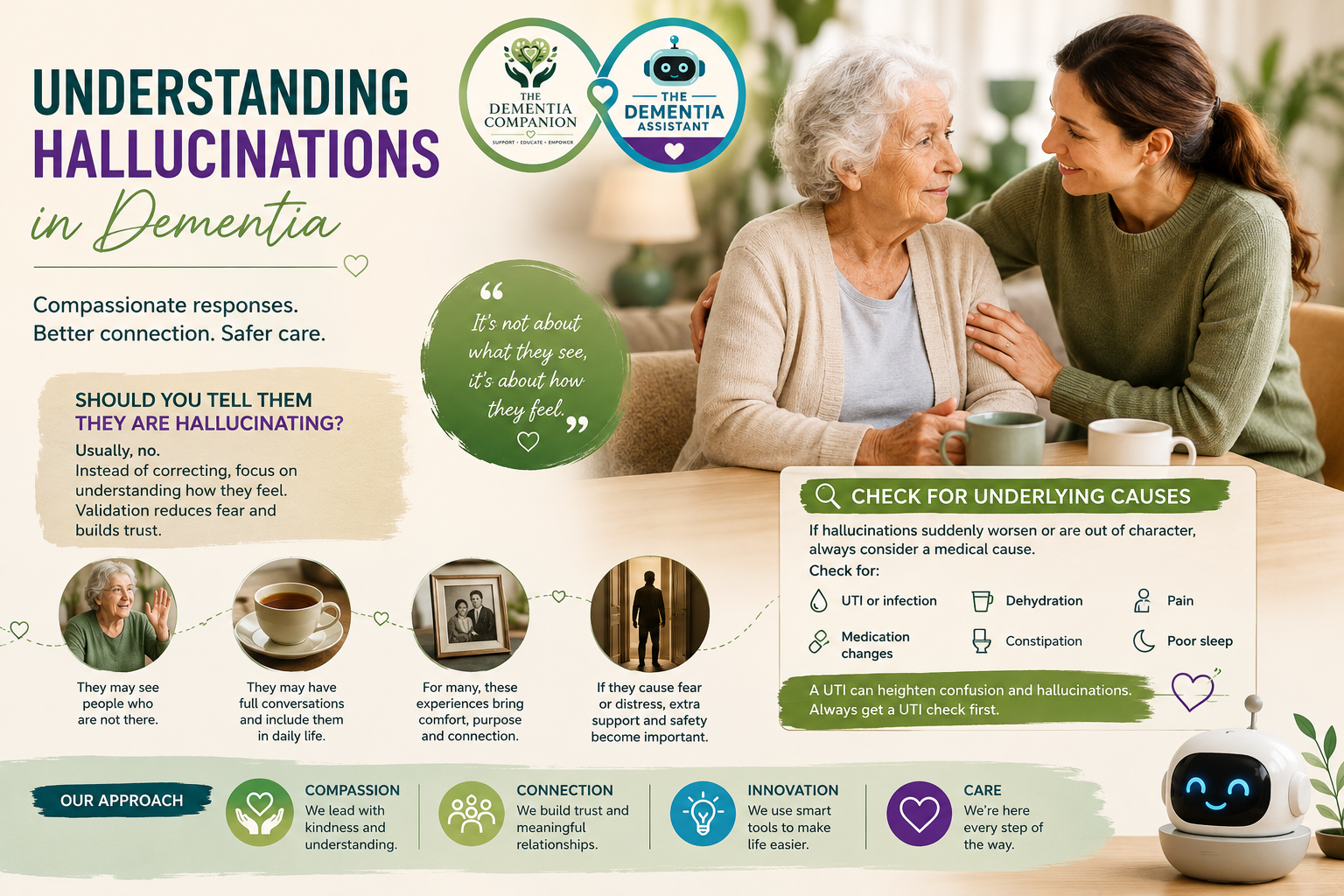
Should You Tell Someone Living With Dementia That They Are Hallucinating?
Hallucinations can be one of the most confusing, emotional, and challenging experiences for families supporting someone living with dementia.
Many carers find themselves asking:
“Should I tell them it’s not real?”
“Should I correct them?”
“Am I making things worse if I go along with it?”
The answer is rarely straightforward.
Our Natural Instinct Is to Correct
When we see someone talking to an empty chair, setting a place at the table for someone who isn’t there, or having a conversation with a photograph, our natural reaction is often to say:
“There’s nobody there.”
“Who are you talking to?”
“That’s just a picture.”
“You’re imagining it.”
We say these things because we are trying to help.
We want to bring the person back to reality.
Unfortunately, dementia doesn’t always work that way.
Their Reality Feels Completely Real
For someone experiencing hallucinations, the experience is often every bit as real as the person sitting beside them.
Their brain is processing information differently.
What they see, hear, or believe is not a choice.
It is their reality.
When we repeatedly challenge that reality, we can unintentionally create fear, anxiety, frustration, confusion, and sometimes even anger.
Imagine seeing someone standing in your living room and being told over and over again that they don’t exist.
That would be frightening for anyone.
A Real-Life Example From My Practice
I currently support an amazing lady who experiences regular hallucinations.
She has full conversations with them.
She cooks meals for them.
She makes them cups of tea.
She worries when they don’t eat their dinner.
She sets places at the table and includes them in her daily routine.
To an outsider, this might seem unusual.
But when you take the time to understand her story, it becomes something quite different.
This lady has spent most of her life caring for others.
Looking after people has always been a huge part of who she is.
Now she lives alone.
The people she sees feel like family to her.
She talks about them with warmth and affection.
She gets excited when she believes they are visiting.
She feels comforted by their presence.
In many ways, these hallucinations provide companionship, purpose, and routine.
Would correcting her every few minutes improve her quality of life?
Probably not.
In fact, it would likely create distress.
What Can We Say Instead?
Rather than challenging the hallucination, try responding to the emotion behind it.
You might say:
* “They seem important to you.”
* “You look happy to see them.”
* “What are they talking about today?”
* “Would they like a cup of tea?”
* “Tell me about them.”
This approach is often called validation.
You are not necessarily agreeing that the hallucination is real.
You are acknowledging the feelings that accompany it.
For many people, that can be far more comforting than correction.
When Hallucinations Need More Attention
Not all hallucinations are comforting.
Some can be frightening, upsetting, or dangerous.
For example:
* Seeing intruders in the house
* Believing children are trapped somewhere
* Thinking strangers are stealing belongings
* Hearing threatening voices
* Wanting to leave home to escape perceived danger
In these situations, reassurance, redirection, environmental checks, and medical support become much more important.
The goal is always safety and reducing distress.
Clinical Perspective
Hallucinations can occur in several different types of dementia, but they are particularly common in people living with Lewy Body Dementia. They can also occur in Alzheimer’s disease, vascular dementia, Parkinson’s disease dementia, mixed dementia, and other neurological conditions.
From a clinical perspective, hallucinations occur because changes within the brain affect how information is processed and interpreted. The person is not deliberately imagining things or making them up. What they see, hear, smell, or feel can be entirely real to them.
Healthcare professionals will often consider several important factors when hallucinations are present:
* Is the hallucination causing distress?
* Is the person frightened by what they are seeing?
* Is there a risk to their safety or the safety of others?
* Has there been a sudden change from their usual pattern?
* Could there be an underlying medical cause?
It is important to remember that not every hallucination requires medication or intervention.
Many people experience occasional hallucinations that are harmless and non-threatening. Clinical intervention is usually considered when hallucinations are causing significant distress, increasing risk, disrupting sleep, contributing to aggression, or severely affecting quality of life.
Don’t Forget About Physical Health
This is one of the most important things families need to know.
If hallucinations suddenly become worse, appear out of character, become more frequent, or are accompanied by a noticeable change in behaviour, don’t automatically assume it is simply the dementia progressing.
Always consider whether there could be an underlying medical cause.
One of the most common causes we see is a urinary tract infection (UTI).
A UTI can significantly increase:
* Confusion
* Hallucinations
* Agitation
* Anxiety
* Distress
* Changes in behaviour
Other possible causes include:
* Dehydration
* Chest infections
* Constipation
* Pain
* Delirium
* Medication side effects
* Poor sleep
* Sensory impairment such as poor vision or hearing
If there is a sudden change, it’s always sensible to arrange a medical review and request a UTI check or other investigations as appropriate.
In my experience, whenever a family tells me that hallucinations have suddenly appeared or dramatically worsened, one of my first questions is:
“Has the person been checked for a UTI or infection?”
It’s surprising how often an underlying medical issue is contributing to the change.
A Dementia Practitioner’s Perspective
As a dementia practitioner, I have learned that understanding the meaning behind the hallucination is often just as important as understanding the hallucination itself.
Families will often ask:
“Should I tell Mum that nobody is there?”
“Should I remind Dad that he’s imagining it?”
My first question is usually:
“How is it affecting them?”
Because not all hallucinations are negative.
Some people find comfort in them.
Some find companionship.
Some feel reassured by seeing loved ones who have passed away.
Others use those experiences to fill gaps created by loneliness, isolation, grief, or a lifetime spent caring for others.
I’ve worked with people who spend their days chatting happily with visitors that only they can see. They make tea for them, tell stories, laugh together, and feel connected.
Would correcting them improve their wellbeing?
Often, no.
In many situations, what the person needs most is not a reality check but emotional support.
That’s why dementia care is rarely about asking:
“Is it real?”
Instead, we ask:
“What does this experience mean to the person?”
If someone is happy, calm, safe, and comforted, our role may simply be to support them within that experience rather than challenge it.
However, if hallucinations become frightening, lead to distress, create safeguarding concerns, increase falls risk, or result in unsafe decisions, then we need to explore additional support and seek professional advice.
The art of dementia care often lies in balancing compassion with safety.
Sometimes that means stepping into the person’s reality for a moment.
Sometimes it means investigating whether there is an underlying medical issue.
And sometimes it means simply sitting alongside them, listening, and recognising that what matters most is not whether the hallucination is real to us—but how real it feels to them.
A Carer’s Perspective
One of the hardest things for families to learn is that dementia often requires us to stop trying to win the argument and start trying to understand the emotion.
We naturally want to fix things.
We want to explain.
We want to reassure with facts.
But dementia doesn’t always respond to facts.
It responds far better to kindness, reassurance, patience, and emotional connection.
The person is not deliberately trying to be difficult.
They are trying to make sense of a world that is increasingly difficult for them to understand.
The Bottom Line
Should you tell someone living with dementia that they are hallucinating?
In most cases, no.
Instead, ask yourself:
How is this hallucination making them feel?
If it is bringing comfort, companionship, purpose, or joy, then correcting it may do more harm than good.
If it is causing fear, distress, or creating a safety concern, then additional support and medical review may be needed.
As dementia carers, family members, and professionals, our role is not always to bring someone back into our reality.
Sometimes our role is to support them safely, compassionately, and respectfully within theirs.
What’s your experience?
Because in dementia care, preserving dignity, reducing distress, and maintaining connection will often achieve far more than proving what is real and what isn’t.
Louise, Founder, The Dementia Companion & The Dementia Assistant.