“She’s Not My Mum Anymore” – Understanding How Dementia Changes the Brain, Behaviour and Relationships
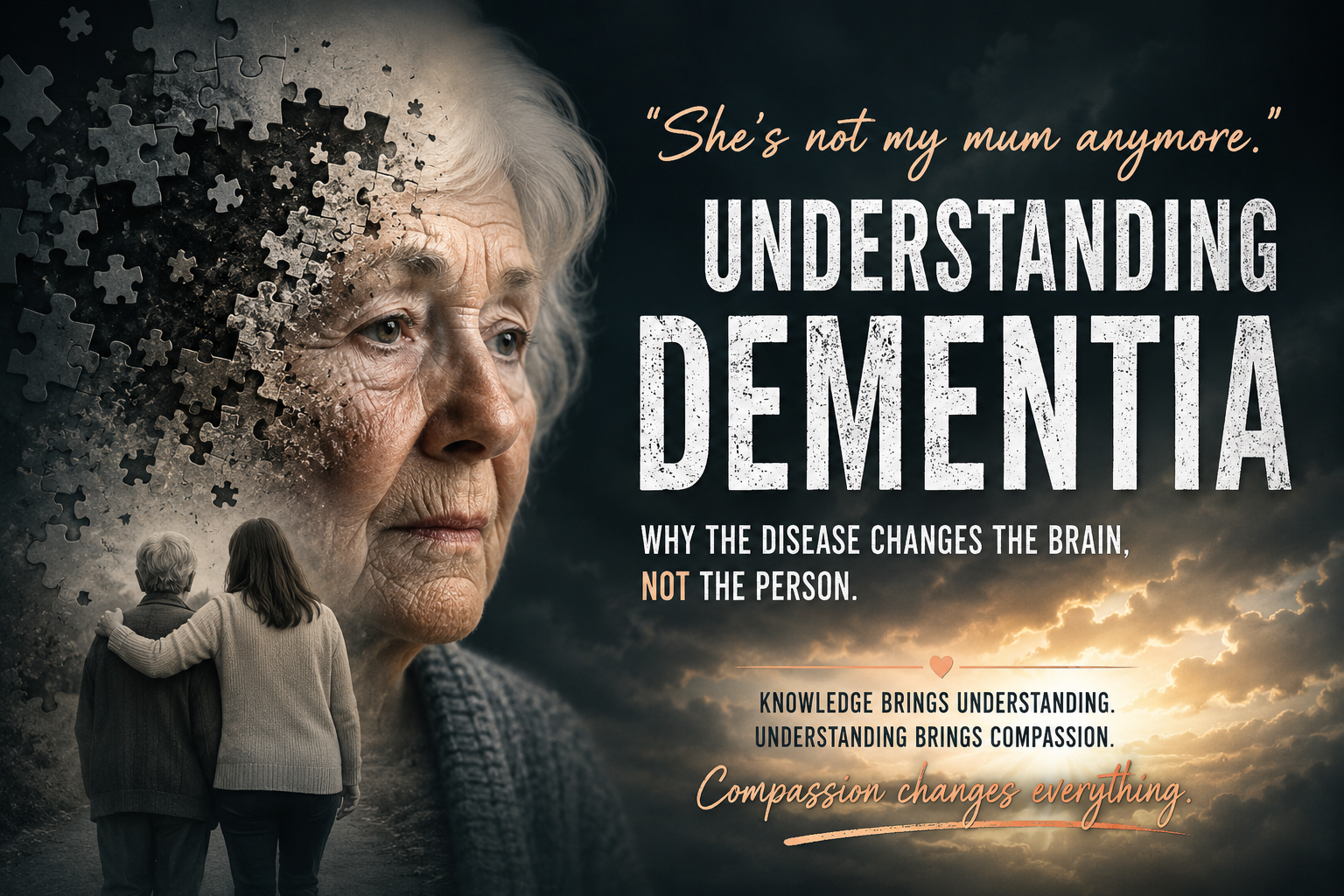
“She’s Not My Mum Anymore.”
The sentence I hear more than any other in dementia care… and why it isn’t the whole story.
By Louise Donaghy
Founder, The Dementia Companion & The Dementia Assistant
“I don’t recognise her anymore.”
“Dad told me to leave his house.”
“Mum keeps accusing me of stealing.”
“He asks for his own mother every day.”
“She doesn’t even know who I am.”
If you’ve ever thought these words—or whispered them through tears—you are not alone.
Almost every family affected by dementia reaches a moment when they ask themselves one heartbreaking question:
“Have I already lost the person I love?”
It feels that way.
It can sound that way.
Sometimes it even looks that way.
But the truth is often very different.
Dementia isn’t changing who they are.
It’s changing how their brain allows them to think, remember, communicate and make sense of the world.
Understanding that difference changes everything.
⸻
“But They Know Exactly What They’re Doing…”
This is one of the biggest objections families tell me.
“They’re only rude to me.”
“They behave perfectly when the doctor visits.”
“They remember things when it suits them.”
“Surely they’re choosing this?”
I completely understand why it feels that way.
But dementia doesn’t switch on and off.
The brain works harder and harder just to do ordinary things.
Many people can “hold it together” for twenty minutes while visitors are there.
Then they come home mentally exhausted.
Imagine trying to complete a full day’s work while speaking a language you’ve never learned.
Eventually your brain would simply give up.
The person living with dementia experiences something similar every single day.
The person who often sees that exhaustion is the one they trust the most.
Not because they love you less.
Because you’re the safest person to fall apart with.
Imagine Your Brain Is Like a City
Think of your brain as a huge city connected by millions of roads.
Every road has a purpose.
One leads to your memories.
Another helps you recognise faces.
Another helps you choose the right words.
Another controls emotions.
Another helps you judge whether something is real or imagined.
Every second of every day, information travels along those roads effortlessly.
Until dementia begins to damage them.
Some roads become cracked.
Some become blocked.
Some disappear completely.
The destination may still exist…
But the brain can no longer find the route.
“Why Does Mum Think I’ve Stolen Her Purse?”
Because her brain knows one thing.
The purse isn’t where she expected it to be.
Normally the brain would replay the memory.
“I put it in the wardrobe.”
“It’s inside my handbag.”
“I left it beside the kettle.”
But dementia has damaged that pathway.
The brain hates unanswered questions.
So it creates the answer that feels most logical.
“Someone must have taken it.”
She isn’t lying.
She isn’t manipulating you.
She genuinely believes what she’s saying.
Arguing won’t repair the damaged pathway.
It only increases fear.
“Why Does Dad Want To Go Home?”
Families often reply…
“But Dad… you ARE home.”
Yet he asks again.
And again.
And again.
Because he may not be asking for a house.
Home often represents something much deeper.
Safety.
Routine.
Childhood.
The place where life made sense.
The brain can’t always explain those feelings with words.
So it asks to “go home.”
Sometimes what they’re really saying is…
“I don’t feel safe.”
“I’m frightened.”
“Nothing makes sense anymore.”
“He Doesn’t Know Who I Am.”
This may be the most painful moment dementia can bring.
But recognising your face and feeling your love are controlled by different parts of the brain.
Someone may forget your name…
Yet still smile when you walk into the room.
They may not know you’re their daughter…
Yet feel peaceful when you hold their hand.
Memory and emotion don’t always disappear together.
Love often remains long after names are forgotten.
“Why Does She Keep Asking The Same Question?”
Another common frustration.
“I’ve answered that twenty times already!”
To you, it’s repetition.
To their brain, it’s often the very first time they’ve asked.
The memory of your answer was never stored properly.
Imagine writing on a whiteboard while someone wipes it clean every few seconds.
That’s what dementia can feel like.
Your patience becomes their memory.
“Why Is He Angry All The Time?”
Anger is rarely the real problem.
It’s often the final stage of fear.
Imagine waking up in a world where:
* People expect you to remember things you can’t.
* Everyone keeps correcting you.
* Rooms feel unfamiliar.
* Conversations move too quickly.
* You know something is wrong, but you can’t explain what.
Most of us would become frightened too.
Behaviour is communication.
The question isn’t:
“Why are they behaving like this?”
It’s:
“What is their brain struggling to tell me?”
Dementia Doesn’t Affect Everyone The Same
There isn’t one type of dementia.
Different conditions damage different parts of the brain.
Some mainly affect memory.
Some affect language.
Some affect judgement.
Some affect behaviour before memory.
Some affect movement or vision.
That’s why comparing one person with another rarely helps.
Every brain tells a different story.
The Question That Changes Everything
Instead of asking…
“Why are they doing this to me?”
Ask…
“What is their brain struggling to do right now?”
That one question changes everything.
You stop arguing.
You start reassuring.
You stop correcting.
You start comforting.
You stop seeing difficult behaviour.
You start seeing someone living with a damaged brain who needs your understanding more than ever.
They Are Not Giving You a Hard Time…
They Are Having a Hard Time.
Families don’t struggle because they don’t love enough.
They struggle because no one explained what dementia is actually doing inside the brain.
Medication has an important place.
Care has an important place.
But understanding is just as important.
When families understand dementia…
Fear becomes confidence.
Frustration becomes patience.
Arguments become conversations.
And relationships that felt lost often begin to heal in new and meaningful ways.
Louise x
Why We Created The Dementia Assistant
We didn’t create another website.
We created a place where families, carers and professionals can finally understand dementia in a practical, compassionate way.
Inside The Dementia Assistant, you’ll find:
* Family communication scripts for real-life situations.
* Step-by-step guidance for hallucinations, delusions, aggression, repetition and distress.
* Practical care planning tools and downloadable resources.
* Interactive learning through the Dementia Academy.
* Children’s education through the Dementia Detective Academy.
* Real-life case studies.
* Professional guidance.
* Support for every stage of the dementia journey.
Because dementia doesn’t just need better treatments.
It needs better understanding.
And when understanding grows…
Compassion follows.
Remember This…
The person you love may forget your name.
They may forget yesterday.
They may even forget who they are.
But they will never forget how you made them feel.
That is why kindness matters.
That is why patience matters.
That is why understanding matters.
Because dementia changes the brain.
It doesn’t erase the person.
Louise Donaghy
Founder – The Dementia Companion & The Dementia Assistant
https://thedementiacompanion.com
https://thedementiaassistant.com