National Care Service & Dementia: Who Cares for Mum Tonight?
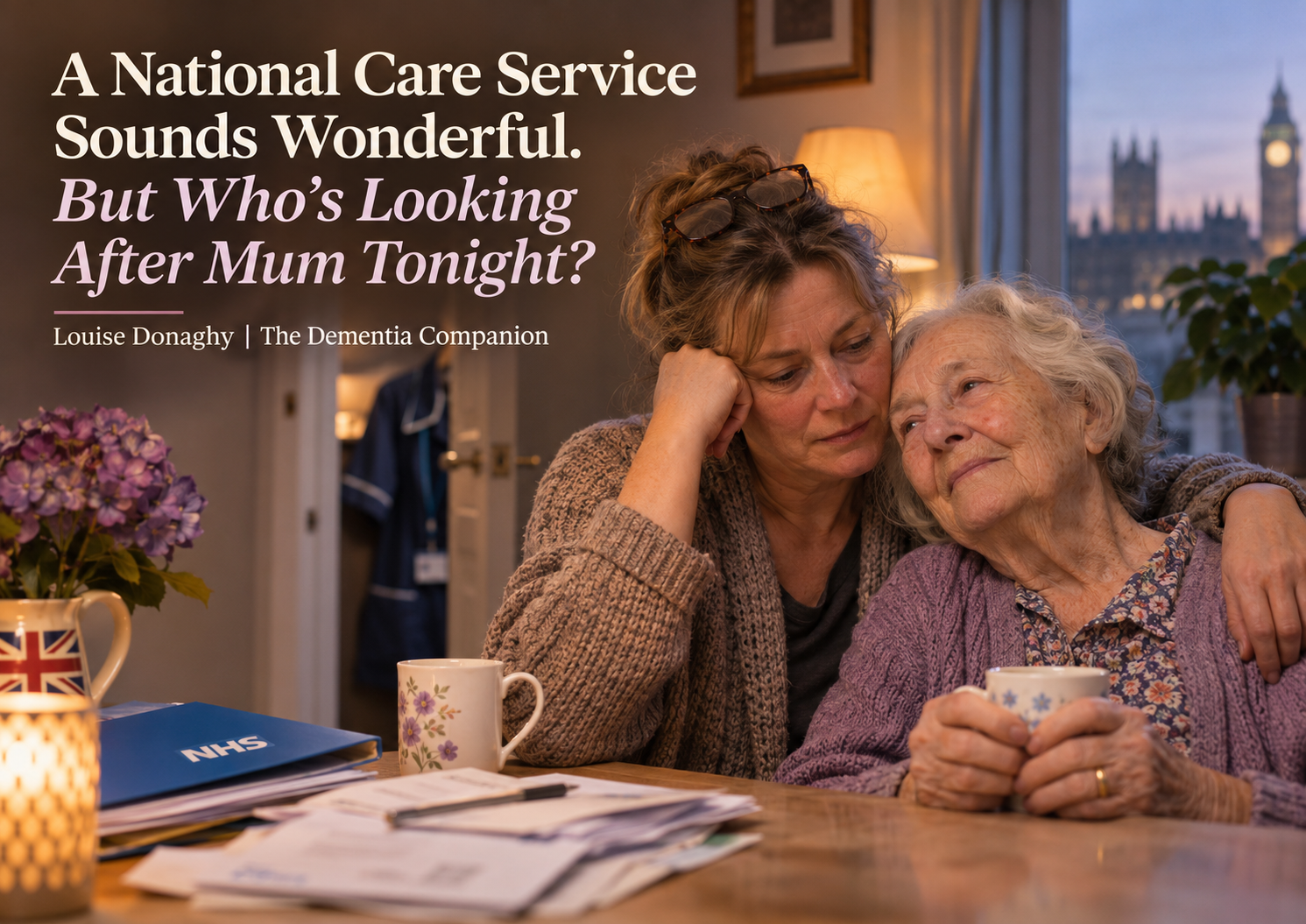
A National Care Service Sounds Wonderful. But Who’s Looking After Mum Tonight?
Britain is promising a better future for social care. But families living with dementia don’t have the luxury of waiting for tomorrow.
By Louise Donaghy | The Dementia Companion | The Dementia Assistant & Hugo
I have been listening to all the excitement surrounding the Government’s plans for a National Care Service.
And do you know what? I would absolutely love to see it happen.
A properly funded care service. Families no longer frightened of losing everything. Care workers paid what they deserve. People living with dementia receiving the dignity, kindness and support they need.
Wouldn’t that be wonderful?
But then I put my sensible head back on, make myself a cup of tea and start asking a few questions.
Because while politicians are standing at podiums talking about the future of care, there is a daughter somewhere sitting at her kitchen table, absolutely exhausted, wondering how on earth she is going to manage another week.
There’s a husband helping his wife into bed for the third time tonight because she doesn’t understand why it’s dark outside.
There’s a son checking his bank account before deciding whether he can afford another few hours of support for his mum.
And there’s a care worker finishing another long day, wondering whether their wages will stretch until Friday.
These are the people I want us to talk about.
Not just the billions of pounds, the commissions, the political promises and the wonderful speeches.
The actual people.
Because dementia care isn’t something that happens in Parliament.
It happens in our homes, our bedrooms, our bathrooms, our kitchens and, quite often, at three o’clock in the morning when everyone else is fast asleep.
A Prime Minister Who Knows the Heartbreak of Dementia
Prime Minister Andy Burnham has spoken openly about his father’s experience of Alzheimer’s disease and his personal commitment to improving social care.
His father, Roy, sadly died in September 2026.
And I genuinely feel for him and his family.
Losing someone you love to dementia is heartbreaking. There can be years of watching little changes, adapting, worrying, hoping and sometimes grieving parts of the person long before you have to say goodbye.
It is an experience that stays with you.
I also believe that when someone has walked that road personally, they can understand things that simply cannot be explained in a government report.
The importance of a familiar voice.
The relief of finding someone who understands.
The exhaustion of always having to think one step ahead.
The incredible difference one kind, compassionate care worker can make to an entire family.
So I welcome the Prime Minister’s passion. I really do.
But I also have to ask something that might make a few people uncomfortable.
Is this going to be the legacy of a Prime Minister who genuinely changes social care, or another wonderful political promise that takes so long to deliver that the people who need it today never benefit?
I don’t claim to know his motives. His commitment to dementia care goes back years, and that deserves recognition.
But we have heard promises before.
And while I am sure the speeches are beautifully written, unfortunately, you cannot pay a care-home bill with a standing ovation.
Let’s Talk About What Families Are Really Going Through
When somebody receives a dementia diagnosis, their family doesn’t suddenly become a team of trained healthcare professionals.
They are still husbands, wives, daughters, sons, brothers and sisters.
They have jobs. Mortgages. Children. Health problems of their own.
And suddenly, somewhere amongst all of that, they become carers.
Not because they applied for the position.
Not because they attended an interview.
And certainly not because someone handed them a lovely little handbook explaining how to do everything.
They become carers because they love someone.
At first, it might be little things.
Helping Mum with her shopping. Reminding Dad about medication. Making sure the bills are paid. Perhaps calling in after work to check that everything is all right.
Then slowly, the visits become longer.
The phone calls become more frequent.
The worry starts following them everywhere.
And before they know it, they are juggling their own lives around somebody else’s needs.
They might be awake half the night and expected to function at work the following morning.
They might find themselves crying in the supermarket because they cannot remember the last time they had an afternoon to themselves.
Or they might be sitting beside someone they love, feeling desperately lonely, even though they are not physically alone.
And the really sad part?
Many of them feel guilty for being exhausted.
Guilty for getting frustrated.
Guilty for wanting a break.
Guilty for wondering how much longer they can carry on.
Yet they keep going.
Because who else is going to do it?
Carers UK reported in September 2026 that an estimated 1.1 million people had left employment over the previous two years to provide unpaid care for someone older, disabled or seriously ill.
That’s around 1,500 people every single day.
Not all of those families are affected by dementia, of course, but many will be.
Think about the financial consequences.
Lost wages. Reduced pensions. Missed promotions. Savings disappearing.
And sometimes, with years of care still ahead, families find themselves looking at the very real possibility of losing the financial security they have spent their lives building.
We talk about the cost of dementia care. But what about the cost of loving someone enough to give up everything to care for them?
Where is that figure in the Government’s budget?
And Now We Are Promising Free Personal Care
On 29 September 2026, the Government announced plans for a National Care Service in England, with free personal care for older people introduced in stages during the next Parliament.
I can understand why families might feel hopeful.
But let’s be very clear about something.
Free personal care does not necessarily mean free care-home living.
Under the proposal, assistance with things such as washing, dressing, eating and toileting would be covered.
However, accommodation and living costs in care homes would remain subject to existing means-tested arrangements.
That distinction matters enormously.
Because if your mum needs residential care, there is still a room to pay for. Food. Heating. Laundry. The everyday costs of living in a care home.
And if you are caring for someone living with advanced dementia, the costs and complexities can continue for years.
There are protections around family homes in certain circumstances, including where a spouse or qualifying relative continues to live there.
But families still need clear answers about what they will actually have to pay.
I would also like to know where younger people living with dementia fit into this promise.
Dementia does not politely wait until your 65th birthday to arrive.
What happens to somebody diagnosed in their fifties, with a family, a mortgage and years of working life ahead of them?
Will they receive the same protection?
Or will we create another system with people falling between the gaps?
These are not awkward questions for the sake of being awkward.
These are real families who deserve honest answers.
The Care Workers Holding Everything Together
Now, this is something I feel particularly strongly about.
I work in care. I know how much of the job happens beyond the tasks written on a care plan.
People sometimes imagine care as arriving at someone’s house, helping them get washed and dressed, making a cup of tea and heading off to the next appointment.
If only it were that simple.
Some days, the most important thing you do is sit down.
You listen.
You notice that someone isn’t quite themselves.
You help them find their favourite cardigan, even though you have already looked in the same drawer three times.
You laugh with them.
You reassure them.
You might spend ten minutes talking about a husband who died many years ago, because in that person’s world, he is still very much part of their day.
You learn that they like their tea in a particular cup.
You recognise when their smile is hiding discomfort.
You understand that someone refusing a shower might actually be frightened, cold, embarrassed or simply not understand what you are asking them to do.
And sometimes you have to use a little humour.
Because let’s face it, a smile and a bit of gentle laughter can turn a difficult morning into a much better one.
That is care. Human care.
It isn’t just washing someone, dressing them or following a checklist.
It is knowing the person behind the dementia.
And those relationships take time.
But time is exactly what our care system so often struggles to provide.
Care workers are rushing between appointments, trying to meet people’s needs within incredibly tight schedules.
Some are paying for their own fuel and coping with gaps between visits. Travel time between appointments should count towards minimum-wage calculations, yet pay arrangements do not always reflect the reality of a long working day.
And their wages?
According to Skills for Care’s October 2026 workforce figures, the median hourly pay for care and support workers in England’s independent sector was £12.60 in March 2026.
Just 39 pence above the legal minimum at that time.
Even more astonishing, someone with five or more years of care experience earned, on average, just 12 pence more an hour than someone in their first year.
Twelve pence!
You could spend five years learning how to support people with complex needs, developing the confidence to recognise deterioration, managing difficult situations with compassion and supporting families through the most emotional experiences of their lives.
And your experience might be rewarded with an extra twelve pence an hour.
I’m sorry, but how can we possibly think that is acceptable?
We call carers wonderful.
We call them angels.
We thank them for their dedication.
And I know that appreciation is genuine.
But care workers are not angels floating around on goodwill.
They are human beings with mortgages, rent, families, electricity bills and petrol tanks that need filling.
You cannot build a National Care Service on compassion alone while expecting the people delivering that compassion to struggle financially.
You cannot ask someone to care for everybody else’s family while making it difficult for them to support their own.
Where Exactly Is All This Money Coming From?
This is where my enthusiasm starts to wobble a little.
The Government plans to help fund the National Care Service by changing the State Pension Triple Lock from April 2030.
It estimates that this could save around £15 billion annually by 2039/40.
That certainly sounds like a lot of money.
But the Institute for Fiscal Studies has warned that these savings are uncertain and may be considerably smaller in the early years.
So I have questions.
Are we talking about funding genuinely new services, or moving money around within a system that is already struggling?
Will there be enough to increase care workers’ pay?
Enough to train and recruit more staff?
Enough to support people in their own homes?
Enough for respite care so families can have a few hours of rest without feeling they are abandoning somebody?
Enough for care homes, community services and people with complex dementia needs?
And will the money actually reach the people providing care?
Because the last thing we need is another beautiful new system with shiny offices, complicated paperwork and impressive job titles while the person visiting Mum is still rushing to finish fifteen minutes of care in fifteen minutes.
Forgive me for being a little cynical.
But perhaps we could start by making sure the kettle has boiled, Mum has eaten and someone has had time to ask her how she’s feeling before we congratulate ourselves on reinventing social care.
And What Happens to Our NHS?
I also worry about the NHS.
Not because I believe a National Care Service will replace it. That is not what the Government is proposing.
In fact, properly funded social care could help the NHS enormously.
People who receive good support at home may be less likely to experience avoidable crises.
People who are medically ready to leave hospital may be able to return home sooner if appropriate care is available.
Families could receive support before everything reaches breaking point.
That makes complete sense.
But both systems need people, funding, training and time.
You cannot simply announce a second national service and expect everything to fall beautifully into place.
The NHS is already facing enormous pressures.
Our social care services are struggling.
And those two systems depend on each other.
When social care fails, the NHS picks up some of the consequences.
When the NHS struggles, people living with dementia and their families can suffer further.
I would love to see hospitals, community services and care providers working together properly.
Not families being passed from one department to another, explaining the same situation over and over again.
But I do not want us to build one service at the expense of another.
We need an NHS that works and a care system that works alongside it.
Not two systems fighting over the same exhausted pot of money.
What About the People Who Cannot Wait?
This is the part I keep coming back to.
The independent Casey Commission is expected to make its recommendations in summer 2027.
The National Care Service itself is planned for the next Parliament, with changes to pension funding starting in 2030.
So even with the best intentions, this is a long-term project.
And I understand that.
You cannot redesign social care overnight.
But dementia does not work to a parliamentary timetable.
It doesn’t say, “Don’t worry, we’ll manage until the funding arrangements are finalised.”
It doesn’t wait for elections.
It doesn’t wait for reports.
It doesn’t wait for politicians to agree.
A person might be relatively independent today and need substantial support six months from now.
A husband who is managing reasonably well today might become seriously unwell himself because he is caring around the clock.
A daughter might be one sleepless night away from saying, “I can’t do this anymore.”
And she deserves to be heard before she reaches that point.
So while the Government works towards its long-term vision, where is the immediate support?
Where are the genuinely accessible respite services?
Where is the practical help for the person trying to balance employment with caring?
Where are the safeguards for families being pushed towards financial hardship?
And where are the improvements in pay and working conditions that might persuade experienced care workers to stay in the profession?
We should be investing in those things now.
Not waiting for a completely new national system before we begin treating people better.
One Thing I Don’t Want Us to Forget
There is something else that matters enormously to me.
In all this talk about systems, services, budgets and targets, please don’t forget the human connection.
For someone living with dementia, the person walking through the door matters.
A familiar face matters.
Being spoken to with respect matters.
Someone remembering that you used to love gardening, that you don’t like being rushed in the morning, or that you prefer your toast slightly burnt can make more difference than people realise.
Sometimes, simply sitting together and having a laugh is care.
Sometimes, holding someone’s hand when they are frightened is care.
Sometimes, helping a person feel useful by folding a few towels together is care.
And sometimes, sitting quietly with a family member who is worried about what comes next is every bit as important as any practical task.
Not everything valuable can be measured on a spreadsheet.
And yet, those moments are often the first things squeezed out when a service is underfunded.
A truly person-centred National Care Service must make room for relationships, not just tasks.
Because people living with dementia are not appointments to be completed.
They are people with histories, personalities, preferences, relationships and lives that still matter.
And their families deserve to know that the person coming through the door sees that.
So, Prime Minister, I Really Do Want You to Succeed
I mean that.
This is not about which political party somebody supports.
It is about something much bigger.
We are all getting older.
Most of us will, at some point, need care ourselves or love someone who does.
A National Care Service that truly protects families, rewards care workers and provides compassionate, consistent support would be an extraordinary achievement.
And if Andy Burnham can help deliver that, I will be delighted.
But I want more than a promise.
I want a clear timetable.
I want honest figures.
I want to know how we are going to recruit enough people and pay them properly.
I want to know how families who have already sacrificed their earnings and savings will be supported.
I want to know that people living with young-onset dementia will not be forgotten.
And, most importantly, I want to know what is going to change for the family sitting exhausted at their kitchen table tonight.
We have spent decades telling unpaid carers how amazing they are.
We have spent decades praising professional carers for their dedication.
And we have spent decades asking families to somehow find the strength, the money and the hours to carry on.
Perhaps it is time we stopped relying quite so heavily on their kindness.
Because kindness should be valued.
It should never be exploited.
I would love nothing more than to see Britain build a National Care Service we can all be proud of.
But before we start celebrating the care service of tomorrow, perhaps we should make sure the people who need care today haven’t been forgotten.
Britain is asking whether it can afford a National Care Service.
I’m asking whether we can afford another decade of families losing their savings, their livelihoods, their health and sometimes themselves, simply because someone they love needs care.
And if we can find billions to debate, plan and redesign the future of care, surely we can find the determination to make life a little easier for the people holding it together right now.
Because behind every policy announcement is somebody’s mum, dad, husband, wife, son or daughter.
And they are not asking for miracles.
They are asking for help.
Surely that isn’t too much to ask?
⸻
Louise Donaghy
The Dementia Companion
Supporting the person behind the dementia, and the people who love them.