“My Mother Is So Mean to Me. It Hurts.” Dementia or not… it still hurts. 💔
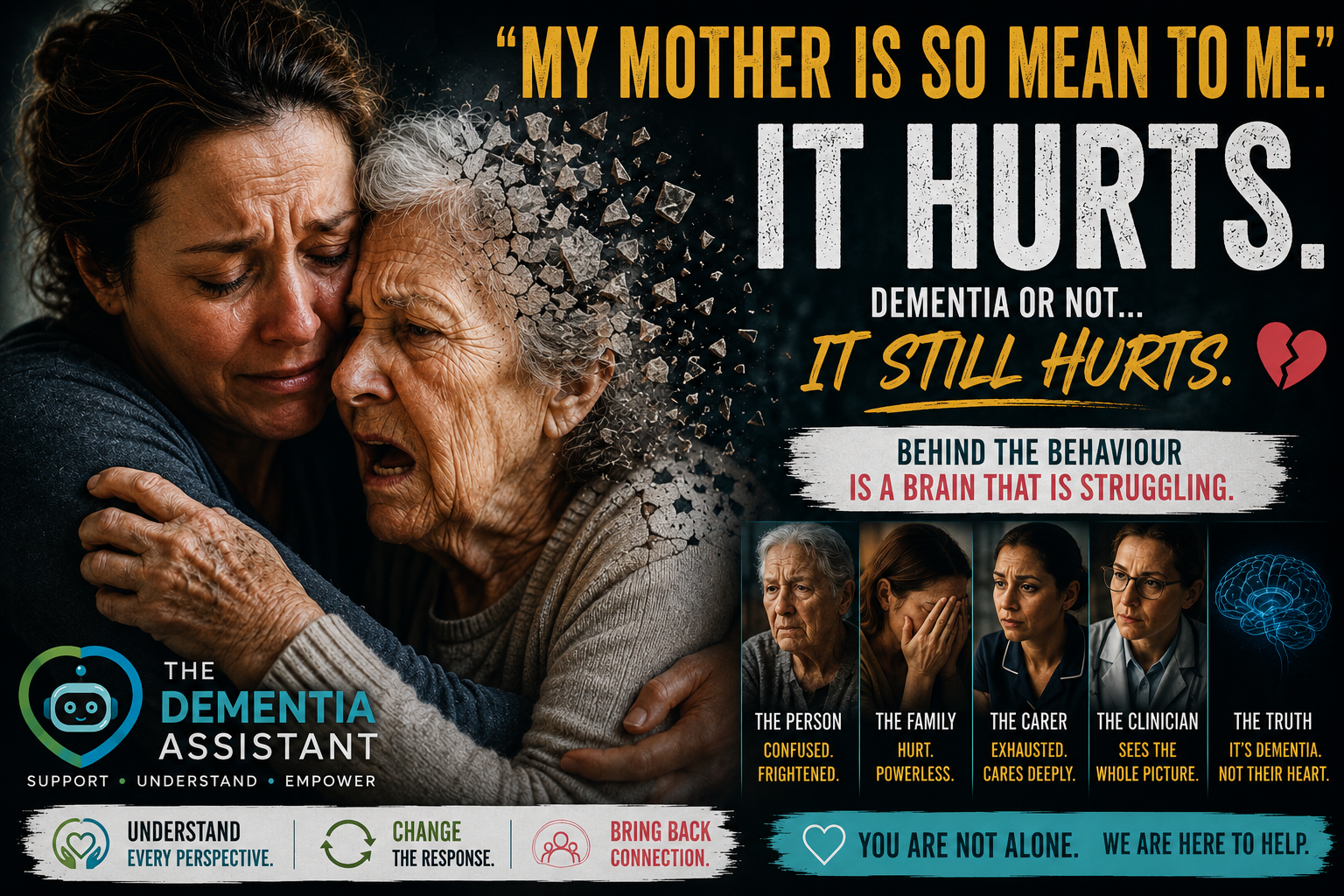
“My Mother Is So Mean to Me. It Hurts.”
Dementia or not… it still hurts. 💔
By Louise Donaghy
Founder, The Dementia Companion & The Dementia Assistant
“She tells me she hates me.”
“She says I never do anything right.”
“I’m the one caring for her every day… yet I’m the one she shouts at.”
“She tells everyone I’m stealing from her.”
“I’m trying my best, but every visit leaves me in tears.”
If you’ve ever thought these words…
Please know something first.
Your feelings are valid.
Yes, dementia changes the brain.
Yes, the disease can explain behaviour.
But that doesn’t mean the words don’t hurt.
Because they do.
And pretending they don’t only adds another layer of guilt to an already impossible journey.
⸻
“People Keep Saying, ‘Don’t Take It Personally.’”
It’s probably the advice carers hear most.
“It’s the dementia talking.”
“She doesn’t mean it.”
“Don’t take it to heart.”
They’re trying to help.
But when someone you love tells you they hate you…
When they accuse you of stealing…
When they say they wish you were dead…
Or they look you in the eyes and tell you to leave…
It feels deeply personal.
You’re human.
You’re not a robot.
Those words land in your heart before your head has time to remind you about dementia.
⸻
Why Does It Happen?
Imagine your brain as an orchestra.
Every section has a role.
Memory.
Language.
Reasoning.
Judgement.
Emotional control.
Empathy.
The conductor keeps everything working together.
Dementia slowly removes musicians from the orchestra.
Eventually the music changes.
Not because anyone wants it to…
But because parts of the brain can no longer work together the way they once did.
The areas that help us:
* Filter our words
* Control our emotions
* Understand consequences
* Read social situations
* Regulate frustration
…can all become damaged.
What comes out may no longer reflect what the person truly feels.
⸻
“She Was Never Like This.”
Another sentence I hear every week.
“My mum was the kindest woman I knew.”
“Dad would never have spoken to anyone like this.”
“She taught me kindness my whole life.”
That’s exactly why this hurts so much.
You’re grieving two things at once.
The loss of the relationship you once had…
And the painful behaviour you’re experiencing today.
Both are real.
Both deserve to be acknowledged.
⸻
“Why Am I Always the Target?”
Perhaps the hardest question of all.
“She’s lovely with the carers.”
“She smiles at visitors.”
“Then I walk through the door… and everything changes.”
It feels unfair.
But think about children.
Who do they usually have meltdowns with?
Their safest person.
The one they trust.
The one they know won’t walk away.
Many people living with dementia have spent all their energy trying to make sense of the world.
By the time they’re with the person they feel safest with…
They have nothing left.
This doesn’t make the behaviour acceptable.
But it may explain why you, of all people, receive the hardest moments.
⸻
Dementia Explains Behaviour… It Doesn’t Erase Your Feelings.
This is something we don’t say often enough.
You are allowed to feel hurt.
You are allowed to cry.
You are allowed to feel exhausted.
You are allowed to step outside for five minutes.
You are allowed to need support.
Compassion for the person living with dementia should never mean forgetting compassion for yourself.
Both matter.
⸻
Looking Beyond the Words
Instead of hearing:
“I hate you.”
Try asking:
“What emotion is underneath these words?”
Could it be:
“I’m frightened.”
“I’m confused.”
“I don’t know where I am.”
“I’ve lost control.”
“I’m overwhelmed.”
Dementia often removes the ability to express emotions appropriately.
Fear may come out as anger.
Confusion may come out as blame.
Pain may come out as shouting.
The words may not reflect the emotion underneath.
⸻
Different Viewpoints
The Same Moment. Five Different Experiences.
One of the greatest challenges in dementia care is that everyone experiences the same situation differently.
The person living with dementia…
The family…
The carer…
The clinician…
…may all walk away with a completely different understanding of what just happened.
When we pause and look through each person’s eyes, blame often turns into compassion.
⸻
👤 The Person Living with Dementia
“Why is everyone telling me I’m wrong?”
I know something doesn’t feel right.
People keep asking me questions I can’t answer.
They tell me I’ve already asked that.
They say I’m confused.
But from where I’m standing, I’m trying my best.
Sometimes I can’t find the words.
Sometimes everything feels unfamiliar.
Sometimes I’m frightened and don’t even know why.
When I’m scared, I may shout.
When I’m confused, I may accuse.
When I’m overwhelmed, I may push away the people I love the most.
I don’t wake up wanting to hurt anyone.
Most days, I’m simply trying to survive a world that no longer makes sense.
⸻
❤️ The Family Member
“I’m losing my mum while she’s still here.”
I know it’s the dementia.
People remind me every day.
But she’s still my mum.
When she tells me she hates me…
When she accuses me of stealing…
When she says she’d rather someone else cared for her…
It hurts.
Then I feel guilty for being hurt.
I’m grieving someone who’s still alive.
Nobody prepared me for that.
⸻
🤝 The Professional Carer
“I see both sides every day.”
When I walk through the door, I often meet two exhausted people.
One is living with dementia.
The other is living with the emotional weight of caring.
Both need compassion.
The person living with dementia needs understanding.
The family needs reassurance.
Neither is the enemy.
My role isn’t simply to complete tasks.
It’s to understand the emotion behind the behaviour, reduce distress and help rebuild trust between everyone involved.
Sometimes the greatest care I provide isn’t physical.
It’s helping people understand each other again.
⸻
🧠 The Clinical Dementia Practitioner
Clinical Observation
The behaviour being observed is unlikely to be deliberate or manipulative.
As dementia progresses, changes occur in the parts of the brain responsible for judgement, emotional regulation, memory, reasoning and impulse control.
The person’s response is often driven by:
• Fear
• Confusion
• Misinterpretation of their surroundings
• Pain or discomfort
• Fatigue
• Unmet physical or emotional needs
Behaviour should always be viewed as communication rather than intention.
Before assuming the behaviour is “just dementia”, clinicians should also consider:
* Pain
* Urinary tract infection (UTI)
* Constipation
* Dehydration
* Hunger
* Medication side effects
* Delirium
* Poor sleep
* Anxiety or depression
* Hearing or vision impairment
* Environmental overstimulation or unfamiliar surroundings
These issues can significantly worsen distress and should always be assessed.
Supporting the family is equally important, as caregiver wellbeing directly influences the wellbeing of the person living with dementia.
⸻
🌍 What We Learn When We Listen to Everyone
The person living with dementia isn’t trying to be difficult.
The family isn’t being too sensitive.
The carer isn’t taking sides.
The clinician isn’t ignoring emotions.
Each person is looking at the same moment through a different lens.
When we understand every perspective…
We stop asking,
“Who’s right?”
And begin asking,
“What does everyone need right now?”
That is where truly person-centred dementia care begins.
⸻
What Can You Do?
When emotions are running high:
❤️ Don’t argue.
❤️ Don’t try to prove they’re wrong.
❤️ Speak slowly and calmly.
❤️ Acknowledge the emotion before correcting the facts.
❤️ Step away for a few minutes if either of you needs space.
❤️ Check for pain, hunger, thirst or other physical causes.
❤️ Remember that your wellbeing matters too.
Sometimes the most compassionate thing you can do is take a breath before responding.
⸻
The Conversation We Need to Have
Families are often told to protect the person living with dementia.
And we absolutely should.
But we must also protect the people caring for them.
Because behind every exhausted carer is someone quietly carrying words they’ll never forget.
Supporting carers doesn’t mean loving the person with dementia any less.
It means recognising that both people need care.
⸻
Why We Created The Dementia Assistant
This article also introduces one of the unique features we’re developing inside The Dementia Assistant called Different Viewpoints.
With one click, families, carers, professionals and students will be able to see the same situation through different perspectives:
👤 The Person Living with Dementia
❤️ The Family Member
🤝 The Professional Carer
🧠 The Clinical Dementia Practitioner
👩⚕️ The GP or Specialist
🚑 The Paramedic
🏥 The Hospital Team
🧒 The Child or Grandchild
Because understanding doesn’t come from seeing only one side.
It comes from seeing the whole picture.
Alongside this, The Dementia Assistant provides family communication scripts, practical care planning tools, real-life case studies, professional guidance, Dementia Academy learning and emotional support for carers.
Because dementia care isn’t just about supporting the person living with the disease.
It’s about supporting everyone whose life has been changed by it.
⸻
Remember This…
If your mother tells you she hates you…
If your father pushes you away…
If your husband no longer recognises your love…
Please remember this.
The disease may have changed their words.
It has not erased the years of love that came before them.
Hold on to those memories.
They are just as real as this moment.
And so are your feelings.
Both can exist at the same time.
The greatest gift we can give one another isn’t having all the answers.
It’s choosing to understand before we judge.
Because when understanding grows…
Compassion follows.
And that’s where better dementia care begins.
⸻
Louise Donaghy
Founder – The Dementia Companion & The Dementia Assistant
https://thedementiacompanion.com
https://thedementiaassistant.com