“I Don’t Need Any Help” – Understanding Fear, Anger and Independence in Dementia
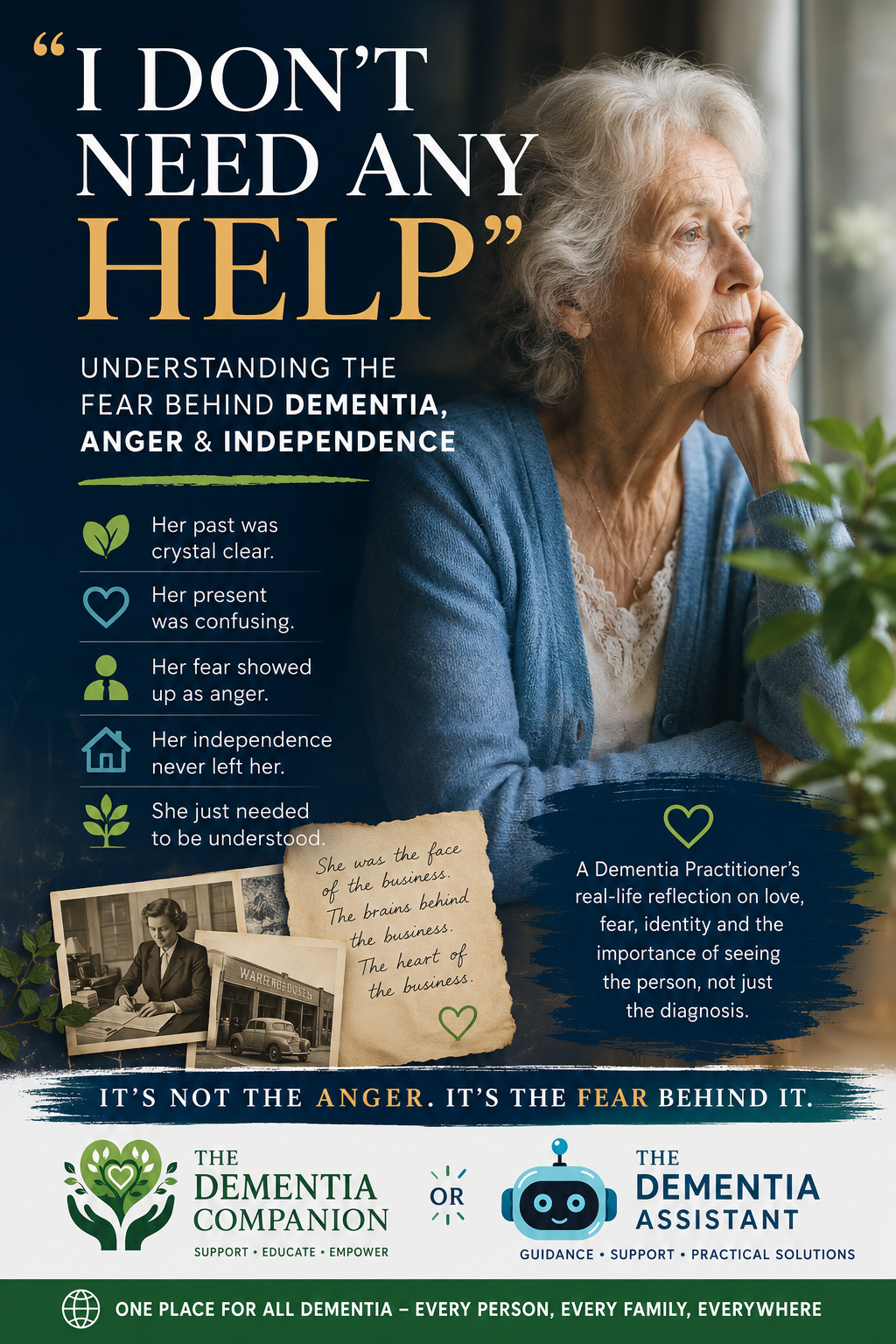
“I Don’t Need Any Help” — Understanding the Fear Behind Dementia
To protect privacy and dignity, identifying details have been changed. The experiences described reflect themes commonly seen in dementia care and are shared with compassion and respect.
There are some people you never forget.
One of my lovely clients was one of them.
Long before dementia entered her life, she was a force of nature.
She was intelligent, determined, fiercely independent, and years ahead of her time. She ran her own business, managed warehouses, employed staff, made difficult decisions, and built a successful life through hard work and resilience.
She wasn’t just involved in the business.
She was the business.
She was the face people knew, the person who solved problems, made decisions, and kept everything moving.
Strong women like her don’t spend a lifetime being told what to do.
They spend a lifetime telling others what needs to be done.
That matters when dementia arrives.
Because dementia doesn’t just affect memory.
It affects identity.
“Why Are You Telling Me What To Do?”
When I first met her, dementia had already started changing her world.
She could tell you stories from her childhood with incredible detail.
She could remember where her father worked.
She could remember old addresses.
She could remember car registration numbers from decades ago.
She could tell you stories from fifty years earlier as if they happened yesterday.
But could she remember who had visited the previous afternoon?
No.
Could she remember what she had eaten for lunch?
No.
Could she remember conversations from a few hours before?
No.
This is one of the most confusing parts of dementia for families.
People often think:
“If she can remember all that, surely she can remember this.”
Unfortunately, that’s not how dementia works.
Older memories are often stored in areas of the brain that remain accessible for longer, while newer memories become increasingly difficult to create and retain.
To her, her childhood often felt more real than yesterday.
The Anger Nobody Understood
One of the biggest challenges for her family was her anger.
She could become extremely frustrated.
She could be stubborn.
She could refuse support.
She could lash out verbally.
She could dig her heels in and refuse absolutely everything.
Many people assumed she was simply being difficult.
She wasn’t.
What I saw underneath the anger was fear.
Imagine waking up every day and feeling that something isn’t right.
People are suddenly coming into your home.
Family members are discussing things about your life.
People are making decisions for you.
Everyone seems to think you need help.
Yet in your mind, you’re still the capable businesswoman you’ve always been.
You still believe you’re managing.
You still believe you’re coping.
You still believe you’re independent.
So naturally the question becomes:
“Why is everyone interfering?”
The anger wasn’t the problem.
The anger was the symptom.
The real problem was fear.
The Dog She Loved
One of the most heartbreaking moments involved her beloved dog.
As her dementia progressed, she began feeding the dog inappropriate foods.
Sadly, the dog became seriously unwell and died.
Deep down, somewhere inside, I believe she understood that something had gone wrong.
But dementia prevented her from fully processing what had happened.
The result was overwhelming grief, anxiety, confusion, guilt, and fear.
She knew she had lost something she loved.
She knew she was hurting.
But she couldn’t always understand why.
This is another hidden aspect of dementia that families rarely talk about.
People living with dementia still experience grief.
They still experience loss.
They still experience guilt.
The emotions remain even when the explanations disappear.
“I Already Did That”
One of the most difficult realities was that she genuinely believed she was still doing everything she had always done.
In her mind:
She was changing her bedding.
She was doing her laundry.
She was cleaning her home.
She was cooking meals.
She was shopping.
She was managing perfectly well.
The reality was very different.
The house wasn’t being cleaned.
The washing wasn’t being done.
Food wasn’t being prepared properly.
She wasn’t recognising hunger.
She was eating very little.
Hydration was poor.
Her safety was becoming a concern.
But from her perspective, everyone else was wrong.
This wasn’t denial.
This was dementia.
Her brain could no longer accurately assess her own abilities.
Why She Accepted Me
There was something else that often created tension.
She accepted me.
She looked forward to seeing me.
She trusted me.
She worked with me.
Yet she often became angry with family members.
Families would ask:
“Why does she listen to you?”
“Why can you get her out of the house?”
“Why does she smile when you arrive?”
“Why did she throw a phone at me but happily go with you?”
The answer was surprisingly simple.
I never tried to take control.
I never argued.
I never corrected.
I never challenged her reality.
I entered her world.
If she believed something, I started there.
If she was frightened, I acknowledged the fear.
If she was confused, I didn’t tell her she was wrong.
I built a relationship before I tried to provide support.
Most importantly, I was never “the carer.”
If somebody introduced me as a carer, support worker, dementia specialist, or professional, she would often become defensive.
So I became her friend.
And that one word changed everything.
Over time, I became one of the only people she consistently recognised.
Not because I was special.
Not because I had some magic solution.
But because I was there every day.
I spent time with her.
I listened to her.
I lived in her reality rather than trying to pull her into mine.
Trust was built one conversation at a time.
The Family’s Pain
This story isn’t about blaming families.
Far from it.
Families are often carrying enormous pressure.
Many are exhausted.
Many are frightened.
Many are grieving.
Many are trying their best with very little education or support.
Watching someone you love change is heartbreaking.
Watching a parent reject your help is heartbreaking.
Watching accusations, anger, paranoia, and confusion become part of daily life is heartbreaking.
The guilt families carry is often enormous.
Sometimes they feel they haven’t done enough.
Sometimes they feel they’ve done too much.
Sometimes they feel trapped somewhere in the middle.
There are no easy answers.
What I learned from this family was that dementia doesn’t just affect the person living with the condition.
It affects everybody around them.
Every relationship changes.
Every role changes.
Every family member grieves in a different way.
The Nursing Home Decision
Eventually, she moved into a nursing home.
For her safety, it was the right decision.
Remaining at home was becoming increasingly dangerous.
The reality is that some people eventually require twenty-four-hour support.
That isn’t failure.
That isn’t abandonment.
That isn’t giving up.
That is recognising when someone’s needs have become greater than what can safely be managed at home.
The difficult part was that she never truly understood why she was there.
In her mind, she was still capable.
Still independent.
Still running her own life.
Still the woman she had always been.
The Clinical Perspective
From a clinical perspective, many of the behaviours seen in dementia are not deliberate choices.
Reduced insight is common.
A person may genuinely believe they are managing daily tasks successfully, even when evidence suggests otherwise.
Changes in memory, reasoning, judgment, and risk awareness can make it difficult for someone to recognise their own limitations.
Fear, anxiety, frustration, grief, and confusion often present as anger, resistance, or refusal of care.
What families see as challenging behaviour is often an attempt by the person to maintain control in a world that no longer makes sense to them.
When we understand the cause behind the behaviour, our response often changes.
A Dementia Practitioner’s Reflection
This wonderful lady taught me one of the most important lessons of my career.
People living with dementia are not trying to be difficult.
Most of the time they are trying to make sense of a world that no longer makes sense to them.
When we stop asking,
“How do I get them to do what I want?”
and start asking,
“What might they be feeling right now?”
everything changes.
Communication improves.
Relationships improve.
Trust improves.
And often, the person’s distress reduces too.
The Person Behind The Dementia
When we support someone living with dementia, we must never forget who they were before the diagnosis.
Before the confusion.
Before the memory loss.
Before the anger.
Before the fear.
My client wasn’t simply a woman living with dementia.
She was a business owner.
A daughter.
A mother.
A friend.
A dog lover.
A fiercely independent woman who had spent her entire life standing on her own two feet.
The dementia explained some of her behaviours.
But it never defined who she was.
And that’s how I choose to remember her.
Not as a diagnosis.
But as a remarkable woman who taught me some of the most important lessons of my career.
Sometimes the greatest thing we can offer a person living with dementia isn’t correction, persuasion, or control.
Sometimes it’s understanding.
And sometimes understanding changes everything.
Louise, Founder, The Dementia Companion & The Dementia Assistant.
https://thedementiacompanion.com
https://thedementiaassistant.com
“Sometimes the greatest thing we can offer a person living with dementia isn’t correction, persuasion, or control. Sometimes it’s understanding. And sometimes understanding changes everything.”