dementia-care-needs-to-change-person-centred-ai-training Dementia Care Needs More Than Awareness. It Needs a Person-Centred System.
Dementia Care Needs More Than Awareness. It Needs a Person-Centred System.
Dementia is not a distant or future problem—it is already here, and the reality is that the care sector is not fully prepared. As more people live with dementia and more families manage care at home, pressure continues to grow on carers and providers who are trying to meet increasingly complex needs with limited time, staffing, and inconsistent training. While compassion is present and carers genuinely care, kindness alone is not enough when someone is frightened, confused, distressed, in pain, hallucinating, refusing care, calling out, trying to leave, or asking for someone who died years ago. In these moments, carers need more than goodwill—they need understanding, practical training, the right language, clear procedures, and documentation that reflects the whole person. Increasingly, they also need technology that supports human care rather than replacing it.
The size of the need
Around 982,000 people are living with dementia in the UK, expected to rise to around 1.4 million by 2040. Globally, more than 55 million people are affected, with nearly 10 million new cases each year. (NICE)
This is not a niche issue.
Dementia affects care homes, home care, hospitals, supported living, community services, family homes, workplaces and schools.
Skills for Care highlights the need for support that is accessible, practical and person-centred for carers, professionals and communities. (Skills for Care)
This is where the gap lies.
Training is often disconnected from daily care, procedures remain too generic, and carers are expected to recall learning months later in the middle of real crises.
Families are often left asking:
“What do I say?”
“What do I do?”
“Am I making this worse?”
“Why has this suddenly changed?”
The training gap
Alzheimer’s Society reported that only 29% of the care workforce in England had received any dementia training, based on Skills for Care data. The CQC has also raised concerns about staff understanding of dementia-specific needs. (Alzheimer’s Society)
This should concern every provider.
Dementia care goes beyond diagnosis. It involves recognising distress, understanding communication, supporting independence, reducing fear, protecting dignity, and knowing when to step back or avoid confrontation. It also requires recognising that behaviour may signal pain, trauma, infection, overstimulation, grief, loneliness or unmet need.
Without understanding how dementia affects perception, language, emotion and judgement, safe care is difficult to deliver.
Guided daily practice notes for carers
Training must extend into everyday interactions.
Before approaching:
Pause briefly.
Check your tone, pace and body language.
Consider what the person might be feeling.
During interaction:
Approach from the front at eye level.
Use their name.
Speak slowly and clearly.
Give one instruction at a time.
Observe their reactions.
If the person resists:
Avoid arguing or correcting.
Acknowledge their feelings.
Try a different approach or return later.
Consider possible causes.
After the interaction:
Reflect briefly.
What worked?
What did not?
What could be done differently?
Documentation guidance:
Record observations without labels.
Describe the situation, response and what helped.
Include emotional cues.
Link behaviour to possible unmet needs where appropriate.
Carer reflection:
How did this interaction affect you?
Do you need support or a break?
Who can you speak to?
These steps help turn knowledge into confident, compassionate action.
Person-centred care must be the foundation
Person-centred care is not just a phrase.
It underpins effective dementia care.
NICE emphasises recognising the value of the person living with dementia, along with their family and carers. (NICE)
Alzheimer’s Society also highlights the importance of involving families and individuals in care planning. (Alzheimer’s Society)
Care should never reduce someone to labels such as:
“aggressive”
“non-compliant”
“wandering”
“refusing”
“challenging”
“confused”
These describe behaviour, not experience.
A person-centred approach asks:
Who is this person?
What matters to them?
What are they communicating?
What might they fear?
What has changed?
What helps them feel safe?
What do they enjoy?
What strengths remain?
What insights can family provide?
This is the difference between recording behaviour and understanding the individual.
Carer wellbeing cannot be separate from dementia care
Carers are under strain.
Family carers are exhausted, paid carers face constant pressure, managers are stretched, and independent carers often carry emotional burdens quietly.
Digital dementia education for informal carers has been linked to improved confidence, reduced stress and better care quality. (PMC)
Support matters.
When carers feel supported, they are more patient, calm and reflective. Without support, they are more likely to feel overwhelmed, reactive or isolated.
Dementia care cannot focus solely on the individual while overlooking the carer.
Carer wellbeing is essential to safe care.
What is already available?
There are many valuable dementia resources available.
These include awareness courses, e-learning platforms, care management systems, communication guides, family support apps, memory tools and emerging AI solutions.
For example, Person Centred Software provides digital care planning systems widely used in the UK. (Person Centred Software)
AI tools are also developing. UCLPartners has explored apps like PuntoCare and PuntoClinic to support accessibility, symptom tracking and memory clinic reviews. (UCLPartners)
Assistive technologies are advancing too. CrossSense, an AI smart-glasses system, won the Longitude Prize on Dementia in 2026 for providing real-time prompts and supporting independence. (The Guardian)
These developments are promising.
However, the market remains fragmented.
Different tools focus on separate areas such as care records, training, symptom tracking, memory support, family information, assistive technology or wellbeing.
What is missing is a connected system that brings everything together.
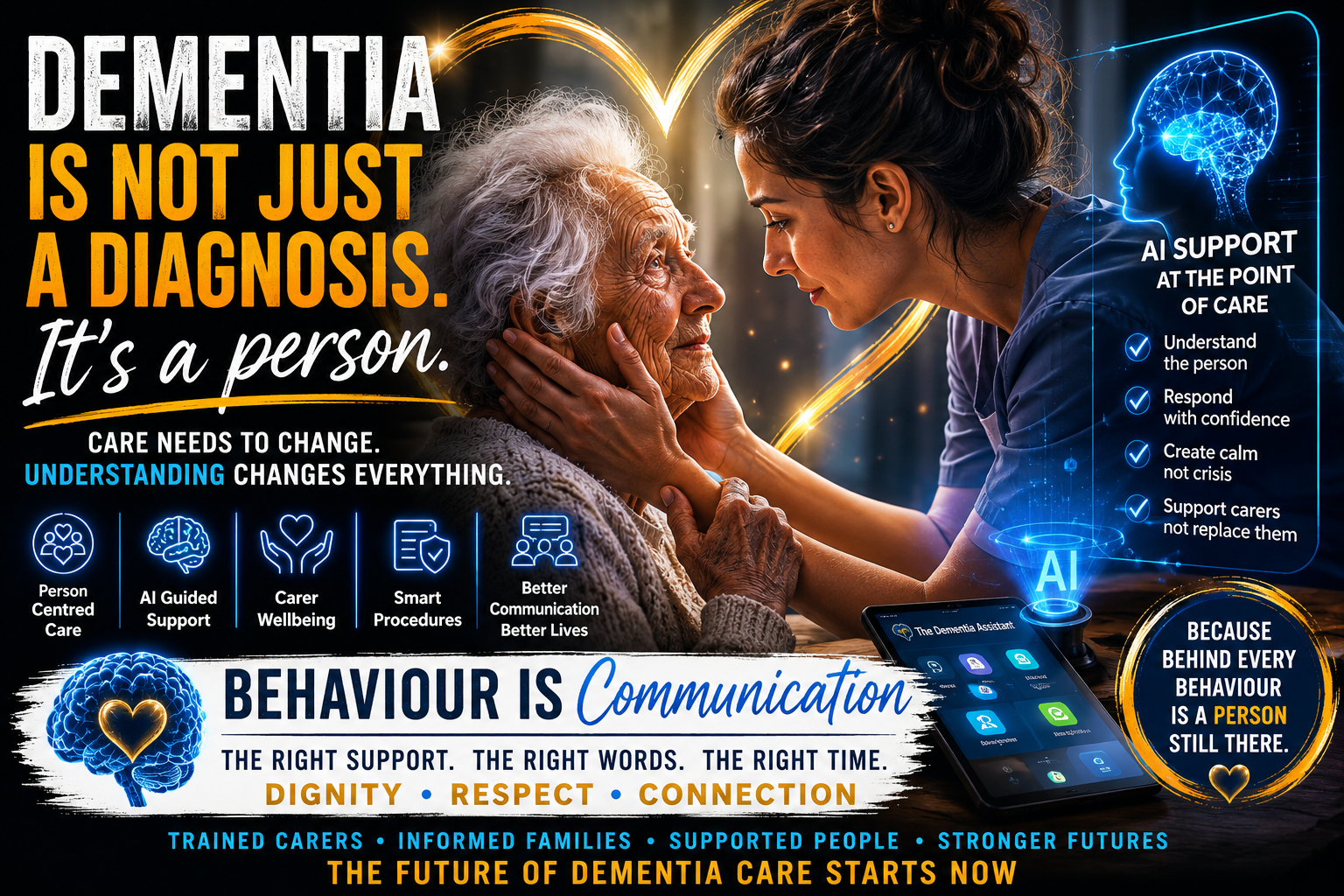
Introducing the Dementia Assistant
A dementia assistant is not just another tool—it is a practical, real-time support system designed to guide carers, families and professionals through everyday situations.
It acts as an intelligent companion that helps translate knowledge into action.
A well-designed dementia assistant can:
Provide real-time guidance during care interactions
Suggest person-centred responses based on behaviour
Help carers understand possible causes of distress
Support appropriate language and communication
Guide documentation in line with best practice
Offer reflective prompts after difficult situations
Provide reassurance and emotional support for carers
Help families understand changes and what to expect
For example, instead of searching through training materials, a carer could ask:
“Why is John refusing to eat today?”
“How should I respond if she thinks I am a stranger?”
“What should I write in the care notes?”
The assistant can respond with practical, situation-based guidance that reflects person-centred care principles.
This is where AI becomes meaningful—not as a replacement for human care, but as a support system that strengthens it.
The AI opportunity — and the risk
AI in dementia care must be used carefully.
Poor implementation risks creating cold, generic responses. Used well, it can help carers pause, reflect and respond with greater understanding.
Its value lies not in answering basic questions, but in guiding real situations:
“Why might Mary be refusing a wash today?”
“How can I respond without causing fear?”
“What should I document?”
“What wording reflects person-centred care?”
“What might the family need to know?”
“How can I support the carer after a difficult incident?”
This is not about replacing carers.
It is about supporting them to understand the person.
The future is interaction-based care
Future dementia support must go beyond teaching facts.
It should focus on interaction:
What to say
What to avoid
How to approach
How to slow down
How to validate
How to redirect
How to recognise distress
How to protect dignity
How to document appropriately
How to support carers afterwards
A dementia procedures and training platform, supported by a dementia assistant, can bridge this gap by turning learning into practice.
It supports carers in real situations, not just in training environments.
Why children must be included
Dementia education should begin earlier.
Children are already affected within families and communities.
They notice changes, hear conversations and may feel confused or frightened.
Research shows that school-based dementia education improves understanding and attitudes. (PMC)
This is not about causing fear, but building understanding.
Grandparents remain the same people.
Love remains.
Kindness and patience still matter.
If dementia is part of our future, education must begin within communities, not only when someone becomes a carer.
The real gap in the market
The sector does not need another generic awareness course.
It needs a complete dementia support ecosystem.
One that helps providers train staff, support families, guide carers, protect dignity, improve documentation, reduce anxiety and keep the person at the centre.
The opportunity is not simply offering training.
It is creating a person-centred dementia intelligence platform that includes a dementia assistant—supporting individuals, carers, families, providers and future generations in real time.
This is where care must evolve.
Dementia care is not just about managing decline.
It is about preserving identity, understanding behaviour as communication, guiding families, supporting staff before burnout, preparing children with compassion, and using AI to protect humanity rather than diminish it.
Final thought
Dementia care must change.
Now.
Awareness alone is no longer enough.
Providers must invest in consistent, practical dementia training that translates directly into daily care, embed person-centred documentation standards, and adopt integrated systems—including dementia assistants—that support staff in real time. Policymakers must prioritise funding, set clear national standards for dementia training and care quality, and support the development of connected, person-centred care technologies. Carers—both paid and unpaid—should seek out training, use reflective practice, ask for support when needed, and advocate for the person behind the diagnosis.
We need understanding, clear procedures, person-centred documentation, carer support, practical AI guidance, early education and systems that work in real-life situations.
The future of care will belong to those who act on this now.
Dementia is not just a medical condition.
It is a human experience.
And every system we build must keep the person at its centre.
We improve lives.
Louise Donaghy
Founder, The Dementia Companion & The Dementia Assistant
https://thedementiacompanion.com
https://thedementiaassistant.com